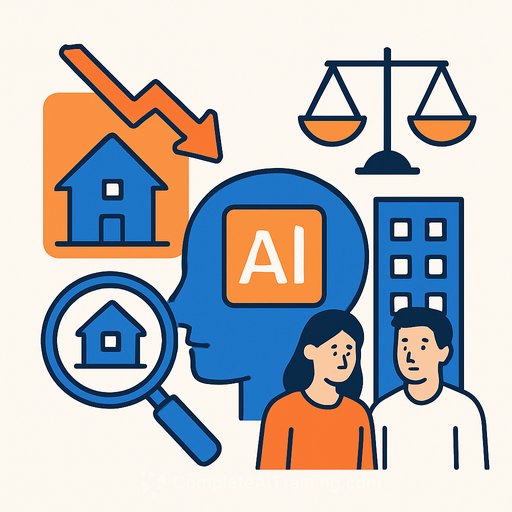
GAO Warns: AI Can Push Up Housing Costs and Quietly Discriminate. Agencies Need Clear Rules Now
AI has moved into every corner of housing. Search, underwriting, screening, and rent pricing. The Government Accountability Office (GAO) says that's exactly why stronger oversight can't wait.
In a Dec. 1 report, the GAO notes federal agencies have already acted in some cases under fair housing laws. But it also calls for the Federal Housing Finance Agency (FHFA) and the Department of Housing and Urban Development (HUD) to issue written guidance so companies know where the lines are-and regulators can enforce them consistently.
Read GAO's work and HUD's Fair Housing Act overview for context.
Where AI is creating risk
Search and discovery: If platforms fail to block or detect prohibited targeting-by race, ethnicity, gender, age, or other protected classes-users can end up with filtered results that violate fair housing laws. Even "helpful" filters can be illegal if they steer people away from opportunities.
Mortgage underwriting: Data-fed models can reproduce historical bias. Black-box decisions also make it tougher for applicants to understand denials and for lenders to issue specific, compliant adverse action notices.
Rent pricing: Algorithmic pricing can overcharge tenants by ignoring on-the-ground conditions like unit quality, maintenance backlogs, or amenities. The GAO points to recent cases where algorithmic tools pushed rent higher; Greystar agreed to stop using such tools following Justice Department action.
What agencies should do next
The GAO's message is simple: write it down. Clear, public guidance helps good actors comply and gives enforcers a firm footing.
- Issue written guidance from FHFA and HUD on AI use across the housing lifecycle: search, marketing, underwriting, screening, rent setting, and collections.
- Define prohibited practices and acceptable controls for vendors and lenders, including data use, model governance, and audit expectations.
- Set requirements for explainability so applicants receive plain-language reasons for denials that meet ECOA/FCRA and fair housing standards.
- Require disparate impact testing and documentation before, during, and after deployment-especially when models update automatically.
- Clarify recordkeeping: inputs, training data lineage, feature lists, performance metrics, overrides, and complaint logs.
- Coordinate supervision among HUD, FHFA, CFPB, FTC, DOJ, and state AGs for consistent enforcement and information sharing.
Procurement and oversight checklist for government teams
- Policy first: Publish an agency AI policy for housing activities that aligns with fair housing laws and specifies model risk tiers.
- Vendor contracts: Require model cards, bias testing results, retraining cadence, human-in-the-loop controls, and redress processes. Make audit rights explicit.
- Testing standards: Mandate pre-deployment and periodic disparate impact testing across protected classes and geographies.
- Explainability: Ensure vendors can produce applicant-level decision reasons that are specific, consistent, and reproducible.
- Data hygiene: Prohibit use of proxies for protected classes (e.g., ZIP code stand-ins). Review feature importance for proxy effects.
- Monitoring: Track denials, price changes, complaint rates, and exception overrides. Investigate spikes fast.
- Human review: Require manual review pathways for contested decisions and for edge cases the model flags as low confidence.
- Incident response: Define thresholds that trigger model rollback, customer notification, and regulator briefings.
Signals agencies should watch
- Rental price clusters across competitors moving in lockstep without clear cost drivers.
- Underwriting denial rates changing after model updates, especially across protected classes.
- Search tools allowing or auto-suggesting filters that could steer by protected characteristics.
- Vendors refusing to share model documentation or impact test results.
Guidance for public-facing programs
- Publish plain-language disclosures wherever AI influences outcomes (search results, pricing suggestions, underwriting screens).
- Create simple, visible channels for consumers to contest decisions and report suspected discrimination.
- Require accessible adverse action notices with concrete reasons, not generic codes.
- Fund periodic third-party audits for high-impact models used by grantees or regulated entities.
For staff development
- Stand up short, role-based training on AI risks, bias testing, and documentation standards for program, legal, and procurement teams. If you need quick upskilling by role, see these AI course paths.
Bottom line
AI can speed up housing decisions. It can also quietly raise prices and sort people out of options they legally should see. The GAO's ask is clear: more written guidance and tighter oversight so innovation doesn't trample fair housing.
Set expectations, test for harm, document everything, and keep a human in the loop. That's how we protect buyers and renters while keeping the market honest.
Your membership also unlocks: