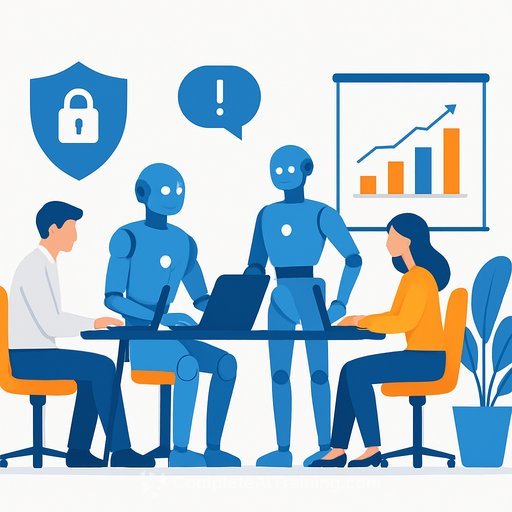
Fed's Waller: The hard part isn't AI-It's change management
Federal Reserve Governor Christopher Waller put it plainly: the technology isn't the hard part anymore. The real work is change management-how you rewire processes, roles, and incentives so AI actually sticks. He also emphasized something most companies skip: training and upskilling should happen on paid time.
Other Fed voices echoed the theme. Boston Fed's Susan Collins and Richmond Fed's Thomas Barkin highlighted the need to be forward-looking without sprinting into every new tool, and flagged that AI has two sides-opportunity and risk. Expect faster labor-market adjustments and tougher compensation choices as automation rolls through real workflows.
What this means for managers
- AI deployment is now an organizational challenge, not a tooling challenge. Treat it like any major process change.
- Budget paid time for learning. If you want adoption, don't make people learn after hours.
- Set clear ownership. Name change leads, workflow owners, and champions in each team.
- Control risk with policy, not fear. Put lightweight guardrails in place so teams can move.
- Measure outcomes weekly. Time saved, error rates, cycle times, and customer impact beat vanity metrics.
A simple 30-60-90 plan
- Days 0-30: Pick two high-friction workflows per team (e.g., reporting, customer replies). Define success metrics. Stand up a pilot squad with a clear problem owner.
- Days 31-60: Run pilots in production-lite. Capture wins, misses, and blockers. Create one-page playbooks and short Loom-style walkthroughs for repeatability.
- Days 61-90: Roll out to adjacent teams. Bake changes into SOPs, onboarding, and KPIs. Lock in a weekly 2-hour paid learning block.
Paid training isn't a perk-it's infrastructure
Set a standard: 2-4 hours per week of paid learning tied to role goals. Managers should track what was learned, how it was applied, and what outcome moved. Reward application, not course completion.
If you need a structure to build this, see the AI Learning Path for Training & Development Managers.
Risk and pace: be forward-looking, not reckless
- Adopt a "safe-to-try" policy: pre-approved tools, approved data sources, and red lines (no PII in public models, etc.).
- Run short risk reviews for new use cases. 20 minutes, checklist-driven, with an escalation path.
- Document model use in your process maps. If AI touches a decision, note who verifies and how.
For a practical frame, the NIST AI Risk Management Framework is a solid reference without overkill.
Design your change stack
- People: Executive sponsor, product/process owner, data or ops partner, and 1-2 team champions per function.
- Process: Clear SOPs that show where AI assists, who approves, and how exceptions are handled.
- Tools: A small, approved toolkit with templates, prompts, and usage examples.
- Cadence: Weekly standup for blockers; monthly review for ROI and next bets.
Metrics that actually move the needle
- Cycle time: Reduction in hours from request to delivery.
- Quality: Error rate, rework percentage, compliance flags.
- Throughput: Volume per FTE per week.
- Adoption: % of team using the new workflow 3+ times per week.
- Customer impact: NPS/CSAT on affected touchpoints.
- Cost-to-serve: Cost per transaction or case.
Hiring and workforce shifts
Expect skills to shift faster than job titles. Move from role-based thinking to capability-based staffing: data literacy, prompt quality, workflow design, and QA. Frontline managers should get first-priority training; they are the adoption lever.
Reskilling pays off when it's targeted. The Future of Jobs report shows consistent gains for firms that invest earlier and focus on applied skills over theory.
Manager checklist
- Choose 2-3 processes to fix with AI this quarter.
- Assign clear owners and publish a one-page plan per workflow.
- Block paid learning time on team calendars and protect it.
- Set guardrails: data policy, tool list, review steps.
- Track outcomes weekly; share wins and lessons openly.
- Fold changes into SOPs and onboarding so progress sticks.
Bottom line
AI is no longer the bottleneck. Your operating model is. Lead with change management, pay for the skill lift, and lock the gains into process and metrics. Do that, and the tech finally pays rent.
Your membership also unlocks: