
AI news ·
Fidesz uses AI-generated videos to spread anti-Ukraine claims ahead of Hungarian election
Hungary's Fidesz party posted AI-generated videos depicting a soldier's execution and a fake phone call to attack rival Péter Magyar ahead of the April 12 vote. Magyar still leads in polls despite the campaign.
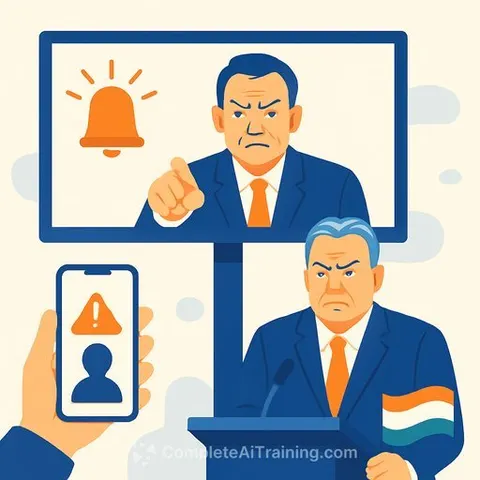
Hungary's Ruling Party Uses AI-Generated Videos to Attack Election Rival
Prime Minister Viktor Orbán's Fidesz party posted an AI-generated video in February depicting a Hungarian soldier's execution, targeting his election rival Péter Magyar weeks before Hungary's April 12 ballot. The video showed a young girl waiting for her father's return from war, then cut to him blindfolded, bound, and shot by captors.
Fidesz paired the fake video with unsubstantiated claims that Magyar's centre-right Tisza party would drag Hungary into Russia's war in Ukraine, impose forced conscription, and raid pension funds to support Kyiv. Magyar's party explicitly pledges not to send troops to Ukraine and has no plans to revive conscription.
The party did not respond when asked whether it created the video or why it posted the content to social media.
AI videos spread across pro-government networks
A second AI-generated video, shared by the National Resistance Movement-a pro-Fidesz activist group-depicted a phone call between European Commission President Ursula von der Leyen and Magyar discussing money transfers to Ukraine. The video received 3.7 million views.
Pro-government media and Fidesz politicians, including Orbán himself, shared the fabricated call. Orbán acknowledged the video was AI-made but warned it could become reality. The group that posted it did not disclose the video's synthetic origin.
A third instance involved AI-generated images of Ukrainian bank workers arrested in Hungary while transporting $80 million and gold to Ukraine. Pro-government outlets published the fake images as fact, showing uniforms and clothing that differed sharply from official government photographs of the same event.
The strategy hasn't moved voters
Magyar leads in most opinion polls despite the campaign against him. His posts on Facebook, TikTok, and Instagram receive twice the engagement of Orbán's, according to 20k, a Hungarian election integrity watchdog.
Magyar has used his own misleading claims-alleging that Fidesz wants to reintroduce compulsory military service, though no credible evidence supports this beyond two brief mentions by party politicians in 2016. He has also made inaccuracies about Hungarian births abroad.
Support for Tisza runs strongest among voters under 40, while nearly half of those over 65 back Fidesz. Younger voters appear driven by resentment toward the government, according to researchers at independent think tanks.
A broader media problem
Éva Bognár, a researcher at the Central European University's Democracy Institute, describes the campaign as built on "a complete false narrative that we're on the brink of war." She notes that Fidesz controls vast resources: public funds, state agencies, and a media conglomerate functioning as a propaganda apparatus.
Hungary's relations with Ukraine deteriorated as Orbán maintained close ties to Vladimir Putin. A survey by Policy Solutions found 64% of Hungarians hold negative views of President Volodymyr Zelensky, while 67% dislike Putin.
If Fidesz wins, the same disinformation tactics will likely continue beyond the election, according to Péter Krekó of the Political Capital research institute. If it loses, he expects a "more tumultuous relationship between the media and politicians."