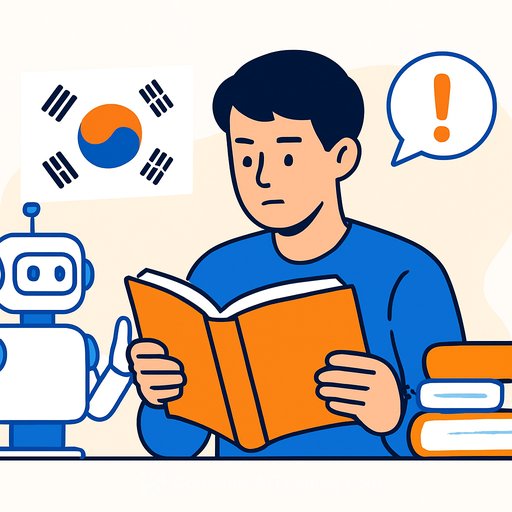
It took me an hour to write a 50-page book with AI. Is that a good thing?
With a few prompts, I spun up a 50-page children's book-cover and title included-in about an hour. Was it publishable? Debatable. But speed like that changes the incentives for everyone who writes, edits, or buys books.
South Korea is the live case study. The National Library of Korea issued 419,534 ISBNs last year, up 13.5% from 369,628 the year before-the first double-digit rise since records began. Translation: more books are hitting the market, faster than the system is used to handling.
Why the surge is happening
AI knocks down the barrier to entry. If you've got an idea but lack time or polish, tools can bridge that gap. Local reports even highlight homemakers and high school students shipping books with AI.
Publishers feel the wave. "For aspiring authors, this is an exceptionally strong opportunity for publishing," said Seo Jin, CEO of Snowfox Publishing, which put out one of Korea's first ChatGPT-assisted titles, "45 ways to find the purpose of life (unofficial title)." Submissions are up-especially helpful for small presses that often struggle to fill their lists.
The catch: speed without standards
Low-quality, low-effort titles are flooding in. Some publishers appear to be pushing out thin or repetitive books to collect mandatory library compensation. In Korea, every book with an ISBN must be deposited with the National Library of Korea and the National Assembly Library, which reimburse the price of one copy.
The pushback has started. On Feb. 9, the National Library of Korea rejected 395 e-books from Luminary Books, citing issues like excessive brevity, reused public materials, and repetition. That wasn't an isolated gripe-it was a signal.
Editors are sounding alarms
"There is a group chat of roughly 2,000 publishers. Editors regularly share cases of authors submitting manuscripts largely completed with the help of AI," said Choi Ah-young, CEO of Calm Down Library. The friction isn't just style-it's accuracy.
Editors green-light ideas because they trust the author can deliver. But if an AI-generated manuscript includes unverified claims, fact-checking becomes a minefield. Some drafts can be revised; others fall apart because the author can't actually rebuild the work. International deals are reacting too: some foreign publishers now add clauses that prohibit AI for translation.
What this means for working writers
The market won't reward clones of generic AI prose. It will reward speed plus voice plus proof. That's your edge.
A practical playbook
- Use AI for drafts, not delivery. Brainstorm, outline, and explore angles with it-then write the final prose yourself.
- Prove your claims. Keep sources, quotes, and links. Build a habit of line-level fact checks on anything AI suggests.
- Tighten your editing stack. Use AI to spot repetition, structural gaps, and tone drift. Keep a human pass for flow and clarity.
- State your policy. If you used AI, disclose how. It builds trust with editors and readers.
- Protect your voice. Maintain a personal style guide: word choices, sentence rhythm, examples you lean on, and topics you avoid.
- Ship what only you can write. Interviews, proprietary data, lived experience, niche expertise-things generic models can't fake.
For publishers and editors
- Require AI-use disclosure in submissions. Ask for a research log or citations when claims are made.
- Add a fact-check pass before copyedits. Flag unverifiable content early.
- Set length and quality minimums for deposits to avoid wasted cycles on books that will be rejected.
- Adopt AI for proofreading and structure checks-but keep final judgment human. As Seo noted: it supports the process, it doesn't replace it.
Expect a sorting effect
As low-effort books multiply, readers will get pickier. That pressure favors distinct voices, strong editing, and verifiable substance. The winners will pair AI's speed with standards most people skip.
Helpful resources
- What an ISBN is and how it's used (International ISBN Agency)
- National Library of Korea
- AI tools for copywriting (Complete AI Training)
Bottom line
AI makes it easy to make a book. It doesn't make it easy to make a good one. Your moat is judgment, voice, and proof-use AI to move faster, then outwork it where it can't compete.
Your membership also unlocks: