Five AI Predictions for Finance in 2026: What Sage CTO Aaron Harris Says Comes Next
AI has moved from pilots to daily use across finance. That raises the bar on governance, audit trails, and who owns the risk. Sage Global CTO Aaron Harris maps out five shifts every CFO, controller, and firm leader should plan for now.
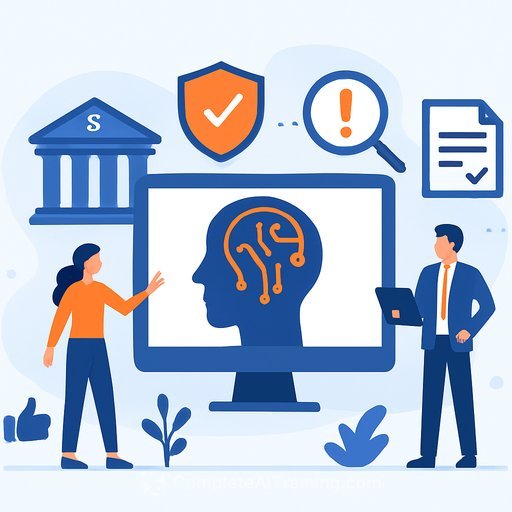
1) CFOs will own AI assurance in finance
AI is making calls that affect cash, compliance, and investor trust. Expect accountability to land squarely with the CFO, not just the CIO or a data team. In finance, "almost right" is wrong, so AI will have to show its work-data sources, logic, and evidence that outputs support business goals.
When that proof exists, CFOs can move faster with less manual review. The standard is clear: explain it, test it, and make it auditable.
2) SaaS will be rebuilt for intelligent agents
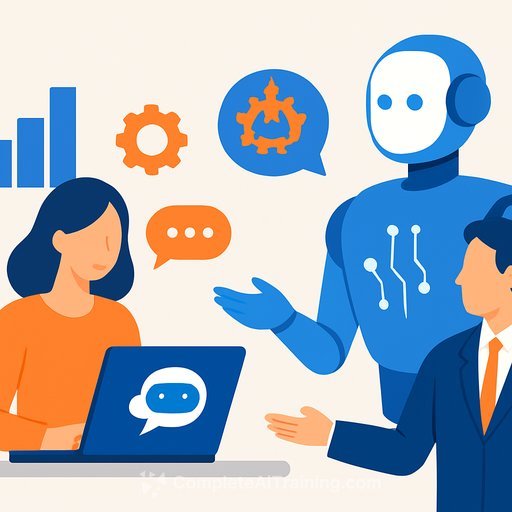
Your core systems will need to support work done by humans and AI agents side by side. That means structured workflows, guardrails, and consistent outcomes-even when no one clicks a button. It's not the end of SaaS; it's a new architecture built for co-working with agents.
Vendors that get this right will expose policies, permissions, testing sandboxes, audit logs, and clear rollback paths for agent-driven tasks.
3) Trust will move from principle to proof
High-level claims about "responsible AI" won't pass audit. For reconciliation, forecasting, and anomaly detection, you'll need explainable models, governed data, versioned prompts, and independent assurance. If a model influences financial decisions, it must be as transparent as a spreadsheet.
Procurement will start requiring evidence: model documentation, control testing, monitoring SLAs, and third-party validation.
4) Data provenance becomes essential
With AI-generated content everywhere, the key question isn't "human or machine?" It's "can we trust it?" Expect broader use of provenance frameworks-cryptographic signatures, secure metadata, and open standards that record origin and changes over time.
Traceability will sit next to accuracy in your control framework. That's how you decide if information is fit for regulated use.
5) CTOs will move to the center inside accounting firms
As intelligent systems take on more execution-layer work, someone must guide how they behave. Harris argues that strong technology leadership inside firms will separate those who innovate from those who lag.
Once teams see AI work reliably-even in one workflow-confidence compounds. The hardest part is getting started; after that, adoption accelerates.
What this means for finance leaders
- Governance shifts to Finance: AI risk becomes a financial control issue. CFOs will sign off on data quality, model usage, and outcomes that must withstand audit and regulation.
- ERP competition shifts to architecture: The edge comes from how systems are built-agent-ready design, auditability, and lineage-more than feature lists.
- Trust becomes measurable: Independent assurance, provenance controls, and transparency standards turn "trust" into a verifiable system property.
Practical next steps
For CFOs and Controllers
- Define AI RACI across Finance: who selects models, who validates, who approves usage, who monitors.
- Set acceptance criteria: explainability required, documented data lineage, version control for prompts and models, and reproducible outputs.
- Stand up Model Risk Management-lite: testing thresholds, challenger models for key forecasts, drift alerts, and an AI incident log.
- Require audit artifacts by default: input data snapshots, decision traces, change logs, and human-in-the-loop checkpoints for material items.
For Accounting Firms
- Put a CTO (or equivalent) in charge of AI behavior: policy, tool selection, guardrails, and firm-wide enablement.
- Productize workflows: build standard, repeatable AI playbooks for close, tax prep, advisory, and analytics with clear quality controls.
- Offer assurance on client AI use: testing, documentation, and independent review for models used in financial processes.
- See the AI Learning Path for CIOs (Chief Information Officers) for guidance on governance, architecture, and operational controls.
For ERP and Finance Ops Teams
- Prioritize agent-ready capabilities: role-based policies, sandboxed execution, event logs, rollback, and approval steps.
- Adopt provenance tooling for critical content: cryptographic signing, secure metadata, and lineage that follows the data across systems.
- Update vendor due diligence: require evidence of explainability, data governance, monitoring SLAs, and third-party assurance.
Helpful frameworks
- NIST AI Risk Management Framework for structure around governance, measurement, and monitoring.
- C2PA for content provenance standards (signing, secure metadata, traceability).
Upskill your finance team
If you're building AI assurance, agent-ready workflows, or provenance controls, training your team is the fastest way to reduce risk and find quick wins.
- AI Learning Path for Vice Presidents of Finance for role-specific strategy, forecasting, and risk modules.
- AI for Finance - a hub of finance-focused training and resources to help teams operationalize controls and use cases.
The takeaway is simple: treat AI like any other core financial system. Make it explainable, make it testable, and make someone accountable. Do that, and you'll move faster with fewer surprises.
Your membership also unlocks: