
AI news ·
Financial Services Commission guidelines place final AI responsibility and liability on employees
The FSC set seven AI rules requiring human oversight for financial firms. This raises civil liability for employees and institutions over AI-driven harm.
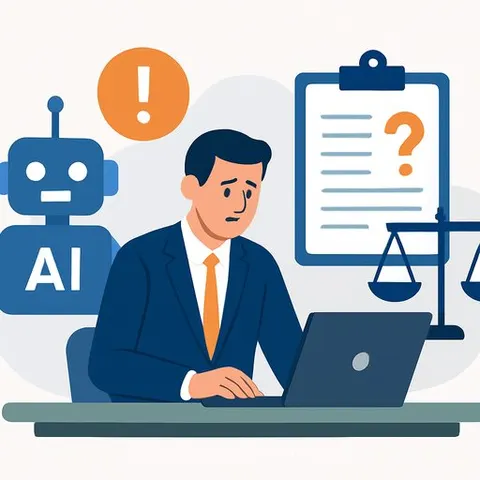
The Financial Services Commission released revised guidelines on artificial intelligence in the financial sector this year, making clear that AI must function as a support tool and that human employees bear final responsibility for decisions. The regulatory stance increases the likelihood that financial institutions and their staff will face civil liability when AI-driven processes cause customer harm.
FSC: AI is a support tool, and humans must be involved
The guidelines, which set administrative supervision standards for financial firms, do not directly create civil-law obligations. Nevertheless, they establish support-tool status as one of seven core principles for AI use. Under this principle, AI output should serve as reference material while employees review and exercise judgment throughout the workflow. For high-risk AI applications, the FSC says companies must build and operate standards that let internal staff and other human actors intervene in how the system functions.
The principle means that if a financial incident occurs, the institution could bear primary responsibility. The guidelines also suggest that liability may fall more heavily on the business unit that used the AI in its work than on the IT department that developed it.
Financial firms and employees may face more liability
The framework can feel lopsided. Firms and employees remain on the hook even after adopting AI, which may raise questions about whether they can deploy such systems without exhaustive pre-launch testing. Compliance efforts like pre-deployment testing can still be considered when regulators review administrative liability, making preventive measures and post-incident controls essential.
The FSC guidelines are not statutory regulations, so they cannot determine civil liability. Unlike administrative responsibility, the question of who bears civil damages when flawed AI output causes losses for customers remains underdeveloped. Few court cases and limited academic debate exist on whether liability would rest with the financial institution, the employee who handled the matter, or an outside vendor that supplied the AI model.
Internal rules at individual financial firms, however, are likely to adopt a structure where employees hold final responsibility for using and verifying AI output. That increases the chance that both financial institutions and their employees will be viewed as substantively involved in AI use, raising the odds of civil liability for damages if an incident occurs.
Rules on the degree of intervention are needed to address liability
Financial services have a direct and immediate impact on people. Given the current spread and sophistication of AI, the principle that AI should serve as a support tool appears necessary in finance. Whether the same principle can be extended to other fields is less clear.
The FSC's support-tool principle is worth considering through the lens of liability. Responsibility for a company or its employees will vary depending on the degree of human involvement. Companies therefore need to set their own principles on that issue and build compliance systems capable of enforcing them. Doing so could provide a clearer way to resolve liability questions arising from the use of AI in finance.
Why this matters for finance professionals
Finance employees who work with AI tools should pay close attention to their firm's internal AI policies. Under the emerging regulatory framework, the person who verifies AI output could be held personally liable for decisions. That is not a distant concern-internal rules are likely to shift responsibility toward employees, making it crucial to understand the required degree of human intervention and to document the human oversight applied to every AI-driven recommendation. The guidelines signal that as AI adoption grows, AI for Finance will increasingly demand that professionals treat AI as a tool that amplifies their own accountability, not one that reduces it.