Hands-on learning gets collaborative at NIC's inaugural AI Hackathon
How do you use AI without losing the human core of teaching? That question sat at the center of North Idaho College's first AI Hackathon, where high school and college students, faculty, industry pros, and community members worked side by side to build practical solutions for classrooms and careers.
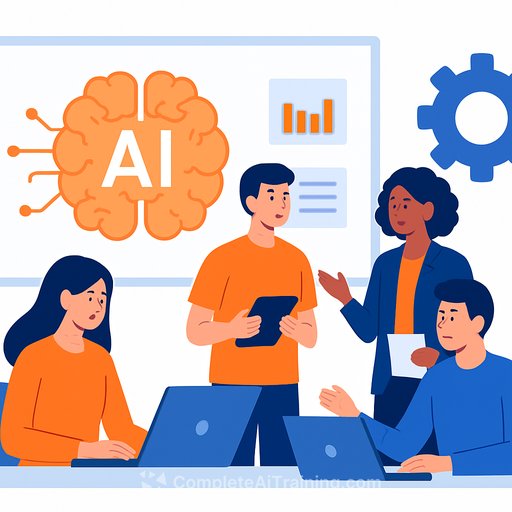
About 50 participants formed teams, moved from brainstorming to prototypes, and pitched ideas to a panel of judges. The pace was focused, not frantic-ideas were tested, refined, and made presentable in a single day. "What an incredible gift we have in education and industry working together," said NIC director of innovation Marita Diffenbaugh. "What starts as a question or a problem to solve can turn into meaningful partnerships and relevant learning."
Student Blake Sanchez summed up the energy: "They came with their unique perspectives, skills and experiences." In one session, Matthew Harnisch led a team huddle that looked more like a design studio than a classroom-whiteboards, quick demos, concise feedback, and clear next steps.
Why this matters for educators
The hackathon format strips AI down to what helps students learn: hands-on problem solving, peer feedback, and fast iteration. It gives teachers a low-risk way to test tools and workflows, then keep what works. NIC X-Labs, the program behind the event, exists to connect students, educators, and employers through applied projects that build job-ready skills.
The University of Idaho Center for Intelligent Industrial Robotics co-organized the event, signaling a tighter link between classrooms and local industry needs. That matters for students entering a workforce in transition-where automation, robotics, and AI influence the work they'll do and the way they'll do it.
What worked at NIC (and how to adapt it)
- Start with human outcomes. Teams framed problems around learning goals and real workflows-tutoring, feedback, safety, and career prep-before picking tools.
- Keep the loop short. Idea → tiny prototype → quick test → revision. Students see progress, teachers see what's viable within actual class time.
- Mix perspectives. Students, faculty, and employers viewed the same problem from different angles. That exposed blind spots and made solutions usable beyond one course.
- End with a pitch. Presentations pushed teams to clarify value, risks, and next steps. It also gave faculty tangible evidence for course and program improvements.
Run a one-day AI hackathon in your program
- Define the challenge: Pick 2-3 prompts tied to curriculum (e.g., "AI-supported formative feedback for writing," "Lab safety tutor," "Attendance insights for early support").
- Set guardrails: Clarify academic integrity, data privacy, and tool permissions. Require a brief "ethics and bias" checklist in every submission.
- Assemble teams: 4-6 people mixing roles or disciplines. Assign a project manager and a presenter.
- Provide a starter stack: Approved AI tools, a template for prompts, sample datasets or scenarios, and a simple rubric.
- Schedule (5-6 hours):
- 60 min: Problem framing and success criteria
- 120 min: Prototype build and quick tests
- 60 min: Risk, bias, and data checks
- 60-90 min: Pitches and feedback
- Assess deliverables: Problem statement, workflow diagram, demo or mockup, learning impact claim, risks and mitigations, next-step plan.
Classroom use cases you can pilot this term
- Feedback assistant: Draft-to-draft guidance with teacher-controlled rubrics; students submit a short reflection on how they used the feedback.
- Practice tutor: Socratic Q&A for math steps, lab prep, or reading comprehension with sources and hints, not final answers.
- Planning co-pilot: Lesson outlines, exit-ticket generation, and differentiation ideas-reviewed and adapted by the teacher.
- Career sampler: Role-play prompts that simulate workplace scenarios aligned to local industry partners.
Policy, privacy, and equity-build trust first
Students need clear rules and consistent modeling from faculty. Create a simple AI use policy, identify approved tools, and explain what is and isn't acceptable work. Require source citation for AI-generated content and make disclosure part of grading.
Protect student data by using institution-approved tools and avoiding uploads of sensitive information. For a helpful overview, see the U.S. Office of Educational Technology's guidance on AI in teaching and learning: AI guidance from the U.S. Department of Education.
Institution-level next steps NIC (and peers) can take
- Faculty learning circle: A standing group that shares prompts, rubrics, and outcomes across departments.
- Course pilots: Select 3-5 courses to test AI-supported workflows with clear metrics (retention, time-to-feedback, writing revision quality).
- Common rubric: One-page template covering learning impact, academic integrity, bias checks, and accessibility.
- Industry project bank: Short briefs from local employers that classes can tackle each term.
- Student AI literacy: A micro-credential covering effective prompting, verification, citation, and ethical use.
- Continuous review: Quarterly tool audits for privacy and efficacy; sunset what doesn't help students learn.
What leaders said
"We had a beautiful and productive day," Diffenbaugh said, noting that turnout and outcomes exceeded expectations. She added, "This is just the beginning of what NIC X-Labs can offer as a connector and inspiring strategy to use the bridge that we've built between education and jobs in our community."
Keep building your own capacity
If you're ready to bring structured AI practice into your classroom, start small, measure impact, and share what works. A focused learning path helps:
- AI Learning Path for Teachers - practical steps for lesson planning, assessment workflows, and student engagement with AI.
The takeaway from NIC's hackathon is simple: keep the people work-curiosity, critique, connection-at the center. Let AI handle the busywork, and give students more time for thinking that matters.
Your membership also unlocks: