DEWA brings core services to ChatGPT: a practical shift in digital government
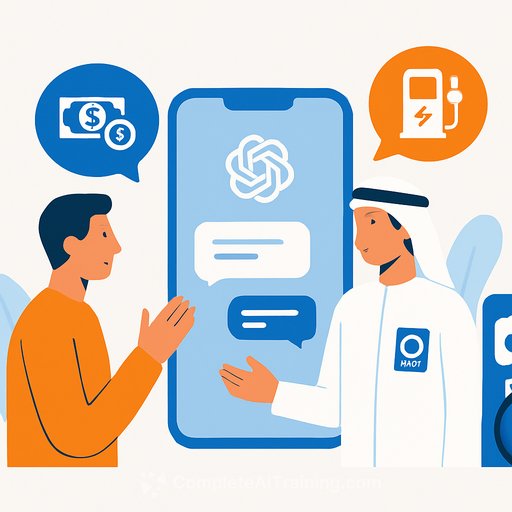
Dubai Electricity and Water Authority (DEWA) has launched its services on the ChatGPT Apps Directory, letting customers handle common tasks through an AI assistant instead of a website or mobile app. DEWA says it has become the first government body and the first utility to offer services directly through an AI platform.
Managing Director and CEO Saeed Mohammed Al Tayer said the move supports Dubai's push in artificial intelligence and digital innovation. The goal: become the world's first "AI-native" utility and meet customers where they already ask questions-inside AI tools-while making access faster and simpler.
What customers can do today
- Check and pay bills.
- Review account details and get billing support.
- Find DEWA's EV Green Charger stations and get directions to the nearest one.
- See information about Customer Happiness Centres, including locations, working hours, and contact details.
- More services will roll out gradually, aligned with DEWA's security and privacy standards.
Security and system approach
DEWA says the service runs within a secure framework to protect user data. Advanced AI models provide quick, conversational responses and can scale to handle demand as usage grows.
Why this matters for public-sector leaders
People are defaulting to AI assistants for information and support. Bringing services to that channel reduces friction and shortens the path from question to resolution.
- Channel strategy: Treat AI assistants as a first-class endpoint, alongside web, app, and call center.
- Identity and consent: Decide what requires login, what can be answered anonymously, and how to confirm user authorization.
- Data protection: Apply data minimization, encryption, retention limits, and clear audit trails.
- Service design: Start with high-volume, predictable tasks (billing, locations, status checks) before expanding.
- Quality and safety: Define guardrails, fallback to human agents, and measure accuracy, resolution time, and customer satisfaction.
- Accessibility and language: Use plain language, support multiple languages where needed, and ensure inclusive access.
- Governance: Involve legal, cybersecurity, procurement, and data teams from day one.
How agencies can move forward
- Map user journeys for your top five inquiries and prototype them in an AI assistant.
- Create a data-flow diagram: what the assistant sees, what it stores, and who has access.
- Set acceptance criteria (accuracy, response time, containment rate) and run a time-boxed pilot.
- Publish a clear privacy notice and change log for any AI-enabled channel.
- Train frontline and back-office staff on new workflows, escalation paths, and exception handling.
Learn more
Upskill your team
If your department is exploring AI service channels, structured training helps you move faster with fewer risks. See practical pathways and examples here:
Your membership also unlocks: