
AI news ·
Fleet managers use AI to cut admin, improve driver safety and reduce vehicle downtime
Fleet managers are using AI to cut admin work-handling parking fines, screening job applications, and predicting breakdowns-rather than replacing staff. Geotab's CEO puts it plainly: "Your job is going to be replaced by people who use AI."
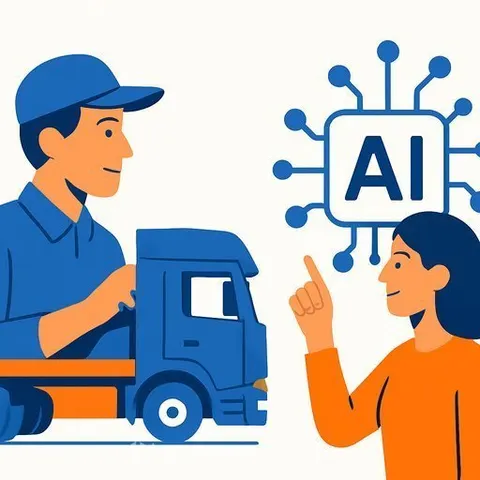
Fleet managers turn to AI for administrative relief, not job cuts
Fleet managers are adopting artificial intelligence to reduce paperwork and free up time for strategic work, not to eliminate jobs. The technology processes large volumes of data to identify patterns, automate routine tasks and support decision-making across vehicle operations.
Paul Hollick, chair of the Association of Fleet Professionals, said fleet managers are already using AI to cut administration around parking fines, create driver dashboards and screen job applications. "Rather than the technology proving a threat to jobs, it could free fleets from ever-growing inboxes and give them time to bring about new improvements through strategic thinking," he said.
The concern about job displacement is real. Research from LiveCareer UK suggested nearly a million jobs in London could be affected by AI, including telemarketers, bookkeepers and data entry specialists. But Neil Cawse, founder and CEO of Geotab, frames the shift differently: "I don't think your job is going to be replaced by AI, I think your job is going to be replaced by people who use AI."
Fleet managers should start by learning how to use AI tools effectively. Cawse recommends subscribing to ChatGPT or Microsoft Co-Pilot and developing prompting skills. "The more you put into the tool the more you get out," he said.
Five ways fleets are using AI now
1. Driver behaviour and safety
AI systems analyse telematics data, weather, road conditions and driver actions to predict crash risk. Samsara found that fleets using its full AI suite - including dual-facing dashcams and driver coaching - achieved a 73% reduction in crash rates over 30 months, compared with 37% for other customers.
In-cab cameras detect distraction, phone use and hazardous conditions in real time. Some systems provide automatic voice coaching to drivers. Geotab's dual-facing dashcam reduced tailgating by 90% and phone use by 95% in a recent pilot.
AI can also recognise safe driving habits, enabling fleets to reward positive behaviour rather than only penalising mistakes.
2. Route optimisation
AI algorithms plan journeys based on traffic, weather, road conditions and driver profiles. The technology can match drivers to routes that suit their skills - assigning urban routes to drivers who perform better in cities, for example.
Colin Ferguson, CEO of route optimisation provider Optimize, said the approach delivers multiple benefits beyond shorter routes. "The actual outcome may be a route, but if you come at it from a different approach, there are multiple benefits," he said. Algorithms also help fleets integrate electric vehicles and maximise their efficiency.
3. Predicting vehicle breakdowns
Predictive maintenance systems analyse sensor data and driver behaviour across thousands of vehicles to spot patterns that precede failures. Geotab estimates each mechanical breakdown costs between £5,000 and £10,000 when accounting for lost productivity and vehicle rental.
The technology can predict battery failures months in advance by monitoring cranking voltage and other indicators. Fleet managers can then schedule maintenance before vehicles break down, eliminating unexpected off-road time.
4. Vehicle theft prevention
Machine learning identifies patterns of potential theft by analysing large volumes of telematics data. Targa Telematics reported a 12% drop in thefts among UK customers in 2025 compared to 2024 after implementing this approach.
5. Vehicle inspections
Computer vision AI certifies that drivers have completed vehicle inspections correctly. Samsara's app requires drivers to photograph vehicles, with AI verifying the image is current. FleetScout, an inspection platform, uses automated drive-through towers and computer vision to detect damage consistently without relying solely on manual checks.
How to get started
Sarah Armitage, decarbonisation and vehicle strategy manager at Network Rail, said freeing staff from repetitive tasks improves job satisfaction and allows them to focus on customer experience and safety. "These are the things that are really key but sometimes get lost in administration tasks that can take hours," she said.
Fleet managers should become familiar with AI tools now and begin integrating them into their operations. Building visible improvements within your organisation creates a case for how AI should drive efficiency across the wider fleet sector.
Both technical knowledge and business judgment matter. AI can sift through mountains of data and construct patterns, but it needs human experience and strategic oversight to turn outcomes into real-world action.