Florida's Proposed AI Bill of Rights: What Insurance Leaders Need to Know
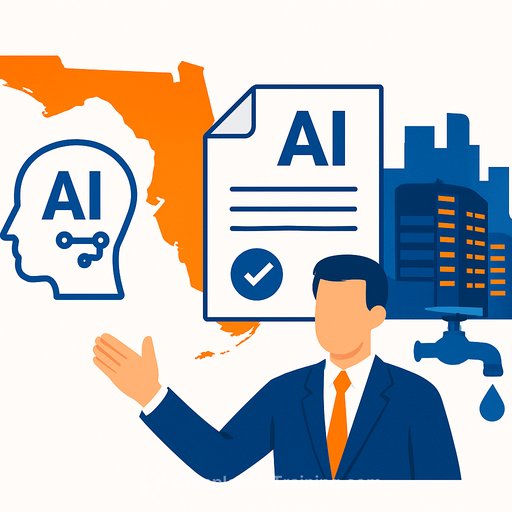
Governor Ron DeSantis has announced a proposal for an "Artificial Intelligence Bill of Rights" and new limits on hyperscale data centers in Florida. For insurers, this signals tighter expectations on how AI is built, explained, and audited-plus new risk dynamics tied to utilities and water resources. Start treating this as a near-term compliance and underwriting shift, not a distant idea.
How this could affect insurance operations
- Underwriting transparency: Expect clearer disclosures when AI assists rating, pricing, and eligibility. Prepare consumer notices and plain-language explanations for adverse decisions.
- Bias and fairness testing: Regular testing for disparate impact across protected classes will likely be table stakes. Document methods, thresholds, and remediation steps.
- Human-in-the-loop for high-stakes calls: Claims denials, rescissions, and essential coverage decisions may require human review and easy appeal paths.
- Auditability: Keep versioned model documentation, training data lineage, performance metrics, and decision logs. Assume regulators could ask for them.
- Vendor governance: Push third parties to meet the same standards. Bake explainability, monitoring, and data-use limits into contracts.
- Privacy and consent: Tighten data minimization, retention schedules, and opt-out flows-especially for monitoring, telematics, voice, or biometric signals.
Data center limits: second-order effects to price and monitor
The plan places strict limits on hyperscale data centers to protect residents from higher utility costs, safeguard water resources, and give local communities more say over big tech projects. That has knock-on effects for property, liability, business interruption, and municipal risk.
- Property and CAT accumulation: Large facilities concentrate values and grid dependencies. Revisit catastrophe, power outage, and heat exposure models.
- Water stress and environmental liability: Cooling demand can drive local water risk. Tighten underwriting questions on sourcing, reuse, and discharge controls.
- Utility cost volatility: If regions push back on capacity, expect price pressure and political risk-both relevant to BI and rate adequacy assumptions.
- Zoning and community approvals: Local rejection power adds project delay and cancellation risk. Reflect this in construction, surety, and developer E&O.
Action plan for carriers, MGAs, and brokers
- Inventory every AI use case across underwriting, claims, SIU, CX, and marketing. Tag each by risk level and decision criticality.
- Document data sources, feature lists, and known proxies tied to protected classes. Remove or mitigate where needed.
- Stand up bias testing with clear acceptance thresholds and rerun schedules. Log results and fixes.
- Create adverse decision explanation templates by line of business. Keep them short, specific, and defensible.
- Add human review checkpoints for high-impact outcomes and fast-track appeals.
- Form a model risk committee with compliance, actuarial, legal, and product. Require sign-offs at deployment and material change.
- Update vendor contracts to mandate explainability, monitoring, incident reporting, and data-use boundaries.
- Tighten retention policies for training data, model artifacts, and decision logs. Define who can access what-and why.
- Run a tabletop exercise for an AI incident: unfair denial, bad data, or drift. Measure response time and evidence quality.
- Brief distribution partners so quotes and denials are communicated with consistent, approved language.
Policy watch and useful references
- Track alignment with the NAIC's work on insurer AI oversight. See NAIC bulletin update.
- Use the NIST AI Risk Management Framework as your structure for governance, measurement, and controls. NIST AI RMF.
Skill up your teams
If your underwriting, claims, or compliance teams need a faster path to practical AI literacy, explore curated learning by role. It's the quickest way to build shared language and process.
Bottom line: Florida is signaling higher standards for AI accountability and tighter scrutiny of infrastructure that strains utilities and water. Move now-clean data, clear documentation, and human oversight will save you time, money, and regulatory headaches later.
Your membership also unlocks: