
AI news ·
Florida doctors face malpractice risk when using AI to draft informed consent forms
Florida doctors using ChatGPT to write informed consent forms face real malpractice exposure. Under state law, AI-generated documents often lack patient-specific risks and alternatives-and no court has ruled this practice meets the standard of care.
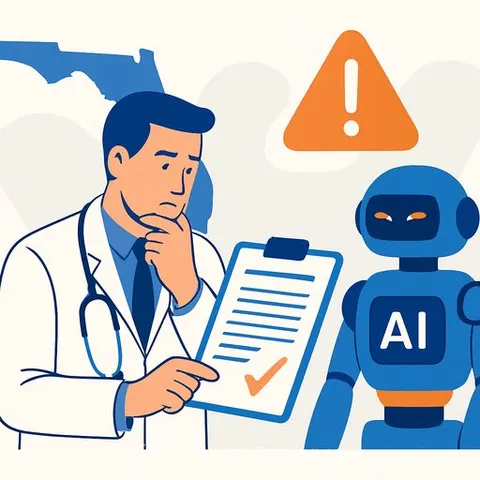
Florida Doctors Using ChatGPT for Consent Forms Face Malpractice Risk
Roughly 10% of U.S. healthcare providers now use ChatGPT regularly, and up to 40% use some form of clinical AI daily. Across Florida, an increasing number of physicians are delegating informed consent documentation to generative AI tools. The legal consequence is a malpractice trap.
The appeal is straightforward: AI produces polished, seemingly comprehensive consent language in seconds at no cost. But AI for Legal professionals and healthcare attorneys recognize the danger. A signed consent form generated by an AI system provides minimal legal protection under Florida law.
What AI Systems Actually Do
Generative AI models like ChatGPT do not retrieve verified legal or clinical data. They generate probabilistic text based on training data of varying quality and recency. When a language model produces fluent but factually incorrect content, the field calls this a "hallucination."
In practice, AI-generated consent forms frequently omit procedure-specific risk disclosures. A language model has no access to the provider's credentials, operative technique, complication profile, or patient-specific risk factors. The result is often a generalized risk list that fails to mention the complication that later materializes.
These forms also fail to identify medically acceptable alternatives with the specificity Florida law requires. A generative model cannot determine the full range of clinically appropriate alternatives for a specific patient.
Florida's Legal Standard
The Florida Medical Consent Law, § 766.103, establishes two independent conditions that must be satisfied simultaneously:
- The consent process must conform to an accepted standard of medical practice within the relevant professional community.
- A reasonable patient must achieve a general understanding of the procedure, its alternatives, and its substantial risks.
These are standards of practice, not stylistic benchmarks satisfied by well-written text alone. The Florida Patient's Bill of Rights independently guarantees each patient the right to receive sufficient information to make an informed decision.
Informed consent under Florida law is a communicative process, not a document-driven event. A signed form is evidentiary, not dispositive. An AI-generated form, by definition, is not part of that dialogue and carries diminished, if any, evidentiary weight.
The Standard of Care Problem
No Florida court has held that delegating consent documentation to a generative AI system satisfies the professional standard of care. In litigation, a plaintiff's expert can reasonably testify that no physician exercising reasonable care would delegate substantive consent preparation to a probabilistic text generator lacking clinical training, patient-specific knowledge, and accountability.
The form may appear adequate. Its legal sufficiency remains a jury question.
Where AI Has Value
This is not an argument against using AI in medicine. AI has demonstrable value in administrative and analytical functions: scheduling, billing reconciliation, clinical summarization, and literature review.
A consent form is different. It is a legal instrument that provides a statutory defense when properly executed. That defense is forfeited when the form can be accurately characterized as the output of a system with no knowledge of the patient, the procedure as performed, or the applicable standard of care.
AI may generate a template. It must then be reviewed, individualized, and validated by a legally and clinically competent professional for each patient encounter. AI for Healthcare works best when it augments human judgment, not replaces it. No language model can substitute for what the law requires to arise from a human relationship.