
AI news ·
Ford rehires 300 veteran workers after AI quality systems fall short
Ford rehired 300 veteran inspectors after AI systems failed to match human judgment. The move pushed the automaker from tenth to first in J.D. Power quality rankings.
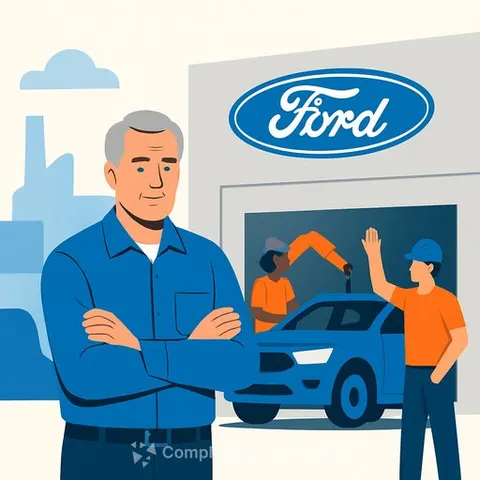
Ford has rehired more than 300 veteran quality inspectors after determining that its AI-driven inspection systems could not replace the nuanced judgment of experienced human engineers. The automaker's move, reported by Bloomberg, comes as the company climbed from tenth to first place among mainstream brands in the annual J.D. Power Initial Quality Survey-its best ranking in 16 years.
The limits of AI-driven quality control
The company acknowledged that while it had leaned heavily on automated quality checks, the results fell short. "Artificial intelligence is a fantastic tool, but it's only as good as the information you use to train it," Charles Poon, vice president of vehicle hardware engineering, told reporters. He added that Ford had previously underinvested in capturing insights from its most seasoned engineers.
COO Kumar Galhotra said the business brought back technical specialists who now "hunt for failure points before a part ever reaches the plant floor." Ford's automation push lacked the ability to tackle complex production problems that demand decades of hands-on experience. The failure highlights the risks of leaning too heavily on AI Agents & Automation without reserving a central role for human oversight.
A talent refresh that delivered results
Ford attributed the quality turnaround to what it called "a significant talent refresh." In a press release, the company said it replaced senior leaders across engineering, supply chain and manufacturing and brought back roughly 300 veteran engineers "who carry the hard-earned wisdom of decades of design." After the rehiring effort, quality metrics improved enough to propel Ford to the top of the mainstream ranking for new vehicles.
Prior-year results had placed the company tenth in the same survey, trailing the industry average. The sharp improvement underscores how institutional knowledge, not just new technology, can correct systemic quality failures.
AI adoption and the automation overreach debate
Ford's experience dovetails with a broader pattern where companies publicly link workforce reductions to AI adoption, a practice critics call "AI washing." While Ford is hiring humans rather than laying them off, the automaker remains the most recalled brand in the U.S.-executives blame those legacy problems on earlier automation decisions, not on the return of human inspectors.
The episode adds to a growing list of cautionary examples in AI for Executives & Strategy that underscore why purely algorithmic approaches can fail in environments that require contextual, experience-based decisions.
Why this matters for executives and strategy
Ford's reversal demonstrates that automation investments do not eliminate the need for domain expertise-they raise the bar for how it's used. Leaders evaluating AI deployment should treat veteran talent as a critical complement, not a cost to be optimized away. The fastest path to quality gains in Ford's case came from re-inserting human judgment into processes that AI alone had mishandled.
For executives charting their own AI roadmaps, the lesson is direct: a system is only as reliable as the experience that trains, tunes, and supervises it. In practice, that means retaining specialists who know what failure looks like and can catch it before it reaches the plant floor-or the customer.