AI in Procurement: How AI Is Transforming Risk Management
Supply chains used to react. Now they anticipate. AI is turning risk management from a scramble into a system-one that spots trouble early, flags what matters and guides action before losses stack up.
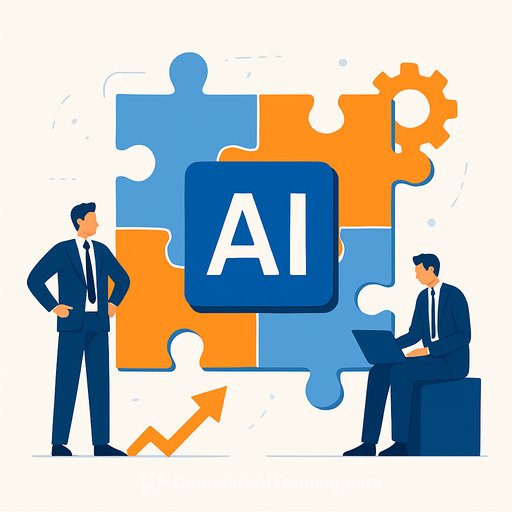
Jeff Morrison, SVP for Global Purchasing and Supply Chain at General Motors, compares it to solving a jigsaw on a moving train. "The puzzle itself is tricky, and the train's bumps and shakes make everything unpredictable. You have to adjust quickly and stay focused as new challenges pop up with every jolt so you can solve the puzzle before the train arrives at your stop."
That's the point: volatility isn't rare anymore. It's constant. Being prepared isn't a nice-to-have-it's a profit safeguard.
From early warning to early learning
AI strengthens decision-making by turning messy signals into ranked, explainable insights. Machine learning models learn from historical events and live data, so the system improves as conditions change.
Teams use AI to monitor behavior and activity in real time, analyze patterns and trigger recommendations. This goes beyond alerts. It becomes an early learning loop that stops threats from becoming incidents.
GEP highlights how AI-based supplier scoring sharpens vendor selection. By assessing performance across categories and auto-prioritizing risk, sourcing teams can spot weak links early, secure better terms and move faster than manual reviews. See the GEP report for details.
Disruption management is a financial necessity
A Sphera survey of 200 CPOs and CSCOs in the US and UK shows the pressure in plain numbers. Nearly three-quarters of companies lost money to supplier disruption. 73% faced disruptions in the past year. Boards are leaning in: 48.5% of leaders get their risk decisions questioned weekly or monthly, with another 46.5% questioned quarterly.
Root causes span geopolitics, tariffs, inflation, insolvencies and shifting regulations. The takeaway is direct: disruption management isn't optional-it's a core P&L lever. Read more in the Sphera survey.
What executives expect from AI
Leaders value speed and defensibility. According to Sphera, the top benefits of AI-generated supplier risk summaries are: fast operational decisions (31%), faster strategic decisions (29%) and accurate insights in under 60 seconds (24%).
Board expectations for ROI are clear: cost savings and cost avoidance (28%), revenue protection from disruption (24%), and top-line growth (21%). AI must compress time-to-decision for day-to-day moves and strengthen the case for long-term bets. Anything less misses the mark.
For more on building the business case and governance, see AI for Executives & Strategy.
Inside GM's digital toolbelt
GM's semiconductor crisis response reshaped its operating model. The company now runs a digital toolset built to anticipate and act:
- Risk Intelligence: Uses AI and machine learning to classify, summarize and tag thousands of daily public posts to anticipate risks such as natural disasters and local disruptions.
- SupplyHealth: Monitors thousands of sites with supplier cooperation to flag high-risk conditions before they escalate.
- SupplyMap: Aggregates data across direct suppliers and sub-tiers to build a map-based view of the network, improving visibility into where risks may surface.
- SupplyAlert: Centralizes communications after a risk is identified, scanning internal data and routing actionable alerts to the right teams.
As Jeff Morrison puts it: "Picture an expert companion on the train who can instantly read the puzzle and shine a light on bumps ahead that humans might miss... At GM, we view AI as a practical, transformative force. It is a competitive advantage to unlock enterprise-wide innovation and efficiencies up and down the value chain."
Close the visibility gap-especially in tier 3
Most risk hides beyond tier 1. GEP reports that 70% of procurement leaders cite insufficient visibility into tier 3 as a primary source of risk, and around 40% say the same for tier 2.
Executives aren't funding AI for dashboards. They want line-of-sight to P&L. You'll need quantifiable cost reduction, revenue protection and growth attached to each capability-plus a path to board-ready reporting.
What great looks like: KPIs that matter
- Time-to-detect: Median minutes from signal to surfaced risk.
- Time-to-decision: Minutes from surfaced risk to routed decision and action owner.
- Tier coverage: % of suppliers mapped to tier 3 with site-level attributes.
- Re-score cadence: Frequency of supplier risk re-scores (e.g., daily/weekly).
- Prevented loss: Cost avoidance attributed to early action (audited).
- Revenue protected: Confirmed revenue at risk preserved due to mitigations.
The executive 90-day plan
- Define the risk taxonomy: Standardize event types, severity, financial impact and response playbooks across regions and categories.
- Unify signals: Ingest public data, supplier disclosures and internal operational data into one risk lake with clear ownership.
- Map the chain: Push for tier-2 and tier-3 mapping; tie each site to parts, SKUs and revenue lines.
- Stand up an AI triage layer: Use LLMs to summarize and rank events, cite sources and propose next-best actions with confidence scores.
- Automate thresholds: Trigger playbooks when metrics cross impact or probability limits; route to owners in procurement, logistics and finance.
- Instrument ROI: Attach every mitigation to a cost-avoidance or revenue-protection estimate; audit quarterly.
- Board reporting: Produce a monthly one-pager: exposures, actions taken, dollars preserved and time-to-decision trends.
- Supplier enablement: Train partners to map sub-tiers and share signals; reward transparency with better terms and faster payment.
For team capability building, explore the AI Learning Path for Supply Chain Managers.
Strategy reset: resilience and segmentation
"The linear model of stretching supply chains globally to lower costs is going away," says Paul Marushka, CEO and president at Sphera. "Trade restrictions, export controls and geopolitical disruption continue to change the game. Firms require an agile, segmented and geographically aligned approach that builds in resilient sourcing strategies to balance risk."
That shift pairs well with AI. Segmentation defines where capacity and buffers live. AI tells you when to use them, how to sequence responses and where the biggest dollar impacts sit.
Final word
"So instead of solving a jigsaw puzzle in the dark on a bouncing train," Morrison adds, "AI is helping our supply chain team at GM illuminate the path ahead and build a stronger business for our customers." That's the bar: see sooner, act faster and prove the financial impact-every month.
Your membership also unlocks: