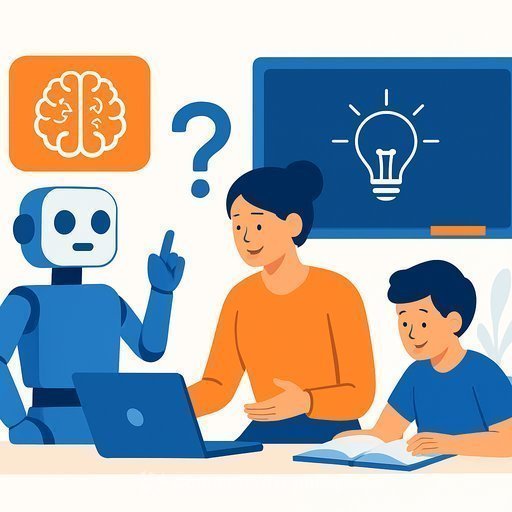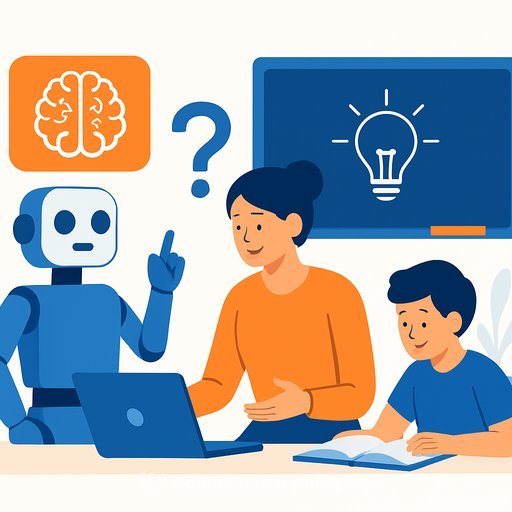
Newman and the university in the age of AI
The steam engine compressed time and redefined work. AI is doing the same-pushing tasks into seconds and tempting us to mistake speed for insight.
That pressure makes an old question urgent again: what is a university for?
Newman's proposal
A university exists to cultivate the intellect. It's not a credential factory, a labor pipeline, or a vending machine for isolated "skills." It is a place where a person learns how to think-how to follow an argument, weigh evidence, and see reality as a whole.
Newman called this a "philosophical habit of mind." It means breadth across disciplines, the capacity to rank goods, and the restraint to resist fanaticism and reductionism. Specialization matters, but alone it narrows. True education forms a mind that can connect knowledge and apply it for real good.
Why theology belongs
Exclude theology and you distort the map. Theology speaks about God-the highest object of inquiry. Saying "we'll cover everything except the most ultimate questions" is not neutral; it silently trains a stance about what counts and what does not.
AI's gifts-and its limits
AI handles pattern recognition, summarization, prediction, and recombination. It can produce readable prose, draft code, create images, and fetch what looks like an answer. Used well, those are real aids.
Used naively, they blur lines: data becomes "knowledge," outputs pose as judgment, speed poses as depth. Our age makes it easy to collect facts while growing less able to assess them. AI can put an ocean of content within reach, but it cannot supply first principles, reason about causes, integrate insights across fields, or order pursuits toward what is truly good.
The hard questions are moral and metaphysical
What is a human person, that we would replace labor, imitate speech, simulate relationships, or outsource choices? What is dignity? Who is responsible when an algorithm mediates decisions? What happens to the weak when the persuasive tools are in the hands of the strong? What becomes of friendship, attention, and contemplation when every idle moment can be filled by a machine built to keep us scrolling?
Engineering tells us what we can do. It does not tell us what we should do. The university's task is to form free persons-capable of self-government-so they can live responsibly in community. That requires virtue, not just competence.
Why the liberal arts matter right now
This is not nostalgia. It's preparation for reality. Real liberal education spans literature to mathematics.
- Philosophy: clarity about meaning and argument.
- Theology: wonder and humility before the highest things.
- Literature: moral imagination-seeing choices and their consequences from the inside.
- History: human nature persists even as tools change; pride gets punished eventually.
- Mathematics: disciplined precision.
- Sciences: attention to the real and careful weighting of evidence.
These studies train observation, inquiry, good argument, and a sense for beauty-things a machine can mimic, but not possess. In short, they educate for accurate judgment.
Leaders need judgment more than ever
The more we automate, the more we need people who can interpret, not just execute. The more data we collect, the more we need wisdom to decide what is worth doing. As tools get more persuasive, we need a moral compass that cannot be coded.
Newman refused to reduce education to utility. Knowledge pursued for its own sake enlarges the soul-and, ironically, proves more practical over time. A formed mind adapts. It learns new tools because it has learned how to learn, spots bad reasoning, and sees beyond the immediate to the enduring.
What a Catholic university should be
Welcome technology, but do not worship it. Pursue innovation without surrendering the question of meaning. Educate a person, not a function.
Such an institution forms workers and citizens, producers and stewards, problem-solvers and truth-seekers. Yes, teach the tools. Also teach students to ask what those tools are for-and who they are becoming as they use them.
Recover this vision and AI won't make the university obsolete. It will make the university necessary. The future belongs to those who can recognize the true, choose the good, and love the beautiful-while remaining fully, irreducibly human.
Practical moves for educators
- Set a clear AI use policy. Define permitted support (e.g., idea generation, code review) and prohibited uses (ghostwriting, unauthorized research summaries). Require disclosure and citation of AI assistance in all submissions.
- Assess for thinking, not outputs. Use oral exams, in-class writing, whiteboard proofs, studio critiques, and iterative drafts with feedback to make the student's reasoning visible.
- Grade the process. Ask for annotated prompts, reading notes, outlines, and revision logs. Reward careful method, not just polished results.
- Keep theology and philosophy in the core. Every major should engage first principles, human dignity, and the common good-alongside its technical coursework.
- Run cross-disciplinary seminars on AI and the human person. Put computer science, philosophy, theology, and social science in the same room.
- Practice "slow thinking." Schedule device-light classes, deep-reading labs, and formal debates that train attention and patience.
- Invest in faculty development. Provide ongoing training in responsible AI pedagogy. See the AI Learning Path for Teachers for practical modules.
- Protect research integrity. Require method sections that detail any AI assistance and adopt field-appropriate standards. For context, review UNESCO's Guidance for generative AI in education and research.
- Form character intentionally. Pair digital minimalism practices with service learning and community life that nurtures responsibility and friendship.
- Read Newman together. Assign selections from The Idea of a University and connect them to present AI cases.
Your membership also unlocks: