AI Strategy: How Freeport-McMoRan Is Using Autonomy and Analytics to Run Leaner, Safer Mines
Operations teams are under pressure to deliver more with tighter labor pools, rising costs and tougher environmental expectations. Freeport-McMoRan is showing a workable path forward by applying AI, autonomy and predictive analytics across sites from Grasberg (Indonesia) to Morenci and Bagdad (Arizona).
The core idea is simple: instrument everything, let models optimize the flow, and remove delays that humans can't see in real time. The results, according to company reports, are meaningful-in both productivity and sustainability.
Autonomous haulage that compounds throughput and safety
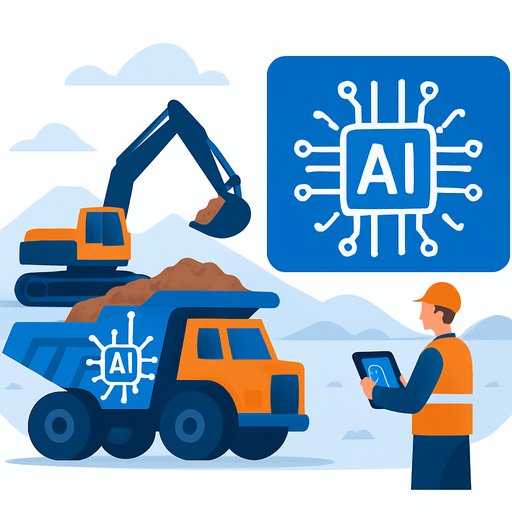
Freeport-McMoRan has rolled out AI-driven Autonomous Haulage Systems across key operations. These fleets use machine learning to optimize routing, speed and maintenance intervals, running continuously without shift-change downtime.
Reported outcomes include an 18% increase in haulage efficiency and a 22% decrease in accident rates. Fuel use is optimized in real time, reducing emissions while keeping output high.
Processing, digital twins and predictive maintenance
In processing plants, AI-powered sensors with X-ray transmission improve ore sorting. Company reports indicate a 12% reduction in energy per tonne processed and a 20-25% improvement in processing efficiency, with less chemical use and lower waste.
Digital twins-fed by geological models, plant sensors and operational data-support early fault detection, scenario testing and maintenance prediction. Freeport-McMoRan anticipates up to 30% less downtime from proactive scheduling driven by these models.
Environmental intelligence and community transparency
IoT and satellite feeds deliver real-time monitoring of air, water and soil. Automated alerts enable immediate mitigation and provide transparent reporting portals for nearby communities.
Renewables are integrated near Grasberg and Morenci, with wind in South America. With AI optimizing energy distribution and intermittency, the company expects a 30% drop in fossil-fuel reliance and a 40% cut in energy-related carbon emissions. AI-managed closed-loop water systems target up to a 50% reduction in total withdrawal, and community platforms help plan for local jobs and supplier contracts-over 1,500 annually, according to company reports.
What operations leaders can copy now
- Start where variance is highest: Pick one fleet and one plant line. Baseline cycle times, delays, fuel/energy per tonne and incident rates.
- Unify your data layer: Stream fleet telemetry, SCADA, historian and LIMS into a time-series store plus a cloud lake. Define schemas, latency targets and ownership.
- Stand up three practical models: dispatch optimization for haulage, remaining useful life (RUL) for critical assets and an ore-sorting classifier.
- Lock in KPIs that matter: OEE, haulage cycle time, unplanned downtime, energy per tonne, fuel per tonne-km, incident frequency and recovery rates.
- Engineer safety into autonomy: geofencing, graded autonomy with human-in-the-loop, shadow runs before handover and targeted operator retraining.
- Governance and monitoring: model drift alerts, audit trails, environmental thresholds with auto-escalation, and cybersecurity segmentation between IT and OT.
- Vendor strategy: push for open APIs and data portability across OEMs to avoid lock-in; integrate with your CMMS/ERP from day one.
- ROI discipline: model payback on fuel, tires, cycle-time gains, avoided incidents and maintenance deferrals; track weekly and prune what doesn't move the needle.
90-day execution plan
- Days 0-30: map the value stream, baseline metrics, select a pilot pit and plant line, draft the safety case, and assess IT/OT integration gaps.
- Days 31-60: deploy sensors and edge gateways, build the streaming pipeline, pilot dispatch optimization and a digital twin, and stand up a downtime prediction model.
- Days 61-90: run A/B tests (model-on vs. model-off), train crews, finalize incident response playbooks, report ROI, and approve the scale-up roadmap.
Tech stack snapshot
- Data and integration: edge gateways, time-series DB, cloud data lake, streaming bus and OPC UA connectors.
- Analytics: AutoML for classification, optimization solvers for dispatch, physics-informed digital twins and RUL models tied to your CMMS.
- Autonomy: perception, routing/orchestration, V2X and safety controllers with graded fallback modes.
- Operations visibility: MLOps with drift detection, control charts for process stability and unified dashboards for Ops and EHS.
Risk controls that keep Ops in command
- Human-in-the-loop overrides and safe-degraded modes for all autonomous assets.
- Network segmentation, allowlists and continuous patching across IT/OT.
- Regulatory alignment for vehicle safety, emissions and environmental reporting.
- Community reporting portals with near-real-time environmental metrics.
Benchmarks to target
From Freeport-McMoRan's reported outcomes: +18% haulage efficiency, -22% accident rates, 20-25% processing efficiency gains, -12% energy per tonne processed, -30% downtime from predictive maintenance, -30% fossil-fuel reliance, -40% energy-related emissions and up to -50% water withdrawal. Your site will vary-treat these as directional goals tied to baselines and geology.
Next step for your team
If you're standing up similar programs, this practical primer can help: GMG autonomous systems guidelines. For a structured skills path and templates for Ops leaders, see the AI Learning Path for Operations Managers.
Your membership also unlocks: