How to design marketing organizations for AI learning and scale
Leaders keep asking the same question: what will this drive? With AI, the answers don't fit the old pattern. Ideas move to execution faster than your systems, reviews and KPIs can keep up. Individuals get immediate speed gains, but the org can't turn those wins into something repeatable, governable and trusted.
The fix is structural, not technical. Separate learning from delivery. Give AI work a place to mature before you judge it by production standards. Without that separation, teams either keep everything "experimental" forever or force incomplete ideas into production and burn trust.
Experimentation and scale need different homes
Traditional tests are bounded. You tweak a channel, creative, or audience and define success up front. AI isn't that. It demands upfront investment, active supervision and a steady stream of decisions that used to live in people's heads.
Early on, there's no delivery upside. Humans validate every output. Roles blur. Confidence wobbles. That emotional friction is why old pilot models collapse. If you don't create a safe, explicit place for learning, AI work stalls or gets shut down by production rules it isn't ready to meet.
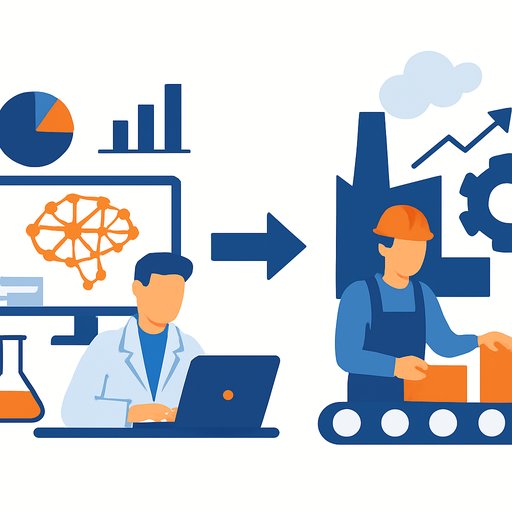
The AI lab and the AI factory
You can't optimize the same workflow for learning and reliability at the same time. Split them.
- AI lab - Is this worth learning about?
- Purpose: exploration, discovery, sense-making.
- Traits: messy outputs, high human touch, fast iteration.
- Measure: learning velocity, patterns found, risks surfaced early.
- AI factory - Can this be trusted at scale?
- Purpose: reliability, throughput, value realization.
- Traits: tighter standards, explicit governance, monitoring.
- Measure: uptime, cost-to-serve, repeatability, business KPIs.
When the two blur, failure follows. Production rules kill lab speed. Experimental behavior inside the factory kills trust. Separation creates a safe, deliberate path from idea to impact.
The base-builder-beneficiary model
To keep AI work grounded, define what enables it, what multiplies it and where value shows up.
Base: what must exist first
- Modular, reusable content architectures.
- Data with clear definitions at the right granularity.
- Explicit brand, legal and policy guidance.
- Stable platforms and integration paths.
- Context graphs that encode decision logic.
When the base is weak, AI looks confident but acts inconsistently. You'll debug "AI problems" that are actually content, data or governance problems.
Builder: where leverage is created
- Automation, workflows and agents (drafting, routing, validation, assembly).
- Builders multiply whatever the base allows-strong base yields compounding gains.
- Without scope discipline, builders sprawl and break under scale.
Beneficiary: where value appears
- Faster launches, lower cost-to-serve, higher throughput and incremental revenue.
- Many teams start here and get disappointed. Sequence matters: base enables builders; builders scale beneficiaries.
- The loop repeats as platforms evolve, data improves and expectations rise.
The human-AI responsibility matrix
Autonomy isn't the goal. Fit is. Match responsibility to capability, visibility and risk tolerance.
- Assist
- Human: thinks, decides and acts.
- AI: drafts, suggests, analyzes steps.
- Use: early exploration, high ambiguity.
- Risk: under-use and slow learning.
- Collaborate
- Human: decides and owns outcomes.
- AI: recommends and executes with approval.
- Use: pattern discovery, repeatable tasks with judgment.
- Risk: decision friction and review bottlenecks.
- Delegate
- Human: sets guardrails and policies.
- AI: executes independently within bounds.
- Use: stable workflows, predictable variance.
- Risk: over-reach and silent errors.
- Automate
- Human: monitors outcomes and exceptions.
- AI: decides and acts end-to-end.
- Use: proven, low-variance systems at scale.
- Risk: trust collapse if failures occur.
How the frameworks work together
Think of this as a single operating matrix.
- In the lab
- Base: emerging and documented as it forms (lightweight tagging, prompt libraries, early retrieval).
- Builder: prototyped and human-supervised (single agent, manual handoffs).
- Beneficiary: hypothesized only (directional estimates and anecdotes).
- Responsibility: Assist → Collaborate. High human touch.
- Signals: learning speed and early failure detection. High tolerance for mess.
- In the factory
- Base: hardened and governed (managed context layers, versioned knowledge stores).
- Builder: orchestrated and monitored (multi-agent workflows, retries, fallbacks).
- Beneficiary: realized and measured (defined KPIs, throughput and cost tracking).
- Responsibility: Delegate → Automate. Human oversight on exceptions.
- Signals: uptime, cost-to-serve reduction, repeatability. Low variance.
One principle stays true: business value lands in the factory. Labs surface potential; factories deliver outcomes. Your job is to create a clean path between them.
Turn frameworks into operating decisions
1) Deliberately separate learning from delivery
- Declare lab work explicitly. Define what will and will not be measured yet.
- Set a time-box and learning goals: hypotheses to test, patterns to confirm, risks to surface.
- Document prompts, context, and edge cases as you go. Make learning portable.
2) Make the promotion gate visible
- Base readiness: data definitions locked, reusable content modules in place, policy guidance codified.
- Builder readiness: workflow stable in dry runs, exception paths defined, monitoring plan drafted.
- Evidence: repeatable results across samples, error rates within agreed bounds, clear beneficiary KPI mapping.
3) Invest in foundations before demanding leverage
- Fund documentation, context graphs and integration work first.
- Then scale orchestration, multi-agent workflows and automation once the base holds.
- Audit foundations quarterly; treat regressions as production incidents, not "tech debt later."
4) Sell outcomes at the right level
- Lab stage: sell learning speed, pattern discovery and risk reduction.
- Factory stage: sell throughput, reliability and business performance.
- Translate both up the chain. Protect early exploration while setting expectations for when hard returns arrive.
Practical checklists you can use this week
Lab readiness checklist
- Clear owner, 2-3 hypotheses, 2-3 weeks.
- Source-of-truth dataset and sample library.
- Prompt repo, context notes and decision logs.
- Exit criteria: pattern repeatability, error bounds, stakeholder sign-off.
Factory readiness checklist
- Versioned knowledge store and managed context layer.
- Workflow orchestration with retries, fallbacks and escalations.
- Monitoring: latency, failure modes, bias and drift alerts.
- Runbook: incident thresholds, rollback steps and on-call rotation.
Example KPIs by mode
- Lab: hypotheses tested per sprint, time-to-learning, defect types discovered.
- Factory: cycle time per output, exception rate, cost per unit, SLA adherence, revenue lift where applicable.
Governance that scales trust
- Adopt a lightweight risk framework in the lab; a formal one in the factory.
- Map responsibility mode (Assist → Automate) to review depth and audit frequency.
- For structured guidance, review the NIST AI Risk Management Framework here.
Org design moves that prevent the usual stall
- Single intake, dual tracks: one backlog with lab or factory tags to prevent shadow work.
- Promotion board: cross-functional leaders decide when lab work graduates and what gets funded.
- Shared libraries: prompts, templates, context packs and evaluation sets live in one place.
- Exception councils: quick, weekly reviews of errors and drifts to preserve trust.
The takeaway
AI changes how marketing gets built, not just how it's delivered. Create safe spaces to learn, clear paths to scale and the discipline to turn experiments into systems. Do that, and the question "what will this drive?" gets a concrete answer your CFO and your team can both stand behind.
If you want structured training for teams adopting these models, explore the AI Certification for Marketing Specialists here. For role-focused learning, consider the AI Learning Path for Business Unit Managers or the AI Learning Path for Project Managers.
Your membership also unlocks: