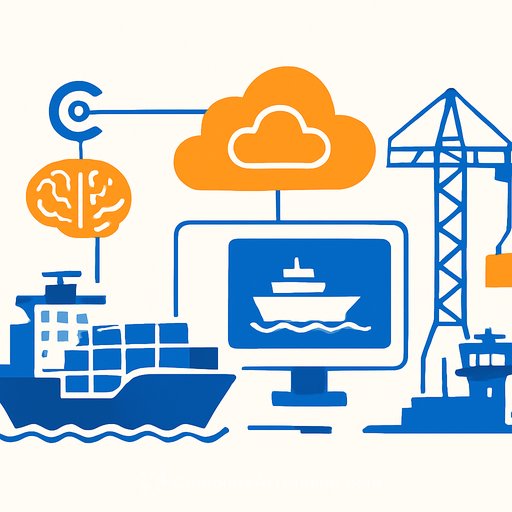
From AI + Ship to Ship-Shore-Cloud: BOTIX's Dual-Drive Strategy for Maritime Autonomy
Date: 12/24/2025
Autonomous operation is moving from concept to deployment across shipping. For product teams, the question isn't "if," it's "what goes first" and "how do we scale without breaking safety or budgets." BOTIX INC is executing a clear plan: start with assistive tech for ocean-going vessels, push supervised autonomy on inland waterways, and bind it all with a ship-shore-cloud architecture.
Why this market window is open
Ships are still early in intelligence while automotive AI has matured at scale. The talent and practices from integrated vehicle-road-cloud systems translate well to maritime, with new work required for hydrodynamics, longer response cycles, and harsher perception conditions. BOTIX's CTO, Huang Liming, brings two decades of land-based autonomous systems experience to accelerate that transfer.
Two product tracks, one platform
Ocean-going: Assisted Navigation. BOTIX launched "Lookout Guard" (瞭望宝), a multimodal perception product aligned with the International Maritime Organization's MASS framework. It assists lookout and issues collision-risk alerts, with a roadmap into shipping data fusion, decision support, and route optimization for broader operational coverage. See the IMO's work on MASS for context: IMO MASS.
Inland waterways: Autonomous Navigation. BOTIX's autonomous navigation system passed principle review and prototype validation by the China Classification Society (CCS) for full-voyage autonomous navigation (Nn) and autonomous operation vessel (A1), now moving toward type certification. It runs supervised autonomy (L3) on single vessels, cutting crews from 2-3 to one and improving energy efficiency by at least 5%. The roadmap advances to L4 with a cloud control center, remote takeover cockpit, and mixed convoy operations where a lead L3 ship guides following unmanned units for ~80% crew reduction and ~10% fleet energy savings via wake effects. Learn more about CCS here: China Classification Society.
Teams focused on communications, convoy coordination, and distributed control can align skills and tooling with maritime networking challenges via the AI Learning Path for Network Engineers.
Architecture: ship-shore-cloud from day one
- Onboard intelligence: Multisensor fusion, decision, and control tuned to maritime dynamics (propeller-rudder coupling, current and wind effects).
- Shore operations: Centralized dispatch, fleet scheduling, and anomaly handling with remote-control capability.
- Cloud services: Data management, training pipelines, HIL simulation, high-precision mapping, and continuous deployment.
- Human-in-the-loop: Supervision mode now; remote takeover for edge cases as autonomy levels increase.
Teams building these ship-shore-cloud stacks can follow the AI Learning Path for Systems Administrators to align infrastructure, cloud management, and continuous deployment practices with maritime requirements.
Five technical pillars that matter
- End-to-end ship-shore-cloud architecture: Works across vessel classes and scenarios; designed for incremental capability rollout.
- Multimodal perception large model: Feature-level fusion across heterogeneous sensors in BEV space for all-weather, all-scenario operation.
- 4D millimeter-wave radar: Long-range, high-resolution sensing with surface detection beyond 1000 m to reinforce perception in low-visibility conditions.
- Decision + path planning: Multi-target planning for complex waterways, backed by a safe, redundant drive-by-wire layer to handle precision control and diverse vessel interfaces.
- Toolchain for iteration speed: Data closed-loop, high-precision mapping, and HIL simulation to shorten cycles from field data to deployment.
Safety stack built for industrial operations
- Sensor redundancy: 360° coverage with cameras and LiDAR, plus thermal IR and in-house 4D radar for harsh weather and night scenes.
- Resilient positioning: RTK-integrated navigation fused with visual semantic positioning for stability when GNSS degrades.
- Drive-by-wire safety: Dual-PLC hot backup and redundant ring network communication to avoid single-point failures.
- End-to-end fault management: From hull systems to autonomy stack, with graded responses aligned to incident severity.
Commercial impact you can budget
- L3 inland deployments: On BOTIX's "Jingzhe," crew reduction to one saves ~RMB 250,000/year in labor. Add energy savings and higher trip frequency: ~RMB 300,000/year total reduction per vessel.
- Convoy ops (next phase): Projected RMB 300,000-500,000/year savings per vessel through crew and energy efficiencies.
- Market reach: Dual-market strategy (domestic + overseas) with European pilots planned for H2 next year. Higher seafarer costs in Europe and the U.S. increase ROI on crew reduction and decision assistance.
- Supply chain leverage: Core tech sourced from China's mature intelligent driving ecosystem for cost and delivery advantages.
Product development notes: building and scaling
- Start with assist: Deploy lookout and collision warning to de-risk integration, collect data, and harden edge cases.
- Design for upgrade paths: Keep interfaces and safety cases ready for the jump from L2/L3 assist to L3 autonomous and then L4 with shore-side control; embed HMI and human-in-the-loop considerations early in product workstreams.
- Cert-first mindset: Align specs early with CCS and IMO MASS classes; bake validation protocols and logs into the software lifecycle.
- Data operations as a product: Build your closed-loop: annotation, simulation coverage, regression gates, and on-ship A/B toggles for safe rollouts.
- Change management: Train crews on HMI, alert semantics, and takeover procedures; measure human factors as seriously as latency and accuracy.
- KPIs to track: Near-miss reduction, CPA/TCPA accuracy, false alert rate, fuel per ton-km, crew hours per voyage, and time-to-takeover in abnormal events.
What BOTIX is building toward
The trajectory is clear: move from single-ship intelligence to coordinated fleets, from manual operations to centralized command, while raising autonomy levels with a human-in-the-loop safety net. BOTIX's integrated ship-shore-cloud approach sets the stage for standardized, scalable deployment across vessel classes and routes.
If your team is leveling up AI skills for product planning, roadmaps, or deployment playbooks, explore role-based programs here: AI courses by job.
Your membership also unlocks: