AI + Mathematical and Physical Sciences: What's Next and What to Do About It
Curiosity-driven science has a track record of sparking big shifts. Quantum mechanics began as a question about atoms and ended up giving us the transistor. Practical breakthroughs also mature through theory; the steam engine only hit its stride after thermodynamics caught up. AI and the mathematical and physical sciences (MPS) now sit at a similar point.
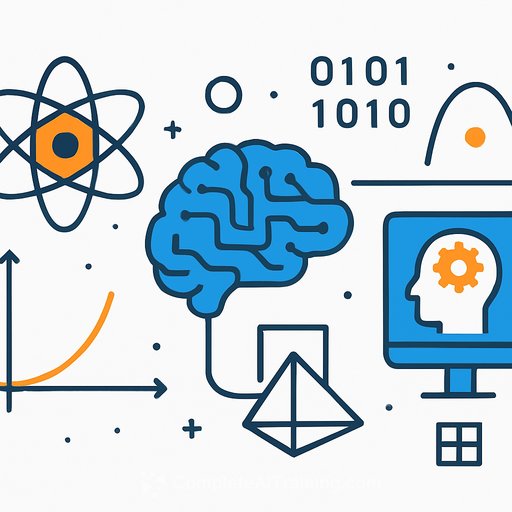
Decades of work in physics, chemistry, materials, astronomy, and mathematics fed the rise of modern AI. Datasets, theory, and hard problems from these fields trained both our models and our thinking. A recent workshop explored how MPS can push AI forward-and how AI can, in turn, accelerate discovery in MPS.
Inside the MIT Workshop on AI + MPS
In 2025, a National Science Foundation-funded workshop at MIT convened leaders across astronomy, chemistry, materials science, mathematics, and physics. The goal: define where AI can deliver real value for MPS-and where MPS can deepen our grasp of AI itself. The resulting white paper appears in Machine Learning: Science and Technology.
A clear takeaway emerged: coordinated investment in compute and data infrastructure, cross-disciplinary research, and rigorous training will move the needle. And it has to run both ways-using AI to do better science, and using science to make AI better.
The "Science of AI" Has Three Parts
Researchers emphasized a simple but powerful frame: treat AI as an object of scientific study. That means building theories, tools, and experiments that explain how AI systems behave-and using those insights to design better methods.
- Science driving AI: Use scientific reasoning (symmetries, conservation laws, constraints) to inform architectures, loss functions, and training protocols.
- Science inspiring AI: Let hard scientific problems push new algorithms-e.g., data scarcity, multi-scale phenomena, uncertainty quantification, and real-time decision-making.
- Science explaining AI: Apply analysis, diagnostics, and interpretability tools from MPS to uncover principles and emergent behaviors in neural networks.
Why This Matters for Your Lab
Particle physics offers a concrete example: real-time AI is being developed to sift collider data streams without missing rare signals. The models serve discovery, but the methods-low-latency inference, compression, calibration, uncertainty estimates-translate to other domains. That cross-pollination is the point: build once, apply broadly.
If you lead a group in MPS, treat AI as shared infrastructure and a scientific frontier. Your advantage won't come from one-off models but from reusable pipelines, principled methods, and people who can speak both languages.
What Funders and Institutions Should Prioritize
- Shared compute and data backbones: Institution-level GPU/accelerator clusters, curated datasets with provenance, and secure pathways for sensitive data.
- Cross-appointments and team grants: Incentivize collaborations that pair domain scientists with method developers and research software engineers.
- Programs for the "science of AI": Fund theory, interpretability, benchmarking, and reliability studies-not just applications.
- Open benchmarks and testbeds: Domain-grounded tasks with clear metrics, stress tests, and uncertainty targets to make progress measurable.
- Training at scale: Fellowships, summer schools, and hands-on residencies embedded in active MPS projects.
Actionable Steps for Research Teams
- Audit your workflow: Map where data moves, where decisions slow down, and where uncertainty blocks conclusions. Those are your AI insertion points.
- Standardize data early: Agree on formats, metadata, and versioning. Good data beats bigger models.
- Start with principled baselines: Physics-informed or constraint-respecting models often outperform brute force-and are easier to trust.
- Plan for uncertainty: Adopt calibration and error bars from day one. If you can't quantify it, you can't publish it-or rely on it.
- Build real-time capability where needed: For instruments and large facilities, low-latency inference and on-the-fly quality control pay off fast.
- Invest in people: Pair a domain expert with an ML engineer and a research software engineer. This trio ships results.
Training and Capacity Building
If your team is ramping up, start with structured learning paths and project-based practice. Two resources worth bookmarking:
Bottom Line
The message from the workshop is direct: treat AI and MPS as a feedback loop. Build shared infrastructure, pursue cross-disciplinary research, and study AI with the same rigor you bring to nature. Do that, and you accelerate discovery-and make AI itself more reliable, efficient, and explainable.
Your membership also unlocks: