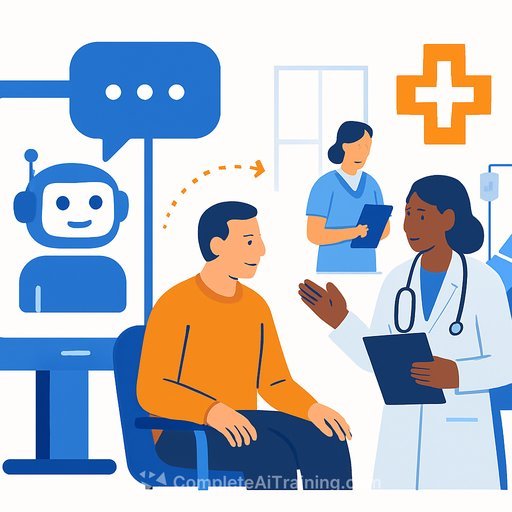
AI Is Moving From Back-Office To Bedside
Health systems are done thinking of AI as a back-office helper. The next push is clinical: decision support, triage, imaging, and care coordination that shorten time to the right diagnosis.
The opportunity is real, but results hinge on workflow fit, validation, and trust. Here's a practical playbook to move fast without creating risk.
Where AI Helps Today
- Operations: prior auth drafting, coding suggestions, denials prevention, capacity and staffing forecasts, supply reorders, and scheduling optimization.
- Clinical support: image triage and prioritization, sepsis and deterioration alerts, risk scoring, ambient scribing, discharge summary drafts, and differential support for complex cases.
Guardrails Before You Scale
- Data and privacy: tight PHI access, audit trails, BAA in place, clear data retention and deletion policies.
- Validation: silent-mode trials, prospective evaluation, calibration checks, fairness testing, and clear off-ramps to human review.
- Regulatory awareness: confirm whether a tool qualifies as SaMD and track FDA status and update plans. See the FDA's overview of AI/ML-enabled devices here.
- Safety: document failure modes, alert thresholds, escalation paths, and who is accountable at each step.
Metrics That Matter
- Operational ROI: minutes saved per task, days in A/R, denials rate, cost per claim, show rate, bed turnover.
- Clinical quality: sensitivity/specificity, PPV/NPV, time-to-diagnosis, time-to-treatment, readmissions, alarm fatigue rate.
- Adoption and trust: utilization by role, override rate, time-in-workflow, and clinician-reported usefulness.
Workflow First, Model Second
AI outputs belong at the decision point, inside the EHR, not in another dashboard. One extra click can kill adoption.
Give short, explainable summaries with links to evidence. Make it easy to accept, edit, or dismiss-and capture feedback for retraining.
Implementation Playbook
- Pick one high-friction use case: clear owner, measurable outcome, and a 90-day runway.
- Build a cross-functional team: clinical lead, data science, IT/EHR, compliance, operations.
- Prep the data: clear definitions, guardrails for PHI, baselines set before go-live.
- Pilot in silent mode: compare AI vs. current process, adjust thresholds, check bias across subgroups.
- Go live with controls: gradual rollout, daily checks, near-real-time monitoring.
- Review monthly: share wins, fix drift, expand only after targets are met.
Procurement Checklist
- External validation and peer-reviewed evidence where possible.
- Real-world performance on your population, not just vendor demos.
- Model update cadence, change logs, rollback plan.
- Clear data-use terms, IP ownership of derivatives, and exit plan.
- On-prem vs. cloud posture, encryption, and incident response.
Training Your Teams
- Clinicians: how to read AI outputs, limits of predictions, and when to escalate.
- Staff: prompt quality for drafting tasks, PHI hygiene, and documentation etiquette.
If you need structured upskilling for clinical and operational roles, explore role-based programs at Complete AI Training.
Equity, Bias, and Responsibility
Bias hides in skewed data, missing labels, and shortcut features. Test performance across age, sex, race, language, and payer segments.
Keep clinical judgment in charge. Document who reviews, who signs off, and how disagreements are handled.
For ethics guidance specific to health, see the WHO's recommendations here.
Quick Wins You Can Land In 90 Days
- Operations: auto-draft prior auth letters, optimize clinic templates, reduce coding backlogs, and route claims at risk for denial.
- Clinical support: radiology worklist prioritization, ambient scribe for clinics, discharge instruction drafts, and early-warning scores with clear escalation.
Bottom line: AI has moved from back-office tasks to clinical decision support. Start narrow, validate hard, ship into workflows, and measure everything. That's how you get real outcomes without adding risk.
Your membership also unlocks: