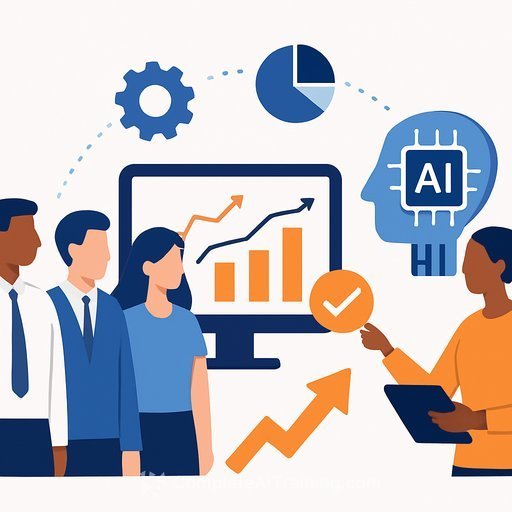
Data Leadership in HCM and BPO: Driving Transformation with Analytics and AI
HR is no longer a back-office cost. With AI and analytics, HCM and HR outsourcing can steer workforce strategy, not just process transactions. By 2027, two-thirds of companies will expect HCM platforms to include AI capabilities. That puts data leaders at the center of value creation across HR operations, talent, and employee experience; see AI for Executives & Strategy for guidance on aligning AI initiatives with business priorities.
The mandate is simple: turn workforce data into decisions that reduce turnover, lift hiring quality, and boost service performance. That requires a clear data strategy, outcome-focused products, and strict oversight of privacy and AI ethics.
Data and AI in action: Use cases that move the needle
AI and analytics already power core HR and BPO workflows. The wins come from pairing clean, standardized data with targeted automation and predictive models.
- Engagement and retention: Spot at-risk segments months before turnover spikes. Trigger timely interventions-career pathways, manager coaching, or flexible benefits-based on signals from surveys, usage data, and collaboration tools.
- Recruiting and talent acquisition: Use AI to screen at scale, generate role-specific interview questions, and match candidates to job requirements. Done well, this shortens time-to-fill and improves quality-of-hire while reducing bias.
- Learning and development: Map skills to business needs and offer personalized learning paths. Recommend courses, mentors, and on-the-job projects that close measurable gaps.
- Operational efficiency: Automate high-volume questions on payroll, benefits, and policy with AI assistants. Track error rates and response times on shared dashboards, then iterate on processes with the data.
The difference-maker: build data products around business outcomes, not reports. Agree on KPIs with CHROs and BPO clients upfront-then ship analytics that directly influence those numbers.
What top data leaders prioritize
- Security and governance: Employee data is sensitive. Set strict access controls, consent management, and audit trails from day one. Trust is an asset-protect it.
- Analytics products, not projects: Create reusable assets: people-analytics dashboards, benchmark reports, and AI assistants for HR. Build once, scale often.
- Ethical AI oversight: Formalize model reviews for fairness, explainability, and performance drift. Validate screening and matching models, document decisions, and establish an ethics review cadence.
Platform strategy matters too. Organizations increasingly want modular HCM suites that integrate third-party AI and custom analytics, as noted in ISG research. Flexibility beats lock-in.
Operational playbook (next 90 days)
- Align with business goals: Tie each analytics initiative to a clear target-lower absenteeism, lift engagement in key roles, or improve candidate quality.
- Build cross-functional squads: Pair HR experts with data scientists, ML engineers, and architects. Ship small, usable features every sprint.
- Raise data literacy: Train HR teams to read dashboards, question models, and act on insights. A good model is wasted if managers don't trust it. If you need a practical starting point, explore role-based upskilling with the AI Learning Path for Training & Development Managers.
- Adopt configurable platforms: Standardize data models, expose APIs, and enable plug-ins for AI modules. Future needs will change-your stack should flex with them.
- Launch a starter data product: Pick one high-impact use case (e.g., attrition early warning). Define the KPI, deploy the model, and integrate the workflow trigger (manager outreach, review scheduling, or a learning nudge).
Scorecard: metrics that prove impact
- Voluntary attrition trend vs. predicted risk by segment
- Time-to-fill and quality-of-hire proxy (performance or retention at 6-12 months)
- Employee engagement movement after targeted interventions
- Service quality: error rates, first-response time, and case resolution time
- AI quality: model drift, explainability coverage, and fairness checks across relevant demographics
What's next
Expect deeper AI integration across HCM suites: scenario-based workforce forecasting, large-language-model assistants for manager coaching and policy Q&A, and richer employee experience analytics. Vendors are racing to provide transparent AI with clear explanations and bias detection built in.
The operating model is shifting to modular ecosystems. Companies want to plug in new AI services fast, not wait for monolithic releases. Leading BPO providers are becoming co-innovators-using shared data, benchmarks, and agile delivery to shape workforce strategy with clients.
Executive takeaway
Data-centric leadership in HCM and HR outsourcing is now a competitive advantage. The play is straightforward: invest in capable CDO/AI leadership, set outcome-driven roadmaps, enforce strong governance, and train managers to act on insights-complementary guidance is available in the AI Learning Path for CIOs. Teams that do this gain clearer visibility into their workforce, better hiring, and higher engagement-without adding complexity.
Start with one measurable win. Then scale what works.
Your membership also unlocks: