How AI & Cloud Are Reshaping Federal Healthcare-From Battlefield Care to Biomedical Research
AI and cloud are no longer side projects in government. A July Government Accountability Office review found AI use across 11 federal agencies grew from 571 to 1,110 instances between 2023 and 2024, with generative AI jumping from 32 to 282 use cases in the same period. Cloud spend is tracking the same curve: federal civilian agencies invested $8.3 billion in cloud in FY25, up from $4.4 billion in 2020.
For healthcare leaders, this isn't theory. It's the operating environment you're in. The question is how to turn these tools into fewer bottlenecks, faster decisions, and better care.
How Can Cloud and AI Improve Organizational Efficiency?
The Department of Veterans Affairs and Oracle are modernizing VA's electronic health record to enable a secure, interoperable system across federal and commercial partners. The goal: reduce duplication, cut chart-chasing, and make handoffs cleaner across settings.
At the Centers for Medicare & Medicaid Services, General Dynamics Information Technology is deploying AI and automation for benefits coordination, digital imaging, secondary payer assessment and debt workflows in the Benefits Coordination & Recovery Center. Less swivel-chair work means more time for judgment where it matters.
Inside the FDA, Martin Makary highlighted how AI can speed up review work for scientific staff. "The agency-wide deployment of these capabilities holds tremendous promise in accelerating the review time for new therapies… The opportunity to reduce tasks that once took days to just minutes is too important to delay."
How Does Advanced Tech Improve American Healthcare Outcomes?
AI's strength is pattern recognition at scale. Jim O'Neill, deputy secretary at HHS, said in September that ChatGPT can "promote rigorous science, radical transparency and robust good health." He added that ChatGPT has received an authority to operate (ATO), and that OpenAI has achieved FISMA moderate level-signals that federal use is moving from pilots to production.
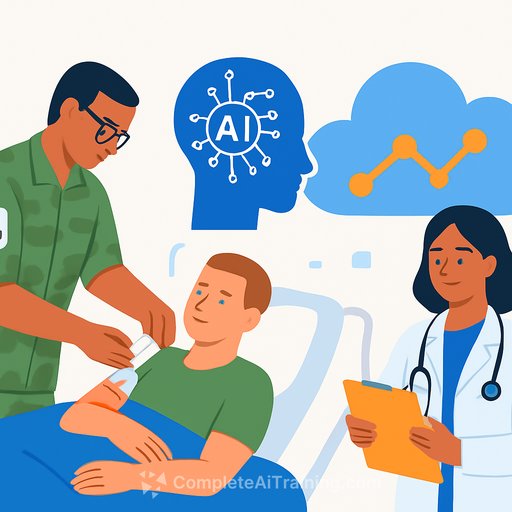
The Defense Health Agency is pushing AI into the Military Health System to support frontline care. Stephen Ferrera, acting assistant secretary for health affairs at the Department of Defense, described AI as a force multiplier: "We can have specialists… be able to, in real time, help guide people that are on the ground at the front line."
Think real-time monitoring that flags deterioration, triage support fed by battlefield sensors, and on-demand specialty guidance. That's not sci-fi-it's a practical way to extend scarce expertise to the point of injury.
What Are the Roles Cloud and AI Play in Biomedical Research?
Policy is clearing the runway. In November, an executive order established the Genesis Mission to expand AI use in federal R&D, including drug discovery and related breakthroughs. On the ground, NIH continues to move research to the cloud to give scientists scalable compute, storage, and access to large datasets-especially helpful for institutions with limited on-prem capacity.
NIH's Cloud Resources Program is supporting researchers with funding and enablement in current cohorts. For context on NIH cloud initiatives, see the agency's overview here.
Can AI Stop Fraud?
Improper payments are still a major drain: CMS reported $31.7 billion in improper payments in Medicare Fee-for-Service and $31.1 billion in Medicaid for FY24. The One Big Beautiful Bill, signed in July, sets aside $25 million for HHS to develop AI tools to prevent and recover improper Medicare payments.
CMS also launched the Crushing Fraud Chili Cook-Off Competition to crowdsource data-driven methods for spotting anomalies and patterns that indicate fraud. The strategy is simple: pair modern analytics with policy and enforcement to move faster than fraud schemes evolve.
What Healthcare Leaders Can Do Next
- Stand up a cross-functional AI council (clinical, operations, security, privacy, acquisition) to set guardrails and prioritize use cases that deliver measurable outcomes in 90-180 days.
- Focus your first wave on high-friction workflows: prior auth triage, imaging worklists, discharge summaries, appeals routing, debt determination, and benefits coordination.
- Treat data as a product. Define ownership, quality checks, lineage, and PHI handling across your cloud estate. Strong inputs beat fancy models.
- Build for compliance from day one: ATO processes, audit trails, model versioning, prompt and output logging, and bias monitoring. If it can't pass an audit, it won't last.
- Use MLOps and human-in-the-loop review to keep models current and safe. Publish clinical governance rules for decision support (advice vs. automation).
- Control cloud costs with clear tagging, reserved capacity where appropriate, and automated shutdowns for idle resources. Clinical savings can disappear in unmanaged compute.
- Prepare your workforce. Provide hands-on training and role-based playbooks for clinicians, coders, and analysts. A practical place to start is curated, job-specific AI courses like these.
Why This Matters Now
Adoption is accelerating across agencies, per the GAO's findings on AI usage growth. You can review their public analysis here. The takeaway: systems, funding, and policy are aligning. Healthcare leaders who execute now will set the standards others follow.
See It in Action
The Potomac Officers Club will feature a panel on cloud and AI in healthcare at the 2025 Healthcare Summit on Feb. 12 (rescheduled from the fall). You'll hear perspectives from across government and industry-including a discussion on integrating cloud and AI into public health services. Secure your tickets today.
Your membership also unlocks: