Unlocking AI's Real Value In Manufacturing Operations
AI is now central to smart manufacturing, yet many teams still deploy it without a clear outcome. That gap between interest and impact is growing: 75% of firms still run on legacy tech, even though 76% say they want modern tools. The message for operations leaders is simple - clarity beats complexity, and execution beats theory.
Supply chains face tariff shocks, demand swings, and tight margins. Legacy systems can't keep pace. AI can, but only if it's used to solve real problems in your plant, not as a side project.
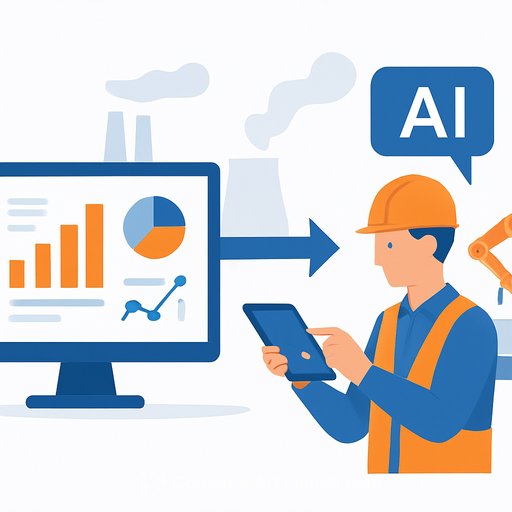
From BI To AI: Move From Hindsight To Foresight
Your ERP already holds the story of your business. Traditional BI tells you what happened and why. Useful, but reactive. You're still steering by the rear-view mirror.
AI shifts you to predictive and prescriptive decisions. Forecast sales from hidden patterns across order history. See likely margin by product mix before you quote. Get recommendations on where new equipment, a supplier change, or a scheduling tweak will drive the biggest lift. Data stops being a reference point and starts directing action.
Operationalising AI: Practical Use Cases That Pay Off
Automate BOM creation. AI can read drawings, images, and charts to identify parts, counts, and descriptions, then produce a digital BOM. Your team reviews and adjusts. The result: fewer errors, cleaner inventory, and faster handoffs into estimating and production.
Tighten RFQ throughput. Let AI scan RFQs to check requirements, flag gaps, draft responses, and assemble final contracts. You cut cycle time and reduce misses on addresses, specs, and delivery dates.
Make unstructured data usable. PDFs, emails, CAD notes, and shop-floor docs often sit outside ERP/MRP. AI extracts what matters and pipes it into your workflows. That means better scheduling, smarter purchasing, and fewer "where did that detail go?" moments.
Keep humans in control. Let AI do the heavy lifting on extraction, matching, and first-draft suggestions. Your people validate, make the call, and move the work forward with more confidence.
Set The Aim First: What Do You Want AI To Achieve?
Pick a business outcome, not a tool. Reduce RFQ cycle time by 30%. Improve BOM accuracy to 98%+. Cut changeover delays by 15%. Forecast monthly demand within 8% MAPE. With a clear aim, your data needs, workflows, and guardrails become obvious.
Then start small. Prove one use case end-to-end. Integrate it into daily work. Measure it. Roll out to the next line, plant, or product family once it works under real conditions.
A Simple 90-Day Plan For Operations Leaders
- Weeks 1-2: Choose one use case tied to a P&L lever (BOM creation, RFQ processing, or demand forecasting). Define the metric and the baseline.
- Weeks 2-3: Map the workflow inside your ERP/MRP. Identify data sources (drawings, PDFs, emails, spreadsheets). Decide review and approval steps.
- Weeks 3-6: Pilot with a small team. Automate extraction and first-draft outputs. Keep humans as final approvers.
- Weeks 6-8: Integrate with ERP fields and approvals. Log exceptions and reasons to improve the model and the process.
- Weeks 8-12: Expand volume. Compare KPI lift to baseline. Document standard work. Train the next cell or site.
Data, People, And Governance
Data readiness: Clean master data, standardise part naming, and control versions for drawings and BOMs. Bad inputs destroy ROI more than model choice ever will.
People: Explain the goal, the workflow changes, and how decisions will be made. Show the team what AI will do and what it won't. Adoption accelerates when operators see fewer reworks and faster approvals.
Governance: Keep audit trails, permissions, and human-in-the-loop checks. Use a simple risk checklist for model use, bias, and vendor data handling. If you need a reference framework, see the NIST AI Risk Management Framework.
Metrics That Prove Value
- BOM first-pass accuracy
- RFQ turnaround time and win rate
- Schedule adherence and changeover delays
- Inventory turns and stockout frequency
- On-time-in-full (OTIF)
- Forecast accuracy (MAPE) by product family
- Rework rate and scrap cost
Choosing Where To Start
Pick the process that creates the most friction for your team and customers. High-volume RFQs with repeat patterns. BOM creation for complex assemblies. Demand forecasting for long-lead items. The best starting point is the one you can measure and improve within a quarter.
If you need practical upskilling for operators, planners, and managers, browse role-focused learning paths: AI Learning Path for Plant Managers, AI Learning Path for Production Planners, and AI Learning Path for Process Engineers.
The Bottom Line
AI's value in manufacturing isn't magic. It's the compound effect of fewer errors, faster cycles, and better bets made earlier. Set the aim, wire it into daily work, measure the lift, and scale what proves out.
That's how operations teams move from reporting on yesterday to making tomorrow's numbers more predictable. If you want support programs and adoption playbooks, the UK's Made Smarter initiative is a useful resource for manufacturers.
Your membership also unlocks: