Kolmogorov-Arnold networks bring interpretability to AI-driven science
AI has delivered in weather prediction and protein folding. But for curiosity-driven research, where the goal is to expose mechanisms, most models operate like sealed boxes. Kolmogorov-Arnold networks (KANs) offer a way forward by making learned structure legible.
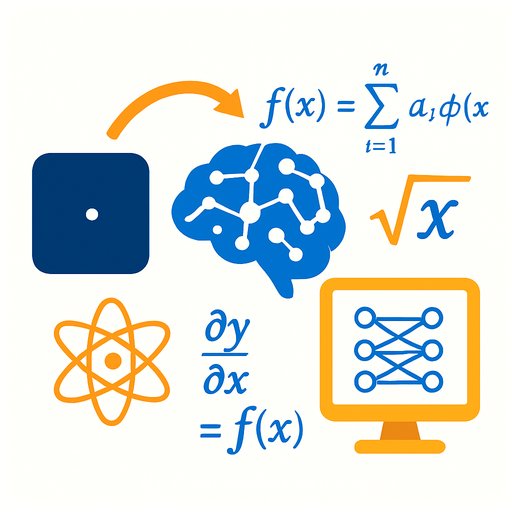
The idea is simple and practical: decompose high-dimensional functions into collections of one-dimensional functions, then fit those 1D pieces with splines you can inspect, swap, or compile. The result is a model that learns from data yet stays close to symbolic form-useful when you're trying to state a law, not just score a prediction.
The black box problem
Application-driven systems can hit impressive benchmarks without exposing the physics inside. AlphaFold is the common example: outstanding structures, limited mechanistic takeaways about atomic forces. Useful for engineering, thin for theory-building.
Curiosity-driven work needs models that expose what was learned and how. That's the gap KANs aim to fill.
What makes KANs different
KANs represent multivariate relations as compositions of learnable univariate functions. Those 1D functions can be symbolically regressed, inspected, or compiled back into code. This keeps the hypothesis space flexible while giving you handles to interpret the result.
The study extends the base architecture with multiplication nodes (MultKANs) and tooling that matters for scientists: a "kanpiler" to compile symbolic formulas into KANs, and a tree converter that visualizes the network as modular trees. That lets you embed priors up front and extract formulas afterward-two directions many models don't support.
Evidence from classic physics
On benchmark problems-conservation of energy and momentum, the Lagrangian of a simple pendulum, relativistic mass, hidden symmetry in a nonrotating black hole, and the stress-strain law for a neo-Hookean solid-KANs recovered the correct physical laws with high accuracy. In several cases, the fits reached extreme precision.
That's the key point: the model didn't just forecast the right values. It surfaced human-readable structure consistent with known theory.
Practical workflow for researchers
- Start small. Frame a compact system with well-defined variables and units. Keep the network scale modest to preserve interpretability.
- Embed domain knowledge. Use MultKAN nodes to express products and invariants you expect to matter. Seed known relations with the kanpiler.
- Train on high-quality data. Track the learned 1D functions directly, not just loss. Sanity-check with dimensional analysis and known limits.
- Audit structure. Use the tree converter to visualize modules; prune or refactor components that don't map to sensible physics.
- Validate like you would a theory. Test conservation laws, symmetry behavior, and out-of-sample regimes. Compare against a plain MLP to quantify the interpretability gain, not just error.
- Extract symbols. Run symbolic regression on the 1D splines and document the final formulas with uncertainty bounds.
Scalability limits (read before you scale)
Even if each learned 1D spline is interpretable, the combined behavior can become unwieldy as networks grow. The study notes that KANs tend to stay interpretable at relatively small scales. Plan your experiments accordingly: break problems into modular sub-systems instead of inflating a single model.
Where KANs fit: between explicit code and learned models
Think of KANs as an in-between: closer to "software 1.0" than typical deep nets because you can manipulate the learned pieces, yet still learn from data like "software 2.0." That balance is well-suited to hypothesis generation, mechanistic checks, and translating raw data into equations you can publish.
Resources
Paper venue: Physical Review X. For background on the theory behind function decomposition, see the Kolmogorov-Arnold representation theorem in standard references.
If you're building skills in explainable and scientific AI for R&D teams, you can browse practice-oriented programs here: Complete AI Training - Courses by Job. For focused resources on interpretable and research-oriented methods, see AI Research Courses.
Bottom line: If your research needs equations and insight, not just predictions, KANs are worth a serious look-especially on problems small enough to keep every learned component in view.
Your membership also unlocks: