AI-ready public buildings: from reactive maintenance to self-managing assets
Your local hospital or school can now sense heat, adjust temperature and even schedule maintenance. That isn't a pitch - it's live in the field.
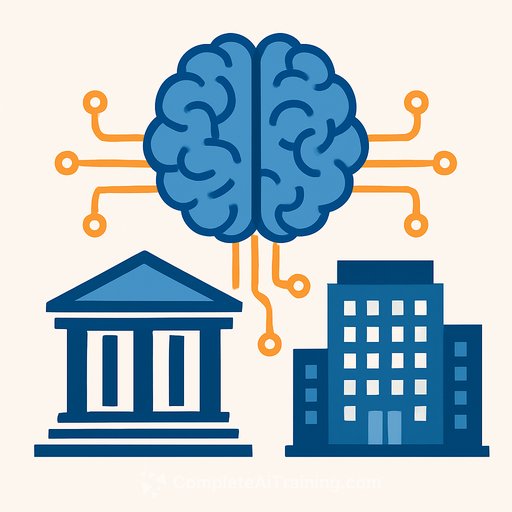
The UK public sector manages more than 300,000 properties worth around £192bn. Prisons, military bases, schools, hospitals. Essential to the country. Expensive to run. Complex to maintain. AI is stepping in to make these assets leaner, cleaner and more resilient.
This isn't just about cutting costs or going green. It's about reimagining the very fabric of the public estate.
From data to decisions: digital twins give buildings a brain
New builds are shipping with digital twins - virtual replicas that mirror their physical counterparts in real time. Sensors feed temperature, humidity, occupancy and energy data into the model - enabling analytics and AI for Operations. The result: a living system that learns.
At Dunfermline Learning Campus, 2,700 students learn in a facility consuming just 45 kWh per square metre a year. That "brain" is already tuning comfort while keeping consumption tight.
What AI actually does, day to day
- Occupancy-led lighting that dims or brightens automatically.
- Self-tuning HVAC that adjusts in real time as weather, usage and air quality change.
- Predictive maintenance that flags faults before they interrupt service.
- Energy anomaly detection that spots waste and drift early.
- Automated reporting to keep estate teams focused on strategy, not chasing alarms.
These systems don't replace human expertise. They amplify it. Your teams move from firefighting to planning.
Smarter from the start: design, build and operate
AI's value runs across the lifecycle. In design, digital twins let you test materials, layouts and energy models before breaking ground. Better choices, fewer change orders.
In operations, the twin becomes the live control room. Need to lift air quality in a busy school? Want to trim energy in an NHS facility without hurting comfort? The data is already there - and the building is learning how to respond.
What's next
Expect buildings that are proactive, not just responsive. A school can drop to a holiday profile automatically. A hospital can adjust airflow minute-by-minute to hold target air quality.
Networks of public buildings will share patterns and learn from each other. One site solves a control issue; the rest benefit in days, not years.
How owners, contractors and FMs can start now
- Define outcomes: energy intensity (kWh/m²), comfort bands, uptime, carbon, compliance. Set targets before tech.
- Audit what you have: BMS capability, meters, sensors, protocols, data access, and maintenance history.
- Instrument the gaps: add reliable meters and IEQ sensors (CO₂, PM2.5, VOCs) where decisions depend on them.
- Pick open standards: BACnet, MQTT, APIs. Avoid lock-in that traps your data.
- Stand up a data layer: a secure data platform that normalises, stores and serves building data to analytics and AI.
- Start with a pilot: one asset, one season, one clear KPI. Prove savings and comfort, then scale.
- Write it into procurement: outcomes-based specs, cybersecurity baselines, digital twin deliverables, and data ownership terms.
- Close the loop: link insights to work orders so fixes actually happen and models keep improving.
- Upskill your team: controls, data literacy and AI-assisted workflows for estate, FM and site managers.
- Track the business case: energy reduction, avoided failures, comfort scores, response time and backlog reduction.
Governance and risk you shouldn't skip
- Data ownership: keep control of raw and derived data across the portfolio.
- Security: segment building networks, enforce MFA, and monitor vendor access.
- Change control: version models, log setpoint changes and keep a clear audit trail.
- Resilience: fail-safes for manual override and safe modes during outages.
Bill Gates predicted AI would take over routine tasks. Buildings are the next logical step. As decarbonisation and budget pressure tighten, AI-driven asset management will shift from pilot to default across the public estate.
The big win is simple: better comfort, lower cost, fewer surprises. Data does the heavy lifting; your people make the high-value calls.
Helpful resources
- UK Government Property Agency - strategy, standards and portfolio guidance.
- Digital Twin Consortium - frameworks and best practices for twins in the built environment.
Upskill your estate and FM teams
If you're moving from BMS-first to data-first operations, structured training shortens the learning curve. Explore role-based options: AI Learning Path for Plant Managers and AI Learning Path for Business Analysts.
The next phase of UK infrastructure won't be built with more bricks - it will be built with better data, better decisions and buildings that think for themselves.
Your membership also unlocks: