AI-Enabled Wargaming at CGSC: Practical Speed, Better Decisions, Zero Friction
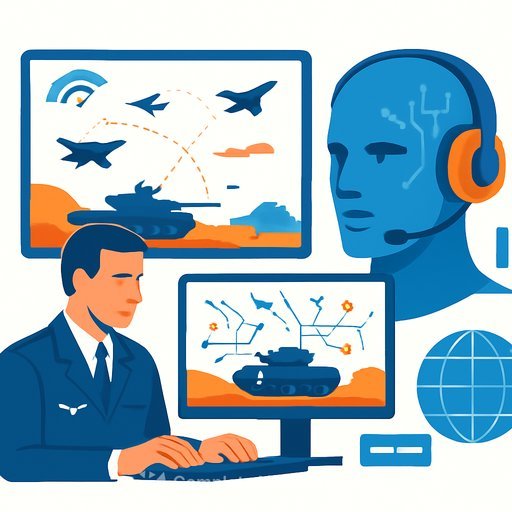
Modernization isn't a headline. It's a requirement. At Fort Leavenworth, a small instructor-student team at the U.S. Army Command and General Staff College built and ran an AI-enabled wargame in a week-at zero cost-and proved what most operations leaders suspect: AI can compress planning time and uncover risks and opportunities that teams miss under normal tempo.
The takeaway is simple. AI is not a side topic for professional military education or operations. It's becoming a baseline skill that shifts how staffs plan, test courses of action, and iterate.
What They Built (Fast)
A five-person team used readily available tools, including Vantage, to create an exercise-specific AI agent trained on doctrine and adversary data. The result was a no-code, repeatable wargame that any staff could run with minimal prep.
- 128,000 data points: Joint Task Force execution, joint publications, enemy battle books, and multi-domain operations tables.
- Prompt playbook: Tested prompts and output templates to drive consistent, usable results.
- Standardized outputs: A synchronization matrix for clear interpretation and reuse.
- Collaboration built-in: A shared environment that supported international partners.
To level-set, students and faculty received two hours of instruction on AI basics: how to prompt, how to guide outputs, and when to override. That kept the exercise focused on the operational problem, not tech setup.
How It Performed in the Exercise
Two staff groups, including international officers, ran a single-day scenario. The AI agent enabled nine full turns-about five times the throughput of a typical dice-based wargame, which averages two turns per day.
Each turn took about 20 minutes, including secondary prompts. Outputs were roughly a page and a half per turn, with visuals, and would have taken hours to replicate manually. That cycle gave students room to test more COAs and explore adjacent outcomes without clogging the schedule.
Cpt. Regina Ebell, a student developer on the team, summed up the approach: "You don't just ask one question and accept the first answer… That iterative process was the 'aha' moment: understanding that AI is a partner you need to guide, not a magic box that you turn loose and trust blindly."
What Changed for Decision Quality
The AI agent surfaced blind spots and highlighted variables that shaped battlefield success-details a human team could miss under time pressure. That led to sharper doctrinal application and more adaptive thinking across the staff.
Maj. Seth Lavenski put it bluntly: graduates are expected to drive modernization. AI is part of that standard. "Our formations expect us to drive modernization, not catch up to it."
Cpt. Tyree Meadows reinforced the human role: "AI is not something you can simply offload thinking to. Leaders must understand how it works, when it's appropriate, how to critique outputs, and how to maintain a human in the loop."
Replicable, Scalable, and Already Spreading
The team emphasized that the exercise is easy to replicate and supports joint warfighter doctrine. The School of Advanced Military Studies has launched a multi-day Practical Application of AI module with similar outcomes.
Maj. Jody Colton is already thinking about integration with the Synthetic Training Environment: "This feels like jumping on a moving train moment. If PME does not incorporate emergent technology, even if it must do it in stride, we will miss the train."
What This Means for Operations Leaders
- Start small, deploy fast: Stand up an AI-enabled wargame with a clear scenario, doctrine pack, and a prompt playbook. Keep it no-code.
- Codify doctrine and data: Load joint pubs, adversary TTPs, and unit SOPs. Map outputs to your staff products to avoid rework. Consider referencing Joint Planning principles in JP 5-0.
- Standardize outputs: Use fixed templates and a synchronization matrix so teams can compare COAs turn by turn.
- Train the loop: Teach iterative prompting, red-teaming, and human override. Make "trust but verify" a habit. For hands-on prompting resources, see Prompt Engineering Guides.
- Timebox the turns: Cap turns at 20 minutes to push tempo. Track decisions per hour as a performance metric.
- Invite partners: Use a collaborative workspace for coalition or interagency input without slowing the exercise.
- Document and reuse: Save prompts, outputs, and insights as a starter kit for the next staff.
Proof and Further Reading
Students and instructors documented the build, methods, and outcomes for PME. Read their article here: AI-Enabled Wargaming at CGSC.
Build Skills Your Team Can Apply This Quarter
If your team needs structured, practical upskilling-prompting, staff workflows, automation, and COA testing-explore role-based options at Complete AI Training: Courses by Job.
Your membership also unlocks: