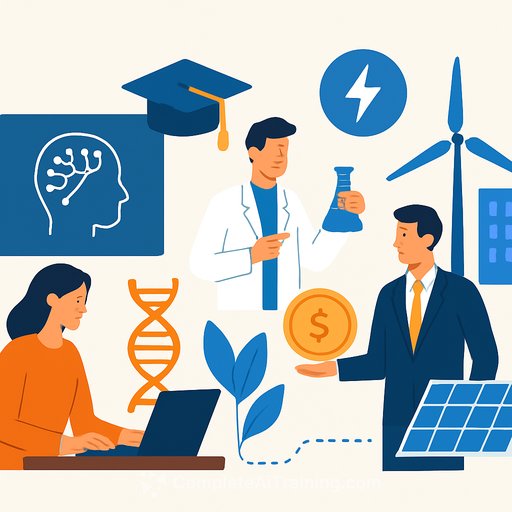
The Influence of Academic Studies on Developing Technology Fields: How Educational Programs Foster Innovation and Attract Investment in AI, Engineering, and STEM
Higher education is moving from theory-first to build-first. Programs that weave AI, engineering, and STEM across disciplines are producing graduates who can ship real solutions-and investors are paying attention. The result: faster innovation cycles, stronger regional economies, and a tighter link between classrooms and industry demand.
The Transformation of STEM Education
More than 60% of leading STEM programs now require AI-related coursework. Interdisciplinary minors and certificates are spreading AI literacy beyond computer science, pairing technical skill with ethics and policy.
There are trade-offs. Generative AI can help students who lack access to tutoring and mentoring, but it can also widen gaps if used without the right guardrails. Universities are responding with AI-based assessment that values authentic work, deeper analysis, and critical thinking. Faculty development is catching up too, giving instructors practical tools to integrate AI without losing academic integrity.
Farmingdale State College: A Working Model
Farmingdale State College (FSC) shows what alignment looks like in practice. Eighty percent of graduates land jobs within six months, supported by targeted facilities and partnerships. A new $75 million Center for Computer Sciences is set to double enrollment in tech programs and ease shortages in cybersecurity, AI, and software development-especially important for Long Island's talent pipeline.
FSC backs instruction with applied research and industry access. The Renewable Energy and Sustainability Center (RESC) advances work in solar, wind, and smart grid technologies. Broad Hollow Bioscience Park gives startups affordable lab space and collaboration with faculty. A partnership with The Estée Lauder Companies adds hands-on experience in sustainability and green chemistry, preparing students for R&D roles in beauty and cosmetics.
Where Investment Is Gathering
Education-rooted startups in AI and renewable energy are picking up momentum. One example: ELTUH, a student-founded company at FSC using AI-driven drones to inspect power lines and assess wildfire risk. Venture backing is still early, but campus infrastructure and industry alliances create a safer launchpad for founders.
Public funding is amplifying this movement. The United Kingdom's £500 million Local Innovation Partnerships Fund supports manufacturing and AI-enabled healthcare through collaborative models. In the U.S., states are channeling resources into lab space and STEM upgrades. New York's $200 million investment in SUNY Old Westbury's Natural Sciences Building shows how public dollars can align campus research with sustainability goals.
Research-Driven Sectors to Watch
Biotech is heating up as AI accelerates drug discovery and synthetic biology. New academic programs, such as Fordham University's biochemistry initiative, feed that pipeline. Isomorphic Labs secured $600 million to advance protein engineering. The catch: heavy reliance on venture capital means leaders should weigh long-term funding durability alongside scientific promise.
Renewable energy continues to scale with public-private collaboration and workforce programs. With $386 billion invested globally, the sector is tackling talent gaps while pushing smart grid innovation. FSC's RESC, which works with National Grid, is a clear example of how applied research converts academic expertise into industry outcomes.
Action Checklist for Education Leaders
- Embed AI across the curriculum: pair core CS with domain courses (health, finance, energy, design) and ethics.
- Redesign assessment: emphasize projects, oral defenses, data logs, and version control to verify authentic work.
- Build industry partnerships: co-create courses, capstones, and apprenticeships; sign MOUs with clear hiring pathways.
- Fund applied research hubs: focus on regional strengths (energy, biotech, cybersecurity) with shared facilities.
- Upskill faculty: run short sprints on AI tools, prompt writing, dataset curation, and model evaluation.
- Back student ventures: provide prototyping grants, legal clinics, and access to labs and pilot customers.
- Map to investment: align labs and centers with public funds and corporate R&D needs.
Metrics That Matter
- Placement rate within six months and median starting salary.
- Number and size of research grants, corporate contracts, and joint publications.
- Startup formation, follow-on funding, and pilot-to-procurement conversions.
- Internship-to-job conversion rates and partner renewal rates.
- Time from industry request to curriculum update or microcredential launch.
Helpful Resource
Building AI literacy fast? Browse role-based learning paths to accelerate curriculum planning and faculty upskilling: AI courses by job.
Looking Ahead
Universities sit at the junction of talent, research, and capital. Programs that integrate AI, engineering, and STEM with authentic work, real partners, and modern assessment will produce graduates who create value from day one. For investors and civic leaders, the strongest opportunities live where academic expertise meets clear industry demand-in AI, biotechnology, and renewable energy.
Disclaimer: The content of this article reflects the author's opinion and does not represent the platform. This article is not intended to serve as a reference for making investment decisions.
Your membership also unlocks: