From concept to market: How AI accelerates physical product innovation
Product teams aren't short on ideas. They're short on confidence and time. Gen AI and intelligent agents are closing that gap-shrinking cycles, stress-testing decisions before metal is cut, and pushing more accurate products into the market with less waste.
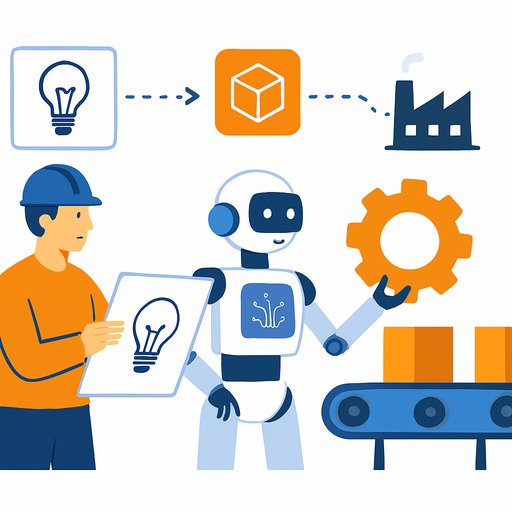
This shift goes beyond digital features. AI is now influencing hard constraints-materials, tolerances, manufacturability-by integrating with CAD/CAE/PLM, simulating multi-physics environments, and coordinating the shop floor. The new workflow is a triad: engineers, operators, and AI systems working in sync to inform design choices and capital plans in near real time.
What's different now
Three capabilities matter most: simulation, prediction, and optimization. Together, they let teams explore more concepts, test them virtually, and converge faster on viable designs.
Leaders are already using gen AI for automated quality analysis, better defect detection, and higher yields. In pharma and materials, timelines are compressing from years to months, with some prototype cycles reduced by up to 70%. Agentic AI can even iterate on prototypes autonomously and propose efficient synthesis paths in chemistry-helping you get to a working prototype sooner.
From idea to design: wider exploration, fewer blind spots
Image and text generation tools plug into concept development to supercharge iteration. Teams surface more options, spot issues earlier, and reduce costly rework downstream.
Colgate-Palmolive uses gen AI to pull signal from consumer feedback and spin up product concepts quickly, tightening the loop between demand and design. Insilico Medicine applied gen AI to drug discovery and reached phase II clinical trials faster, turning multi-year cycles into months and potentially generating billions in value through earlier market entry and better outcomes.
Prototyping and engineering: faster proof, smarter bets
Johnson & Johnson uses gen AI on chemical biosignatures to drive hypothesis generation and candidate selection, improving decision quality while cutting cycle time. In materials and process engineering, AI models molecular structures, predicts interactions, and optimizes synthesis routes-reducing manual trial-and-error.
The result: fewer dead ends, clearer investment choices, and tighter alignment between R&D and manufacturing from day one.
Production and after-sales: quality at speed
GE Aerospace deployed an AI-enabled blade-inspection tool on narrowbody and GEnx widebody engines. Inspection times were cut in half with higher accuracy than traditional borescope methods-getting aircraft back in service faster while improving reliability.
On the shop floor, AI doesn't just adapt to constraints; it informs them. Engineering change management flows more smoothly into production, and agents coordinate planning, quality, and maintenance to keep throughput high and costs in check. For practical shop-floor patterns and maintenance workflows, see AI for Operations.
Where product teams are seeing results
Life sciences and health care: In medtech, the largest share of value from AI is hitting product development. Some companies see potential R&D cost reductions of up to 20%, which can mean hundreds of millions saved for a large enterprise. Trust remains critical as systems like the Mayo Clinic's gen AI programs support drug discovery and precision medicine. Northwestern Medicine built an in-house gen AI that drafts near-complete radiology reports, boosting productivity by up to 40% without losing accuracy.
Consumer and mobility: Clorox prototypes product concepts quickly using gen AI, testing hundreds of digital prototypes with millions of consumers to tighten product-market fit. In Detroit, the Accessibili-D autonomous vehicle pilot used AI-driven decision systems and a data platform for real-time insights, connecting seniors and people with disabilities to essential services with high satisfaction and a model that can scale.
Energy, resources, and industrials: Adoption of gen and agentic AI is still early, but momentum is building. Siemens is advancing Industrial AI agents across concept design, digital prototyping, and quality. One oil and gas operator managing 1,000 pieces of critical equipment across 80 sites used gen AI and speech-to-text to summarize diagnostics, helping engineers prioritize issues faster and improve maintenance outcomes.
Government and public services: Urban infrastructure is getting smarter. Singapore's Virtual Singapore initiative uses a city-scale digital twin to integrate sensor data, satellite imagery, and GIS into a real-time 3D model. Dubai's 2040 plan applies gen AI to propose and validate urban layouts with input from residents and officials-supporting better planning decisions.
Technology, media, and telecom: Formula 1 teams use AI simulations to test car designs under countless scenarios. In semiconductors, leaders apply gen AI to chip design, equipment optimization, and even fab construction planning. Intel uses gen AI to anticipate delays and enable predictive maintenance across complex build-outs.
How to put this to work in your product org
- Map your product life cycle and flag bottlenecks where simulation, prediction, or optimization can move the needle (concept screening, DFM checks, ECN throughput, QA yield).
- Integrate AI with CAD/CAE/PLM. Build a design graph that links requirements, geometry, materials, and process parameters. Instrument test rigs and lines for feedback loops. See Design for examples of AI-driven design automation.
- Start with a digital twin of the critical subsystem to validate assumptions before hardware. For context, see NIST's overview of digital twins: Digital Twin at NIST.
- Adopt the triad workflow: engineer owns requirements and review, operator owns run rules and safety, AI agent explores options and proposes plans within clear boundaries.
- Set guardrails: data provenance, traceable decisions, verification/validation gates, and human sign-off at key milestones.
- Upskill the team on generative design, AI-first FMEA, and prompt patterns for CAD/CAE tasks. If you need a fast path, explore the AI Learning Path for Plant Managers.
- Instrument for ROI: tie models to quality, cost, and time metrics from day one; sunset pilots that don't clear thresholds.
- Plan for scale: reusable prompt libraries, model/version control, MLOps, and QMS integration so audits and compliance stay clean.
KPIs that keep you honest
- Time to concept lock and first feasible prototype
- Design options evaluated per week and simulation coverage
- ECN lead time and right-first-time rate
- Scrap/rework, yield, and process capability (Cp/Cpk)
- Inspection time per unit and defect escape rate
- Service MTTR and predictive maintenance accuracy
Common pitfalls (and simple fixes)
- AI overfitting to simulated data: schedule physical validation at set intervals and feed results back into models.
- Hallucinated outputs: constrain agents to approved data and tools; require citations and uncertainty flags.
- IP and privacy risk: keep sensitive data in secure environments with strict access and logging.
- Unbounded autonomy: define safe operating limits, escalation logic, and kill switches.
- Integration debt: choose a few critical systems to integrate deeply rather than many shallow connections.
Bottom line
AI is compressing the distance between idea and in-market hardware. The advantage goes to teams that combine human judgment with agent speed-testing more, committing later, and hitting targets with fewer surprises.
Start where the math works: one product, one line, one bottleneck. Prove the lift, codify the workflow, then scale. If you want structured training to move faster, check out the AI Learning Path for Plant Managers.
Your membership also unlocks: