Managers, Agentic AI, and the Next Version of Your Job
Managers manage people, processes, and problems. Over the next year, one process jumps to the front: agentic artificial intelligence. It will affect your team, fix some issues, create new ones, and change how management works. The job isn't shrinking, but the shape of it is.
From Passive Tools to Proactive Agents
We've moved past AI that summarizes meetings and edits drafts. The next phase gives AI agents autonomy to act on your behalf. Reid Hoffman explored this in Superagency. Salesforce made it concrete with Agentforce for customer service learn more, and Don Tapscott with Joseph M. Bradley call this "Identic AI."
Identic AI behaves like a digital consigliere. It learns your habits, preferences, and priorities. It can negotiate contracts, kick off major initiatives, and coordinate with other systems. It's an extension of your judgment at machine speed.
Your Team Now Includes Agents
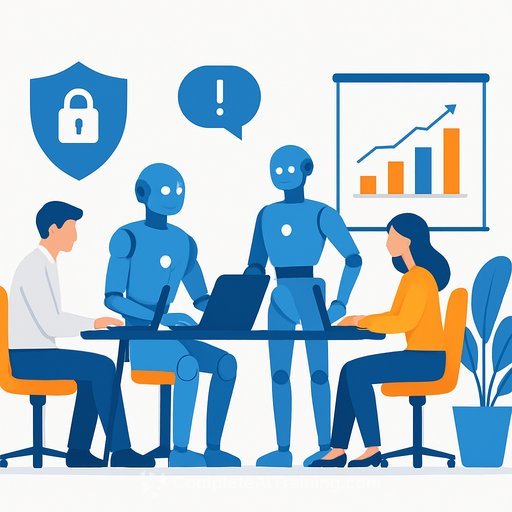
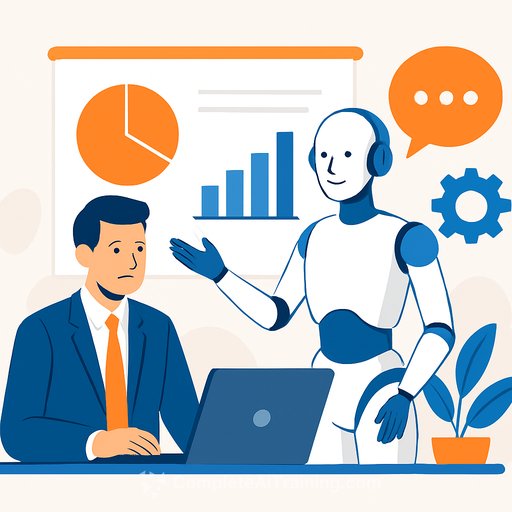
Leaders will run hybrid teams made of humans and their agents. The agents never sleep, never burn out, and move fast. Your job is to ensure they lift human work rather than overshadow it. That means clear rules, fair recognition, and visible standards.
Organizations will flatten as AI takes on traditional middle-management tasks. Middle managers shift from go-betweens to specialists: coaching, coordination, and oversight. Think head coach at the top and specialized coaches in the middle. This is where AI-enabled execution meets human interpretation and creativity.
Your 2026 Task List
- Define agent autonomy: Write down what agents can decide, what they can recommend, and what requires human approval. Treat agents like new hires with a RACI.
- Onboard agents: Sandbox first, then staged access. Enable audit trails, rate limits, escalation paths, and a clear kill switch.
- Design work: Map workflows across human-agent pairs. Reassign routine tasks to agents and elevate human work to analysis, relationships, and decisions.
- Metrics that matter: Track outcomes, not activity. Attribute results to pairs (person + agent) to keep incentives aligned.
- Relationship design: Set cadences for human-to-human and human-to-agent syncs. Create rituals for feedback, recognition, and conflict resolution.
- Governance and risk: Adopt a framework like the NIST AI Risk Management Framework see the framework. Define guardrails for negotiations, customer interactions, and data use. For role-specific guidance on governance, risk, ethics, and compliance, see the AI Learning Path for Regulatory Affairs Specialists.
- Upskill managers: Teach agent orchestration, prompt-to-policy translation, and quality review - see the AI Learning Path for Project Managers for practical, role-focused practices.
- Communication rules: Document who speaks for the agent, how agents introduce themselves, and how to correct agent errors with customers.
- Security: Least-privilege access, secrets management, separation of duties, and regular red teaming for agents.
- Budgeting: Shift planning from headcount to capacity. Model ROI by comparing agent cost to outcomes delivered.
- Incident response: Write playbooks for misfires. Practice drills. Fix upstream data, not just downstream outputs.
- Ethics and compliance: Bias checks, consent for agent-led interactions, and an appeals path for employees and customers.
Identity Is Now a Management Topic
Identic AI raises identity questions. Who are you as a manager when a digital counterpart speaks and acts in your style? Define values, decision rights, and non-negotiables. Let your team see the line between your judgment and your agent's output.
Keep Humans Essential: Relationships, Curiosity, Imagination
Relationships don't happen by accident. Design them. Set expectations for how people and agents collaborate, and how credit is shared.
Two human traits will set your team apart. Curiosity pushes beyond the brief and asks better questions. Imagination reframes the problem and creates new options. Build both into the culture with short experiments, weekly learning hours, and space for contrarian ideas.
What This Means for Middle Managers
The role won't vanish, but it will change. Less traffic control, more coaching and oversight. You set the rules for agent conduct, audit outputs, and translate strategy into systems. The best managers will become the bridge between intent and execution.
Cannonballs: What Actually Stops Progress
- Compensation tied to short-term metrics that punish long-term bets.
- Risk processes built to say "no" by default.
- Approval layers where one skeptic can overrule ten supporters.
- Cultures where failed experiments stall careers.
- Funding insight: Founders backed by parents or friends tend to take fewer risks and grow slower than those funded by outside investors. Brian Baik's research points to fear of losing loved ones' money.
- Stuck? Borrow from Lu Ann Cahn's "do something new every day." Even small changes-like a new route to work-can refresh your brain and open options.
Start Next Week
- Pick one workflow and draft an agent RACI.
- Pilot with a small team, daily standups, and a visible scoreboard.
- Run a 30-day experiment with pre-set guardrails and a clear exit.
- Share results. Keep what works. Kill what doesn't. Repeat.
Want structured upskilling for managers?
Explore practical programs by job role and skill track at Complete AI Training: Courses by Job. Leaders focused on governance and strategy may also find the AI Learning Path for CIOs helpful for managing agent-enabled teams.
You still manage people, processes, and problems. Add curiosity, imagination, and agent oversight. That combination will separate good managers from great ones in 2026.
Your membership also unlocks: