
AI news ·
From Copyright to the AI Act: Legal Risks for AI Products and What to Do About Them
AI is in your stack already, and so are the legal risks. Get ahead on rights, data use, privacy, liability, bias, and reliability with clear policies, contracts, and audits.
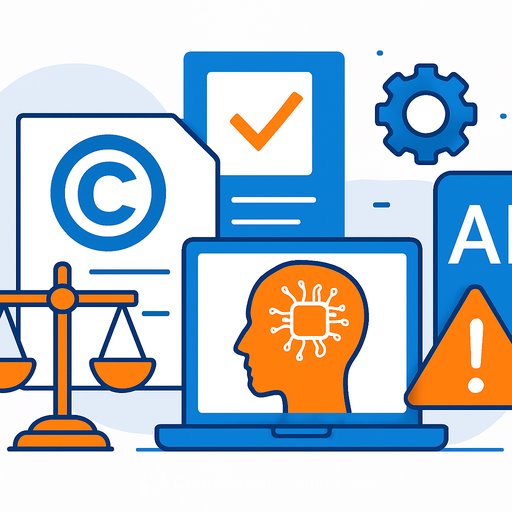
Legal Challenges in Developing AI-Based Products: What Businesses Need to Consider Today
AI is already baked into daily operations. The legal risk is here, not theoretical. If you build products, your roadmap needs legal guardrails as much as feature specs.
Below is a practical, no-fluff overview of the core issues product and legal teams should align on now - plus what to do next.
1) Copyright in AI-generated content
Current law does not recognise AI as an author. That creates a gap: who owns the rights - the model developer, the user, or your company?
The risk is real: weak protection from copying, disputes with users and partners, and lower investment confidence. In some cases, competitors can reuse outputs with little friction.
- Document the creation process and data sources.
- Adopt an internal AI use policy covering prompts, outputs, attribution, and approvals.
- Allocate rights clearly in MSAs, licences, and Terms of Use.
2) Training on protected content
Training on copyright-protected works without permission is under heavy scrutiny. In the EU, rights holders can opt out, but application to commercial AI is contested. In the US, lawsuits show unlicensed use can trigger large claims.
Recent cases (e.g., news and music rights disputes) make the point: ignoring content rights invites litigation and reputational fallout.
- Map training and fine-tuning datasets; secure licences or use sources with clear rights.
- Honor opt-outs and robots.txt signals where applicable.
- Keep an audit trail of datasets, licences, and compliance decisions.
3) Personal data, confidentiality, and AI security
Training and adapting models with personal data often lacks a valid legal basis under privacy laws such as the GDPR and the CCPA. New attack surfaces also exist: model inversion and prompt injection can expose sensitive information.
Consequences include fines, data leaks, and trust erosion. The EU AI Act is rolling out, and more jurisdictions are moving fast, which raises cross-border transfer and accountability issues.
- Run a DPIA for AI use cases; define purposes and legal bases.
- Restrict model access to sensitive data; apply data minimisation and retention controls.
- Update privacy notices and internal records of processing.
- Implement guardrails against prompt injection and model inversion; monitor and patch.
- Plan for cross-border transfers and vendor oversight.
Resources: EU AI Act (EUR-Lex) and GDPR overview.
4) Liability for AI actions
Who answers for an AI-driven mistake? Usually, the company delivering the end service. If you integrate a third-party model via API, you'll likely face the client - not the model vendor.
Causation is hard to prove and standards vary, which increases exposure.
- Define liability splits, indemnities, and caps in supplier and customer contracts.
- Use disclaimers and acceptable-use terms; align with insurance coverage.
- If your system is high-risk under the AI Act, meet the applicable obligations early.
5) Algorithmic bias and discrimination
Models reflect their data. In HR, healthcare, fintech, and education, bias can turn into unlawful discrimination and fines.
- Test for bias before launch and on a set cadence; document metrics and fixes.
- Use representative datasets and apply fairness constraints where feasible.
- Provide explainability and escalation paths for affected users.
6) Ethics and behavioural manipulation
Recommendation engines and generative systems can nudge choices - commercially and politically. Lack of transparency can trigger claims of unfair practices.
- Label AI-generated content and inform users when they interact with AI.
- Adopt internal ethical standards and review sensitive use cases.
- Limit dark patterns; provide clear opt-outs.
7) Specific risks in games
AI now drives NPCs, dialogue, and visual assets. That raises issues around copyright, minors' data, and strict platform rules (Steam, Epic, Xbox).
- Track data sources and licences for assets and training data.
- Disclose AI use in marketing where required; moderate user-generated content.
- Align with each store's policy to avoid takedowns or blocks.
8) Quality and operational failures
Models can produce inaccurate or illogical outputs, which is critical in domains like medicine, finance, and compliance. Outages and API shifts can stall operations if you lack fallback plans.
- Verify output accuracy; add human-in-the-loop for high-impact decisions.
- Test regularly with regression suites and real-world edge cases.
- Build fallback modes, circuit breakers, and clear incident playbooks.
What this means for business
AI legal risk is part of daily operations now. Teams that set clear rules early move faster with fewer surprises.
- Create internal AI policies and governance.
- Structure rights in contracts; document datasets and licences.
- Meet legal requirements (GDPR, CCPA, AI Act) and keep evidence.
- Test models, monitor drift, and enforce data quality.
- Add fallback mechanisms and human oversight.
How external counsel can help
- Legal audit of AI features and data flows.
- Structuring rights to data, models, and outputs.
- Compliance with GDPR, the AI Act, and sector rules.
- Drafting internal AI policy, supplier terms, and user terms.
- Support in disputes and regulator inquiries.
Need advice on AI legal risk or a focused audit of your product? Contact a lawyer for further information.
Upskill your team
If you're building an internal program for AI policy, risk, or product enablement, explore curated learning paths by role: Complete AI Training - Courses by Job. Relevant options include the AI Learning Path for Training & Development Managers for governance and organisational readiness, and the AI Learning Path for Systems Administrators to help teams manage secure, governed AI infrastructure.