From cough sounds to X-rays: How AI is helping detect TB and strengthen remote care
AI in healthcare works best when it trims delays, plugs specialist gaps, and routes patients to timely treatment. Across India, practical tools are doing exactly that - from cough-based TB triage to AI-supported X-rays, telemedicine decision support, disease surveillance, and fundus screening for diabetic retinopathy.
If you run a program or a facility, the playbook is clear: use AI to widen screening, keep clinicians in control, and hardwire confirmatory pathways. Here's what's working and how to deploy it without adding friction for your teams.
TB screening in the field: Cough-based triage
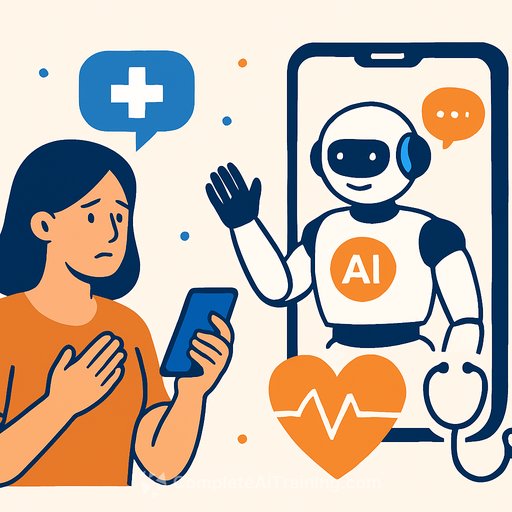
Frontline workers in places like Kurukshetra, Haryana, are recording cough sounds on a smartphone app. The model compares patterns against a TB cough database and flags probable positives for confirmatory testing.
During campaigns in Kurukshetra, Mumbai, and Mizoram, the app screened around 1.62 lakh people and led to a 13% rise in diagnosed cases over routine screening. While validation by ICMR is in progress, a pilot is live across 91 districts in 17 states.
- Where it fits: Active case finding, door-to-door outreach, and screening camps.
- What you need: Clear consent, simple job aids for ASHA/ANM workers, and a fast track to testing and treatment.
- What to watch: Model performance across dialects, age groups, and comorbidities; routine audits for false negatives.
Portable AI X-rays at PHCs without radiologists
Hand-held devices - roughly the size of a camera - capture and interpret chest X-rays within seconds. They're now being used in primary health centres that have X-ray capability but no radiologist on site. The goal is early flagging of lung changes before cough appears.
About 473 portable units are in use, with 1,500 more being added. Several models, including Indian devices, have ICMR approvals and have helped surface additional asymptomatic TB cases.
- Protocol: Screen, flag, confirm (sputum/NAAT), initiate treatment; document outcomes in Nikshay.
- Safety and quality: Radiation safety, periodic calibration, image quality checks, and escalation rules for uncertain cases.
- Practicalities: Reliable power, offline mode, and integration with existing registries and lab workflows.
WHO guidance on CAD for TB screening can help refine operating criteria and thresholds.
Clinical decision support on eSanjeevani
India's telemedicine platform now includes a clinical decision support system (CDSS) trained on consultations from over six crore people. It recognises around 300 symptoms tied to common conditions such as respiratory infections, gastritis, fever, and diabetes.
With more than 43 crore consultations across 1.36 lakh spokes and 18,000 hub hospitals, the CDSS acts as a smart filter - surfacing high-probability differentials while keeping the doctor in charge. Clinicians can accept or reject suggestions, and feedback loops improve the model over time.
- Frontline workflow: Health worker fills a structured form; the CDSS prompts for duration, severity, and location of symptoms; hubs get a focused summary.
- Governance: Clear audit trails, supervision, and periodic case reviews to prevent automation bias.
AI for faster outbreak detection
Surveillance teams now use an AI model that scans news in 13 languages for outbreaks, unusual clusters, or atypical symptoms. Early versions over-flagged non-health events; the model has since improved and now filters more precisely.
The result: a 150% increase in actionable alerts. Officers can spend less time reading newspapers and more time planning responses, verification, and containment.
- Set up: Define escalation rules, duplicate suppression, and handoffs to district rapid response teams.
- Measure: Time from alert to verification and intervention, plus signal-to-noise ratios.
Preventing blindness: Fundus AI for diabetic retinopathy
At AIIMS, clinicians worked with ministries to build an AI model that plugs into existing fundus cameras and flags early retinal changes linked to diabetic retinopathy (DR). This helps doctors focus on likely positives instead of scanning every diabetic patient manually.
The clinical challenge is straightforward: patients often feel fine until vision loss appears. Screening at the same visit and location where diabetes care happens raises detection and reduces missed follow-ups. Similar tools are being developed for glaucoma.
- Where to place: PHCs and NCD clinics running diabetes programs.
- What to standardise: Image capture protocols, referral thresholds, and follow-up reminders for at-risk patients.
- Outcome tracking: Proportion screened, refer-to-attend rates, time to treatment, and preventable vision loss.
What to do next: A practical rollout checklist
- Pick high-friction use cases: TB screening (cough app + portable X-ray), DR screening at diabetes OPDs, and CDSS at telemedicine spokes.
- Run small pilots: 2-3 facilities, clear metrics, weekly reviews, and fast iteration on workflow gaps.
- Lock the pathway: Screening → confirmation → treatment → adherence support. No screening without a reliable downstream plan.
- Train the field: Short refreshers for ASHA/ANM staff, laminated job aids, and on-call support for the first month.
- Governance: Consent, data minimisation, role-based access, bias checks, and periodic revalidation on local data.
- Measure what matters: Coverage, PPV/NPV, time to diagnosis, treatment initiation within 7 days, false-positive load on labs, and cost per additional case found.
- Procurement basics: ICMR-approved devices/models, uptime SLAs, battery life, offline capability, and simple EHR/Nikshay/eSanjeevani integration.
Known risks and how to manage them
- False negatives: Maintain clinical judgment; never skip confirmatory tests for TB.
- Model drift: Schedule quarterly reviews, especially after updates or workflow changes.
- Equity: Validate across accents (cough apps), device types (imaging), and demographics.
- Overreliance: Keep the clinician as final decision-maker; use AI as a triage and prioritisation layer.
Build team capability
Your people make this work: procurement teams who ask the right questions, clinicians who supervise, and field workers who run the process every day. If you're building AI literacy for health roles, see curated options by job role here: Complete AI Training - Courses by Job.
Your membership also unlocks: