AI & Strategy at the Knowledge Forum 2025: Decision-Making That Drives Results
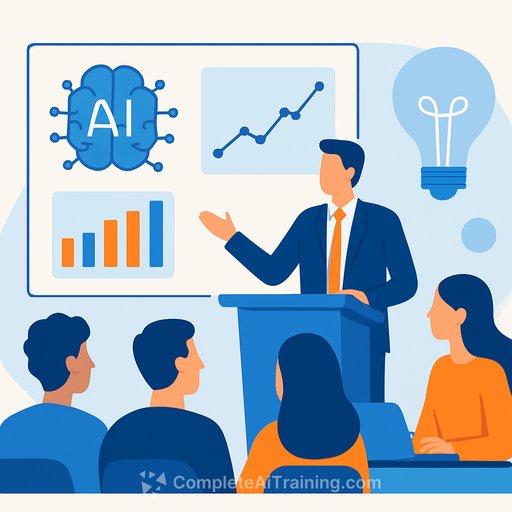
FGV EAESP hosted another edition of the Knowledge Forum, the core discipline of its Professional Master's in Administration (MPA). The 2025 theme, "AI & Strategy: decision-making in the digital age," extended a track record that has covered Future of Work, ESG, and Strategic Innovation.
Coordinated by Professor Paul Ferreira, the Forum doubled down on the "scientist-manager" profile: leaders who apply analytical rigor, evidence, methods, and technology to generate measurable impact.
Why this matters for executives
AI is changing how organizations decide, operate, and create. Speakers emphasized two levers: build a data foundation that turns information into advantage, and run continuous experimentation to compound learnings. For executives focused on governance, data strategy, and decision frameworks, the AI Learning Path for CIOs offers role-specific guidance.
Carlos Azevedo, associate partner for AI & Data Science at Bain & Company, showed how multimodal, more accessible models are reshaping digital consumption with conversational commerce and personalization at scale. For a broader view on scaling personalization, see this overview by McKinsey here.
Professor Eduardo Francisco Rezende reinforced a practical truth: the edge goes to firms that treat data as a strategic asset, not a side project-solid pipelines, clear ownership, and a test-and-learn culture.
Guardrails: limits, risk, and decision quality
Technology without thinking is a liability. Professor Gilberto Sarfati shared ideas from "Superdecision," warning that heavy automation can fuel cognitive laziness. Good tools don't replace disciplined judgment.
Marcelo Suzuki, global executive at Siemens, was blunt: operating tools isn't the point-framing the right problem is. The illusion of certainty grows when AI runs on autopilot, which makes risk management and escalation paths nonnegotiable. For reference frameworks, consider the NIST AI Risk Management Framework here.
Customer, creativity, and discovery
Isabella Milano, MPA graduate and product marketing manager at Google, presented research on creativity in AI-mediated teams-training, prompts, critique rituals, and iteration cycles matter more than any single tool.
Claudia Carneiro, search product lead Brazil at Google, highlighted the evolution of search: smarter, multimodal, and contextual. Expect direct effects on how people find, compare, and decide across purchase paths.
Use cases that move the needle
In healthcare, Alex Julian, CIO of Hospital Sírio-Libanês, showed applications from predictive records to smart scheduling. These are practical, measurable wins-waiting times, capacity, and quality indicators improve together.
In finance, Cíntia Barcelos, CTO of Bradesco, emphasized integrated data, ethics, and governance to turn AI into outcomes, and shared the evolution of the BIA virtual assistant.
In industry, Cristina Cestari, CIO of Volkswagen, explained how technology can capture tacit knowledge and turn it into process advantage in legacy environments.
To close, Fernando Vitti, founder and CEO of Nexforce, presented Revenue Operations as an answer to structural inefficiency-unifying data and actions across marketing, sales, and success.
Applied challenge: AI with a business scoreboard
This edition brought a hands-on partnership with Resorts Brasil. Students tackled a real challenge across customers, processes, and supply chain, building AI-based solutions and competing for an on-site experience at the network's resorts.
The format made the learning stick. Exposure to different business lenses, plus a live problem with constraints, pushed students to ship practical answers-not slides.
Executive playbook: how to turn insight into action
- Start with decisions, not tools: List high-frequency, high-value decisions. Define success metrics, risk levels, and what "good" looks like.
- Build a single source of truth: Clean data, clear ownership, data contracts, and secure access. No shortcuts here.
- Experiment weekly: Write testable hypotheses. Use champion-challenger designs. Keep cycles short and measurable.
- Keep a human in the loop where stakes are high: Escalation paths, audit trails, and scenario reviews prevent false certainty.
- Instrument outcomes: Track ROI, drift, and model performance in production. Tie metrics to financial and customer KPIs.
- Train for creativity under constraints: Teach prompt patterns, critique methods, and brainstorming sprints. Make it a team sport.
- Upgrade discovery: Treat search and recommendations as product features. Connect multimodal inputs to your catalog and content.
- Unify revenue operations: Break silos across marketing, sales, and success. Standardize data, handoffs, and SLAs before automating.
Project managers and delivery leads interested in operationalizing these practices can find practical frameworks in the AI Learning Path for Project Managers.
Bottom line
The Knowledge Forum 2025 reinforced the MPA's role as a space for experimentation and collective construction. It develops leaders who can question, decide, and deliver in an AI-driven context.
More information about the program is available through FGV EAESP's official channels.
If you're planning structured upskilling for leadership teams, finance leaders can explore the AI Learning Path for Vice Presidents of Finance.
Your membership also unlocks: