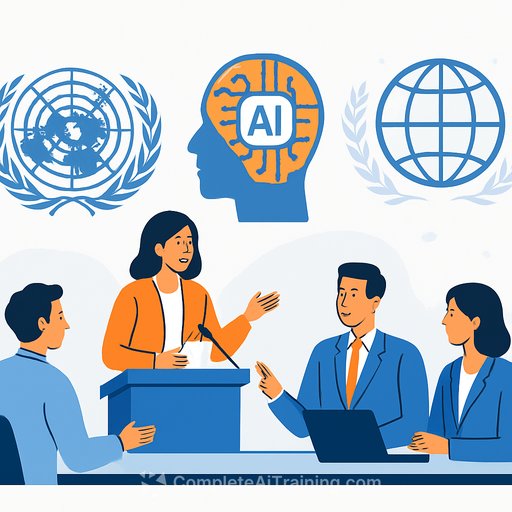
AI Governance: Three Lessons from the Global Digital Compact
2026 is a make-or-break year for global AI governance. The UN is stepping into a faster cycle of action, with the Independent International Scientific Panel on AI and the Global Dialogue on AI Governance moving from concept to build-out. The core question is practical: What does credible, inclusive cooperation look like when technology changes faster than policy?
As the UN Secretary-General put it, AI is moving fast enough that no single country sees the whole picture. Shared guardrails and shared opportunity require shared understanding - and a structure that can keep pace.
The Global Digital Compact and AI Governance Today
The UN has been working toward a common approach for years. The Secretary-General's 2020 Roadmap for Digital Cooperation called for AI that is safe, human-rights based, and peace-supporting. The idea of a Global Digital Compact followed in Our Common Agenda, and the ITU's AI for Good series has convened practitioners since 2017.
In 2024, the Compact negotiations brought AI to the center of Member State diplomacy. Delegations wrestled with digital rights, data governance, and AI at UN scale. The result: momentum behind two complementary mechanisms - a Scientific Panel to ground debate in evidence, and a Dialogue to convert that evidence into cooperation.
Lesson 1: Consensus Is Possible
The Compact showed that agreement on AI is within reach - even in a tense geopolitical climate. The key was groundwork built outside the microphone: off-the-record briefings, practical demos, and neutral convenings where delegates could ask basic questions without political cost.
Just as important, multistakeholder sessions brought diplomats, technical experts, companies, civil society, and UN entities into the same room. Treat those forums as part of the governance model, not a side show. That's how shared language forms - and how it sticks.
Lesson 2: Global Legitimacy Is the UN's Advantage
The UN is the one table where every country has a seat. That matters because AI's risks and benefits are global, while the ability to set rules and steer markets is concentrated. Without an inclusive platform, a few countries and companies will set the terms, and many others - especially across the Global South - will be left reacting.
But legitimacy isn't enough. The job now is to deliver outcomes that advance innovation, human rights, development, security, and capacity - together. The UN's role is to provide the umbrella where different approaches interoperate, standards are practical across markets, and benefits stay open to all. Trust in the Scientific Panel and the Global Dialogue will determine success in 2026.
Lesson 3: Interoperability and Standards Prevent Fragmentation
Countries arrived at the Compact with different assumptions shaped by economics, capacity, and security concerns. Left alone, those differences produce incompatible rules, uneven oversight, and bigger risks in high-stakes domains, including defense and critical infrastructure.
The antidote is interoperability - aligning core concepts, evaluation methods, reporting, and accountability so systems can work across borders. High-level principles help, but shared technical touchpoints turn cooperation into something governments and companies can actually use.
Two New Mechanisms - What They Mean for Governments
Independent International Scientific Panel on AI: A standing source of evidence on AI capabilities, risks, benchmarks, and mitigation options - independent of commercial or national agendas. Expect public reports, shared taxonomies, and testing guidance that regulators can plug into policy and procurement.
Global Dialogue on AI Governance: A political space to convert evidence into common reference points, voluntary norms, and coordinated action. Think: templates for incident reporting, compatible audit expectations, and pathways for capacity building.
What Government Teams Can Do Now
- Map where your agencies already use or buy AI. Flag high-risk applications and gaps in oversight.
- Designate a cross-ministry lead for AI risk, standards, and procurement. Give them authority to coordinate.
- Adopt baseline procurement clauses: model documentation, evaluation results, red-team evidence, and incident response terms.
- Engage early with the Global Dialogue working streams and share lessons learned from pilots and audits.
- Align with emerging evaluation methods (e.g., capability testing, safety benchmarks) to ease cross-border cooperation.
- Stand up a public incident and safety reporting channel; contribute anonymized cases to international repositories.
- Invest in skills: policy analysts who can read model cards, auditors who can test systems, and lawyers who can translate findings into enforceable terms.
- Support regional capacity building so smaller agencies and neighbors aren't left behind - interoperability depends on it.
Why This Approach Works
Consensus builds when people can learn without penalty and test ideas against real use cases. Legitimacy scales that consensus beyond early adopters. Interoperability turns it into working policy. The Compact's lesson is simple: do all three at once, and progress is within reach.
Resources
For context on earlier UN work, see the Secretary-General's Our Common Agenda and the ITU's AI for Good initiative. These provide helpful background on values, priorities, and practical convenings.
Build Capacity in Your Team
The test ahead is clear: convene everyone, prove value fast, and connect national actions into a system that works across borders. If the Panel and the Dialogue earn trust and deliver concrete tools, the UN can help governments keep AI safe, useful, and fair - at a pace that matches reality.
Your membership also unlocks: