How AI Will Soon Be Used to Support Every Process at BMW
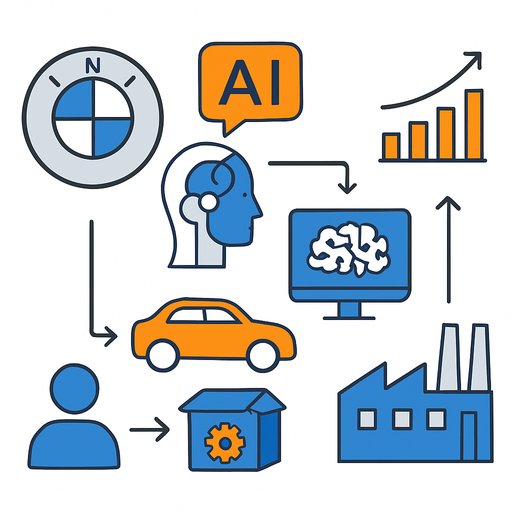
BMW isn't dabbling in AI. It's standardizing it. The company already runs hundreds of AI use cases across its value chain and expects every process to be AI-supported in the near future.
For product development teams, this isn't theory. It's a blueprint for how to compress cycle times, improve quality, and make better calls with cleaner data.
Enterprise strategy: AI everywhere, ROI first
"We're scaling artificial intelligence along the value chain, from development and production through to sales. In the foreseeable future, every process at the BMW Group will be AI-supported," says Marco Gorgmaier, VP Enterprise Platforms and Services, Data, AI, BMW Group. The mandate is direct: efficiency, innovation, and measurable ROI.
BMW has built a Group-wide AI platform and a gen AI self-service layer so employees can spin up solutions without heavy engineering lift. The BMW Group AI Assistant lets non-technical users create and integrate AI into their daily work, while governance handles security, compliance, and approvals. The tech stack stays open to multiple model providers to avoid lock-in.
Supplier network and data collaboration
"At the BMW Group Purchasing Division, digitalisation and artificial intelligence are no longer just future topics - they are part of our daily reality," says Dr Nicolai Martin, Member of the Board of Management of BMW AG, Purchasing and Supplier Network. The approach is collaborative and transparent across suppliers with shared goals.
BMW is a driving force behind Catena-X, the open data ecosystem for the automotive industry, built to support resilience, sustainability, and regulatory needs. It enables full-chain product carbon footprint (PCF) calculations from raw materials to finished parts-validated with an example on the BMW iX kidney grille produced in Landshut. Learn more about Catena-X here.
Product development: from documents to digital twins
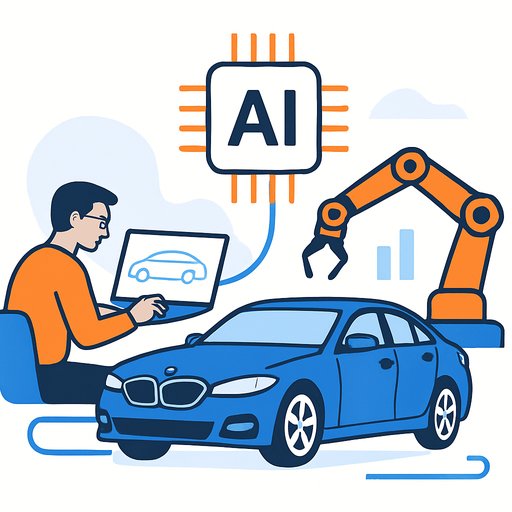
AI is plugged into engineering workflows: parsing specifications and standards, generating insights from historical data, and accelerating simulations. Teams run crash, aerodynamics, and autonomous scenarios with less reliance on physical prototypes and tighter iteration loops.
At BMW's AI Lab in Landshut, employees experiment hands-on with new methods to optimize component manufacturing and quality inspections. The objective: higher precision, fewer defects, and faster validation before release.
Procurement intelligence
Procurement runs on AI-backed assistants. The Tender Assistant helps teams craft strong tender packages using the latest templates and best practices. The Offer Analyst reviews supplier offers, highlights legal and technical gaps, and compares responses against requirements.
Both tools live inside AIconic, a multi-agent system with a centralized chat interface. It combines natural language search with internal knowledge and market data to speed up sourcing decisions.
Software-defined production
Under the BMW iFACTORY concept, plants are shifting to networked, data-driven operations, with hundreds of AI use cases already live. Details on iFACTORY are available on the BMW Group site here.
AIQX-the company's AI quality platform-monitors lines in real time with sensor and image analysis to catch defects immediately. Research is also underway on humanoid robots for autonomous execution of complex assembly tasks and on smarter transport systems to streamline in-plant logistics.
What product leaders can copy now
- Stand up an internal AI assistant with guardrails. Give teams self-serve tools, approvals, and logging. Avoid dependence on any single model provider.
- Prioritize high-ROI use cases: spec/standards analysis, simulation acceleration, automated quality inspection, procurement triage, supplier risk, and product carbon footprint coverage.
- Invest in data contracts and traceability. Standardize schemas (e.g., for PCF), labeling workflows, golden datasets, and audit trails across the lifecycle.
- Treat models like products. Define acceptance criteria, offline evals, bias checks, drift monitoring, and human-in-the-loop gates for safety-critical decisions.
- Bake in security and compliance from day one: access controls, PII handling, vendor risk reviews, and retention policies.
- Operational metrics that matter: cycle time per iteration, defect escape rate, tender throughput time, simulation coverage, and CO2 traceability coverage.
- Upskill your teams with practical tracks: see AI for Product Development and the AI Learning Path for Product Managers.
The takeaway
BMW's stance is clear: AI isn't a side project; it's the operating system for how work gets done. "We are now entering the next chapter: scaling AI across our organisation to unlock new levels of efficiency and to empower smarter, faster and more forward-looking decision-making," says Dr Nicolai Martin.
The signal for product teams is straightforward-build the platform, pick the use cases with line-of-sight to ROI, bring suppliers into the data loop, and measure everything. Scale what works. Retire what doesn't. Then repeat at factory and fleet scale.
Your membership also unlocks: