
AI news ·
From Desks to Docks: AI Speeds Ergonomics and Strengthens Workplace Safety
AI speeds ergonomic assessments and flags risks sooner, with experts staying in the loop. Insurers gain scalable virtual reviews, earlier interventions, and cleaner claims.
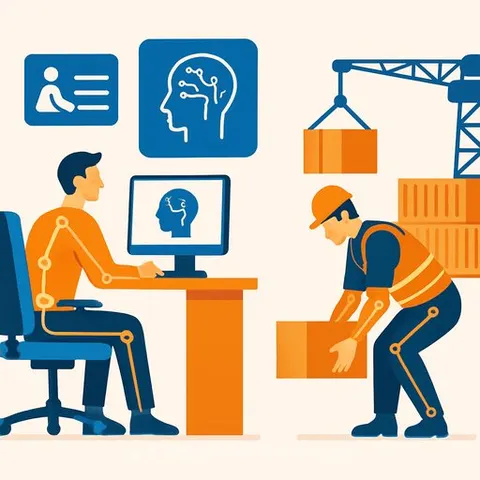
How AI Is Reshaping Workplace Ergonomics and Safety for Insurers
Ergonomic injuries make up a large share of workers' comp claims and loss costs. AI can shorten assessment timelines, expand reach, and surface risks sooner - as long as human expertise stays in the loop.
"As an ergonomist, doing job task assessments took a long time. We saw AI as a tool that could help us speed up the back end, specifically the measuring and quantifying risk of awkward postures and forceful exertions," said Michael White, Managing Director of Ergonomics at The Hartford.
That speed matters to carriers. Faster assessments mean earlier interventions, fewer strains and sprains, and cleaner claims trends you can underwrite, price, and manage with more confidence.
Office vs. Industrial: Different Playbooks
Office environments give AI a head start. Adjustable chairs, standardized equipment, and consistent setups make photo-based assessments reliable and repeatable.
"We're currently developing an AI-based office assessment tool with one of our vendors that captures images of the workspace," White said. The system guides users through questions on keyboard, mouse, monitor, and chair position, then recommends changes like lowering monitors or raising chair height.
In plants, warehouses, and distribution centers, exposure is higher and variability is greater. The Hartford focuses more here - but with a different approach that blends AI with expert review.
Scale for Carriers: Virtual Ergonomics at Volume
Traditional on-site visits don't scale when you have hundreds of accounts. Video capture does.
"Virtual interactions have been a great way to be efficient, allowing us to reach as many people as possible. We can send a link to a customer, who then takes a couple of videos. These are sent back to our AI platform, enabling us to work with customers remotely without being on-site," White said.
For insurers, this supports broader service delivery, faster turnarounds, and better documentation for improvement plans and premium credit decisions.
Keep the Human in the Loop
AI boosts throughput, not judgment. "You definitely cannot put 100% trust in AI at this point, and you need a second set of eyes or even a third set of eyes," White said.
AI performs best in stable, repeatable workflows. "In more controlled environments, such as a shipping receiving area, AI can be useful… a very repeatable process," White noted. In variable work, expert ergonomists validate findings, solve edge cases, and collaborate with employees.
The human connection is irreplaceable. "A good consultant always considers the person doing the job… We always seek to ask those folks doing the job for solutions," White said. That dialogue drives adoption and lasting behavior change.
Beyond Ergonomics: Computer Vision for Safety
Computer vision extends well past posture analysis. With existing CCTV, companies can flag forklift incidents, slip-trip-falls, and unsafe behaviors in real time.
White's team has seen systems catch risky actions like doing donuts in forklifts, climbing on energized equipment, ducking under conveyors, and contacting hot electrical components. This turns near-misses into teachable moments before they become claims.
Wearables add real-time coaching. "When someone wears a sensor like a belt clip and bends too far, the device vibrates to alert them," White said. "We've seen pre- and post-implementation results showing that when the belt clip vibrates, users don't bend at the waist as far."
Personalization Beats One-Size-Fits-All
AI can spot individual risk patterns and suggest targeted fixes, instead of blanket rules that nobody follows. "It goes away from the one-size-fits-all approach, which is still needed," White said. Traditional controls remain essential, but data enables smarter prioritization.
"This technology might allow you to hone in on a specific worker's risk profile and provide a coaching opportunity to say, 'I noticed your assembly station is a little too low… Let's raise this up so that you're not hunching forward,'" White added.
What This Means for Insurers
- Loss control productivity: Cover more sites with virtual assessments and AI-first screening, then route high-risk jobs to ergonomists for deeper work.
- Early signal for underwriting: Use assessment outputs, improvement adoption rates, and near-miss patterns as risk indicators for pricing and credits.
- Claim severity mitigation: Address high-frequency exposures (lifting, push/pull, repetitive reach) before they become recordables and litigated claims.
- Customer stickiness: Offer AI-powered services that show measurable improvement, backed by expert consultation.
- Documentation: Store before/after photos, video timestamps, and corrective actions to support audits and safety committee reviews.
Guardrails: Privacy, Governance, and Adoption
- Consent and transparency: Notify employees, define purposes, and avoid covert monitoring. Work with HR and unions where applicable.
- Minimal data, short retention: Capture only what you need and delete quickly. Anonymize where practical.
- Bias and error handling: Validate models on your environment. Require human review for high-impact decisions.
- Cybersecurity and vendor diligence: Review SOC 2, encryption, data residency, and incident response.
- Metrics that matter: Track strain/sprain rates, lost-time days, near-miss frequency, and adherence to recommendations.
How to Pilot in 90 Days
- Pick two use cases: Office workstations and one repeatable industrial task (e.g., dock loading).
- Baseline: Capture current injury rates, near-misses, and posture/lift metrics.
- Select vendors: One computer vision tool and, if relevant, one wearable with haptic feedback.
- Governance: Secure legal/HR approval, employee consent, and a simple data retention policy.
- Train line leaders: Show how to capture video, read dashboards, and coach without blame.
- Measure and decide: Compare pre/post metrics. If you see fewer risky bends and better workstation fit, expand. If not, adjust or sunset.
Practical Touchpoints for Carriers and Brokers
- Bundle AI ergonomics in service plans for middle market and large accounts; tie credits to adoption and outcomes.
- Use findings to prioritize engineering visits and focus on high-severity exposure points.
- Share short, visual reports with CFO/HR to secure budget for controls and wearables.
- Coordinate with TPAs on early reporting and fast-track care for flagged high-risk jobs.
Standards Still Matter
AI adds speed, but foundational ergonomics remain your anchor. For reference, NIOSH and OSHA publish practical guidance on risk factors and controls that align well with AI-generated findings.
Adoption Is Building
"We've had some customers who, after piloting these technologies with us, have independently purchased them for in-house use," White said. That creates stronger collaboration and frees ergonomists to tackle the hardest problems.
Expect more companies to move this direction as policies mature around privacy and as line leaders see fewer strained backs and better workstation fit with simple changes.
Upskill Teams on AI for Safety
If you're building an AI-enabled loss control program, educate your safety, claims, and underwriting teams on practical AI use cases and governance. A focused curriculum shortens the learning curve and reduces false starts.
Explore AI courses by job to align training with ergonomics, safety, and insurance workflows.
The Bottom Line
Use AI to screen quickly, confirm with experts, and coach workers in real time. Do that well and you'll cut strain injuries, strengthen your book, and deliver safety outcomes that employers can feel at the end of every shift.