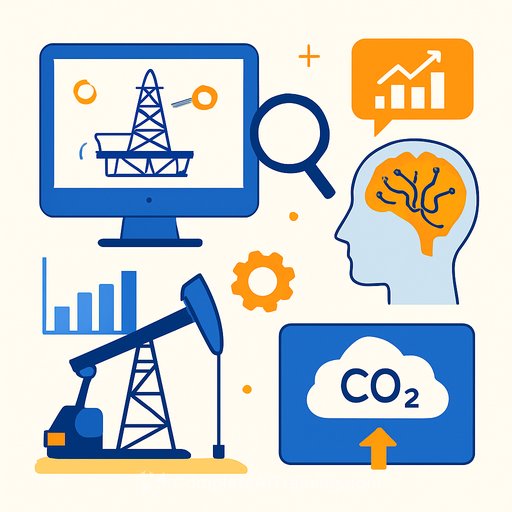
Top 10 AI tools driving innovation in oil and gas operations
Operators are being pushed to do more with tighter crews, stricter standards, and volatile markets. AI is now baked into day-to-day work across upstream, midstream, and downstream to keep assets online, cut emissions, and improve safety.
Below are ten AI tools delivering measurable gains in the field and in the control room, with examples you can benchmark against.
1. Digital twins
Digital twins create a live, data-rich view of assets and processes. They ingest sensor feeds, engineering docs, and historical performance to mirror platforms, pipelines, and refineries in near real time.
Shell and BP use digital twins for remote inspections, structural health checks, and planning. Shell reports inspection time reductions near 30%, with less exposure for personnel. Market analysts project strong growth for O&G twins through 2028, reflecting the operational value they're delivering. For context, see the digital twin market outlook from MarketsandMarkets.
- Ops wins: Faster inspections, better handovers, improved training, and tighter emissions visibility.
2. Predictive maintenance
AI-driven maintenance tools flag anomalies and forecast failures before they halt production. They analyze vibration, temperature, flows, and logs to recommend interventions.
Casting a wide net across decentralized equipment, Chevron reports roughly 20% less unplanned downtime in refining after adopting predictive tools. GE Predix and IBM Maximo are common platforms that help push maintenance from time-based to condition-based.
- Ops wins: Fewer emergency callouts, longer asset life, smarter parts planning.
3. AI-enhanced reservoir modeling
Reservoir decisions are time-sensitive and data-heavy. AI models speed up seismic interpretation, petrophysics, and reservoir behavior predictions, so teams can act with more confidence.
Schlumberger's DELFI uses machine learning across geoscience workflows to tighten field development plans. In shale, these tools improve lateral placement, frac design, and production forecasts using patterns from look-alike wells.
- Ops wins: Better well economics, fewer dry holes, tighter cycle times.
4. Remote monitoring platforms
AI-enabled monitoring brings field conditions into centralized rooms with sensor integration, edge analytics, and alerting. Algorithms watch for deviations and suggest corrections.
BP and Equinor run offshore assets from remote centers to reduce headcount offshore and keep continuity during weather or logistics constraints. Apache uses smart platforms to run unmanned pads, optimize flow, and detect leaks automatically.
- Ops wins: Leaner staffing, faster response, stable production during disruptions.
5. Asset lifecycle management tools
Coordinating design, commissioning, operations, and decommissioning gets complex fast. AI-enabled platforms such as AVEVA APM and IBM Maximo align maintenance plans, risk, and compliance in one flow.
Condition-based scheduling replaces calendars with actual asset health. Documentation stays audit-ready, which matters when regulators or insurers come calling.
- Ops wins: Lower maintenance cost, fewer paperwork loops, better compliance posture.
6. 3D visualization tools
AI-powered visualization turns drawings, scans, and drone footage into live 3D environments. Teams can "walk" the facility, see live tag data, and rehearse tasks before stepping on site.
Platforms like AVEVA Insight and Cognite Data Fusion surface valve states, pump KPIs, and control system data inside the model. Crews test scenarios, clash-check designs, and line out safe work steps without halting operations.
- Ops wins: Fewer reworks, safer interventions, faster capital project reviews.
7. Shale development optimization
Shale economics are sensitive to small choices. AI helps pick drilling paths, tune completion designs, and cut non-productive time by learning from thousands of offset wells.
Halliburton's DecisionSpace analyzes formation properties and predicts outcomes to reduce the odds of landing in poor rock. Teams standardize best practices across basins and bring unit costs down.
- Ops wins: Higher EUR per well, smoother executions, fewer surprises.
8. Training and simulation
As experienced personnel retire, simulation keeps know-how alive. AI and digital twins power realistic scenarios for control room decisions, offshore procedures, and field maintenance.
Baker Hughes and Kongsberg Digital offer environments where crews can practice rare, high-consequence events without risk. This improves readiness and shortens onboarding.
- Ops wins: Fewer errors, stronger safety culture, consistent performance across shifts.
9. Emissions monitoring and reporting
Regulators and investors expect credible emissions data. AI tools detect leaks, track flaring and venting, and automate reporting by blending sensor, satellite, and historical data.
C3 AI's ESG suite is one example focused on real-time analysis and anomaly detection. For methane context and benchmarks, the IEA Methane Tracker is a helpful reference.
- Ops wins: Faster leak detection, lower compliance risk, clearer progress on carbon intensity.
10. Integrated digital oilfield platforms
Consolidated platforms bring wells, equipment, and subsurface into one operational picture. Data from thousands of sensors flows into dashboards that recommend setpoint changes or maintenance actions.
Saudi Aramco, ADNOC, and Petrobras are deep into digital oilfield strategies. Solutions like Honeywell Forge enable centralized oversight across pads and remote sites, improving decisions and lowering total cost of ownership.
- Ops wins: Unified KPIs, fewer silos, quicker optimization across assets.
Industry outlook
AI in oil and gas has moved past pilots. It's now part of standard operating models that prioritize safety, sustainability, and margin.
Expect more automated inspections, condition-based turnarounds, credible emissions accounting, and smarter planning. Teams that build data quality, skills, and governance today gain resilience for whatever the market throws at them next.
Quick next steps for operations leaders
- Pick two use cases with clear ROI (for example, pump predictive maintenance and fugitive methane detection) and define success metrics upfront.
- Tidy the data pipeline: sensor calibration, tag naming standards, historian health, and access controls.
- Run a 90-day pilot, document learnings, and scale with standard work and playbooks.
- Upskill crews so the tools stick. If you need a structured path by role, see our AI courses by job.
Your membership also unlocks: