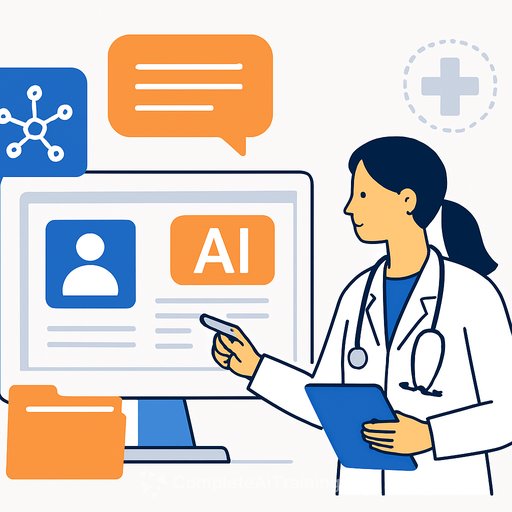
From Data Deluge to Clinical Intelligence: How AI Summarization Will Change Healthcare
The CMS Health Tech Pledge signals a turning point for data access in healthcare. By July 2026, providers, pharmacies, and health systems are expected to tap standardized data via FHIR APIs. Access is great. But more data, without smarter interpretation, can slow care and bury clinicians under alert fatigue and noise.
The path forward is pairing EHR interoperability with AI summarization. Not generic assistants. Purpose-built tools that condense decades of records into the right insights for the right moment.
Interoperability Isn't the Finish Line
FHIR solves the transport problem. It doesn't solve clinical usability in high-pressure settings. A single EHR can span years of notes, labs, imaging, and messages. The average hospital generated around 50 petabytes of data per year in 2019 - a number that's only grown. That's the equivalent of 50 million books. The Library of Congress holds roughly a third of that.
When data volume spikes, cognitive load spikes. If we don't filter, prioritize, and summarize, clinicians spend more time validating and less time treating.
Learn more about the standard here: HL7 FHIR. See CMS guidance on interoperability here: CMS Interoperability.
What Effective AI Summarization Looks Like
Different roles need different views of the same chart. An ER physician needs immediate risks and current meds. A primary care provider needs longitudinal trends and care gaps. Patients need clear, plain-language next steps.
In the ER, a patient arrives with a broken leg. A capable assistant surfaces a six-year history of recurring blood clots that changes the treatment plan. It suppresses the noise - like a lapsed flu vaccine - because it's irrelevant at that moment. That's the point: context-first output.
- Filters duplication and flags outdated entries
- Prioritizes findings based on setting (ED vs. inpatient vs. outpatient)
- Adapts language to the audience (clinician vs. patient)
- Summarizes across chart notes, clinical docs, and history via FHIR APIs
Accuracy and Oversight Are Non-Negotiable
Hallucinations, omissions, and subtle misedits can harm patients and drain clinician time. Low-quality data makes it worse: misspellings, copy-paste errors, acronyms, and inconsistent recordkeeping all amplify risk. Many health records exceed common model context windows, pushing systems beyond their limits if not engineered carefully.
AI should augment, not replace, clinical judgment. Build a "Swiss Cheese Layer" of safeguards where overlapping defenses catch errors before they reach patients.
- Human-in-the-loop review for high-stakes use cases
- Continuous monitoring and feedback loops
- Regular model updates and regression testing
- Clear audit trails for every AI-generated summary
What to Build Before July 2026
The pledge isn't just a compliance deadline. It's an operational test: can you turn standardized data into faster, safer decisions?
- Foundation: Ensure reliable FHIR connectivity, mapping, and data quality checks across key sources.
- Workflow selection: Start where clarity saves time and risk - ED triage notes, discharge summaries, inpatient handoffs, and preventive care gap reviews.
- Context routing: Route the same patient data through role-specific prompts and policies (ER, PCP, patient, care manager).
- De-duplication and recency logic: Collapse repeats, highlight deltas, and timestamp every conclusion.
- Safety gates: Phrasing checks for meds/allergies, source citations, and confidence signals when data is thin or conflicting.
How to Measure Value
- Time-to-insight: Minutes saved per chart review or handoff
- Documentation load: Reduction in note length without loss of fidelity
- Error rate: Discrepancies found in QA spot checks and chart audits
- Clinical outcomes: Timeliness of critical interventions, readmission trends
- Staff feedback: Alert fatigue, trust in summaries, adoption rates
Governance That Scales
- Use-case tiers: Define where AI drafts vs. assists vs. requires full sign-off
- Data stewardship: Standardize terminology, acronyms, and reference ranges
- Security and compliance: Access controls, logging, PHI handling, and vendor risk reviews
- Education: Provider training on when to rely on summaries and when to drill into the source
A Practical 90-Day Plan
- Weeks 1-2: Form a cross-functional team (clinical leaders, informatics, IT, compliance, quality)
- Weeks 3-6: Stand up FHIR connections and a secure sandbox; select two workflows; define gold-standard examples
- Weeks 7-10: Build context-aware prompts, add de-duplication and recency logic, configure audit trails
- Weeks 11-12: Pilot with 10-20 clinicians; collect timing, accuracy, and satisfaction metrics; refine and decide on wider rollout
Bottom Line
Interoperability will flood care teams with more data. AI summarization turns that flood into signal. Health systems that invest now will reduce cognitive load, speed decision-making, and make standardized data clinically useful when it matters most.
Don't wait for July 2026. Build the workflows, guardrails, and training today so your teams can move faster with confidence tomorrow.
Resources
Optional Upskilling for Teams
If you're planning AI-enabled workflows and want structured training for clinical, informatics, or administrative roles, explore role-based programs such as the AI Learning Path for Administrative Assistants.
Contact
Angelo Pirozzi, Managing Director, The BDO Center for Healthcare Excellence & Innovation - (561) 909-2100 / apirozzi@bdo.com
Sabina Kotelnik, Assurance Principal - (954) 989-7462 / skotelnik@bdo.com
Your membership also unlocks: