Building AI confidence early: partnering with the National Centre for Computing Education
AI adoption across the UK is moving fast, but confidence doesn't appear by magic. It's built through exposure, practice, and clear wins that students can see for themselves. That belief sits behind a partnership with the National Centre for Computing Education (NCCE) to make AI literacy practical and accessible across schools.
The goal is simple: demystify AI, widen access to computing pathways, and help young people see real careers they can step into. Start early, make it hands-on, and keep it relevant to the classroom.
From theory to practice: Year 9 AI Explorers in Leeds
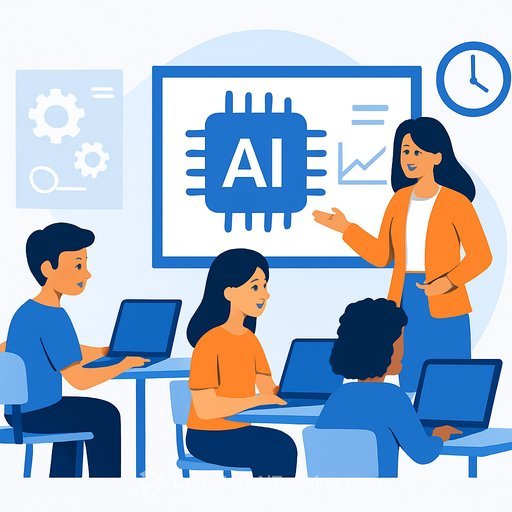
In 2024, we co-hosted an AI Explorers workshop in Leeds with NCCE for Year 9 students. The session introduced core AI concepts and moved quickly into practical prompt-engineering exercises.
Students experimented with AI tools, tested prompts, and discussed strengths and limits. Teachers told us the format made AI feel usable, safe, and tied to real tasks-rather than abstract or intimidating.
Scaling what works: new workshops and wider participation
Building on that success, more workshops are now underway, including an upcoming Manchester event aligned with NCCE's mission to widen participation. The sessions show that technology careers go far beyond traditional programming roles.
Colleagues share concrete use cases from real organisations so students can connect classroom learning to future roles. The focus stays on confidence: how AI works, where it helps, and how to use it responsibly.
Why this matters for educators
As AI becomes part of everyday work, the next generation needs technical awareness and the confidence to engage with AI tools. Early, practical exposure helps students develop both.
These programmes also broaden participation-especially for girls and students from underrepresented backgrounds who might not initially see themselves in tech. Confidence and familiarity are often the missing pieces.
Practical steps schools can take now
- Run short, low-stakes AI activities in KS3/KS4 that fit existing schemes of work. Think 20-40 minutes, clear task, quick reflection.
- Introduce prompt craft as a writing and thinking skill. Start with structure, constraints, and iterative testing. See Prompt Engineering for ideas.
- Make evaluation a habit: test outputs for accuracy, bias, and clarity. Ask students to compare versions, cite sources, and explain trade-offs.
- Use accessible, low-cost tools and set clear safety and privacy boundaries. Agree what data can and can't be shared.
- Tie AI tasks to real subjects-English (summaries, critique), Geography (data insight), Design (ideation), Computing (model limits, datasets).
- Bring in industry voices to show real pathways-data roles, product, design, analysis, operations, and policy.
- Track confidence, not just knowledge. Quick pre/post surveys help you see what's working and who needs more support.
- Be intentional about inclusion: small-group roles, visible role models, and tasks that reward diverse strengths.
For more classroom-ready approaches and training, explore AI for Education.
A partnership model you can reuse
- Co-design with teachers so activities align to curriculum and assessment needs.
- Swap long lectures for short demos and guided experiments.
- Show real constraints-costs, quality checks, data privacy-so students learn good habits early.
- Build progression: intro in Year 8/9, deeper tasks in Year 10/11, work-related projects or employer challenges in post-16.
Get involved
If you want support, the NCCE offers high-quality CPD, resources, and networks for schools. Explore opportunities at Teach Computing (NCCE).
For policy and safeguarding context, see the Department for Education's guidance on AI in education: Generative AI in education.
The takeaway
Building AI capability is not just a university or mid-career issue. It starts earlier-with familiarity, confidence, and curiosity in the classroom.
Partnerships between industry and education, like the work with NCCE, give students real experiences and clear role models. That's how we prepare young people to participate fully in an AI-enabled economy.
Your membership also unlocks: