NVIDIA Open-Sources AI Blueprints to Upgrade Warehouses and Product Catalogs
January 15, 2026
Retail leaders are getting two practical tools to modernize operations without ripping out legacy systems. NVIDIA released open-source blueprints for a Multi-Agent Intelligent Warehouse (MAIW) and Retail Catalog Enrichment that sit on top of what you already run and make it smarter, faster, and easier to manage.
What's new
The blueprints target common blockers: aging platforms, siloed data, and rising customer expectations. They give your teams a starting point to build AI agents for warehouse decisioning and product content at scale, while keeping policy controls in place.
Why it matters for operations leaders
- Reduce firefighting with real-time, explainable insights across equipment, tasks, and staffing.
- Fix "sparse data" in catalogs so products are found, understood, and purchased.
- Standardize workflows and policy enforcement across regions and brands.
- Accelerate pilots by layering AI over existing WMS/ERP, robotics, and ecom stacks.
Multi-Agent Intelligent Warehouse (MAIW)
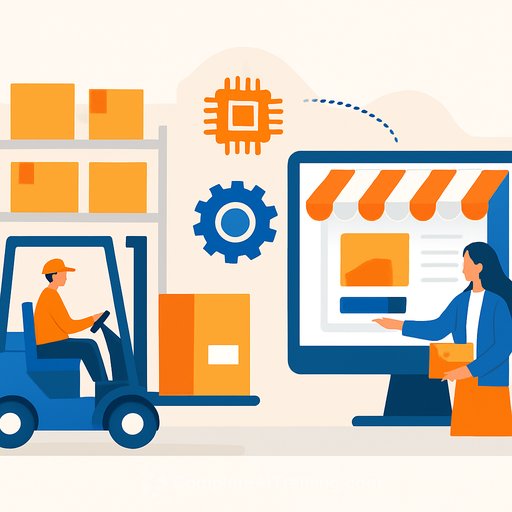
MAIW adds a synchronized AI layer above your WMS, ERP, robotics, and IoT devices. It uses specialized agents for equipment operations, task coordination, safety compliance, forecasting, and document processing (AI for Operations).
- Supervisors can ask, "Why is packing slow?" The system analyzes equipment status, task queues, and staffing to identify bottlenecks and recommend adjustments.
- Insights are explainable and policy-aware, so changes align with safety and SOPs.
- Partners like Kinetic Vision are already applying the blueprint to long-standing supply chain issues.
The result: fewer reactive shifts, more predictable and data-driven decisions on the floor.
Retail Catalog Enrichment
Retail Catalog Enrichment addresses inconsistent and incomplete product data. Using generative AI, it produces structured, localized, and brand-aligned content at scale (Generative AI and LLM).
- Generate titles, descriptions, attributes, and metadata that match your brand rules.
- Create culturally relevant 2D/3D visuals for faster onboarding and merchandising.
- Standardize attributes across suppliers and regions, improving discoverability and conversion.
- Companies like Grid Dynamics report gains in catalog accuracy and customer findability.
The bigger stack: from warehouse to storefront
Combined with tools like the NVIDIA Retail Shopping Assistant Blueprint and the open-source Nemotron-Personas-USA dataset, teams can deliver richer product pages and more conversational shopping. The direction is clear: agents that see, reason, and act on inventory and supply chain data to make retail more adaptive and autonomous.
How to pilot this quarter
- Pick one high-friction use case: packing delays, pick path optimization, or missing catalog attributes.
- Audit data sources and permissions - WMS/ERP tables, IoT streams, product feeds, brand rules - and consult Data Analysis best practices.
- Define guardrails: safety policies in the warehouse; brand, legal, and localization rules in catalog.
- Set success metrics and a review cadence with Ops, IT, and Compliance.
- Start small: integrate read-only, validate recommendations with human-in-the-loop, then automate steps with clear rollback plans.
KPIs to track
- Warehouse: dock-to-stock time, pick rate, packing cycle time, equipment uptime, SLA adherence, safety incident rate.
- Catalog: attribute completeness, time-to-listing, search-to-product click rate, product page conversion, returns due to misdescription, localization coverage.
Risk, governance, and change management
- Enforce policy at the agent level: safety limits, brand voice, and compliance constraints.
- Keep humans in approval loops for sensitive actions and content.
- Log decisions and explanations for audits and continuous improvement.
- Train supervisors and merchandisers on prompt patterns and exception handling.
Resourcing and integration
You don't need a full rebuild. Treat the blueprints as a layer that speaks to existing systems via APIs and connectors. Start with a pilot measured in weeks, prove value against one KPI, then expand scope and automation depth.
Where to learn more
Explore NVIDIA's retail initiatives and AI workflows for context and technical guidance: NVIDIA for Retail. If you're planning team upskilling around retail AI and multi-agent systems, consider focused, role-based training and hands-on pilots to build operational capability.
Your membership also unlocks: