From hype to hospital: How AI is being used in health care and research
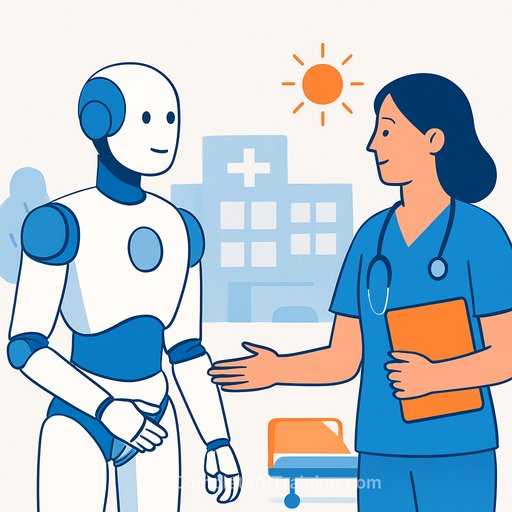
Fast-forward 25 years. The emergency waiting room is calm because humanoid robots handle triage, comfort kids, and draw blood without a fuss. AI speeds up diagnosis in imaging suites and aids discovery of safer, more effective drugs. Surgical robots shorten wait lists with precise joint and valve procedures.
Utopia? Hype? Or a near-term operating model? A free community event hosted by the Institute for Aging and Lifelong Health (IALH) at the University of Victoria, in collaboration with Island Health, will separate wishful thinking from what is already working-and what comes next.
Event snapshot
From hype to hospital: How AI is being used in health care and research
Wednesday, Jan. 28, 2026 * Free and open to health professionals and the community
"AI has incredible potential within a health-care setting, but there are still a lot of unknowns for professionals and the public," says Jodie Gawryluk, associate professor of psychology at UVic and interim director of IALH. "We hope this event brings people together to learn from world-class scientists at UVic and an award-winning clinician and executive leading the integration of AI at Island Health."
What you'll learn
- How AI is used today across radiology, dermatology, cardiology, surgery and psychiatry.
- Human factors that make or break clinical adoption: accuracy, trust, usability, safety, legal liability and public protection.
- Equity and bias: understanding data sources, measurement error and mitigation strategies.
- Social, empathic robots in care-from helping children with diabetes estimate carbs to cognitive stimulation for people with dementia.
- Real-world deployments at Island Health: decision support, operational efficiency and patient flow-plus the constraints and risks. See AI for Operations for examples of workflow and patient-flow automation.
Who's on the panel
Elizabeth Borycki and Andre Kushniruk (School of Health Information Science, UVic) will ground the discussion in clinical use cases and patient safety. "AI can streamline and modernize care," says Kushniruk. "But benefits depend on continual attention to usefulness, usability and safety."
Christopher Picard (clinical nurse specialist, trauma and forensic services, Island Health) and Graham Payette (executive director, intelligent automation and AI, Island Health) will share how AI supports decisions, operations and care delivery inside complex public systems-and where it struggles.
The session will be moderated by Jodie Gawryluk and Cindy Trytten (director of research partnerships and knowledge mobilization, Island Health). "Research on AI is, and will continue to be, critical as we move forward," says Trytten.
Why this matters for clinicians and health leaders
AI is moving from pilots to practice. That demands strong clinical governance, clear guardrails and measurable value. If you lead teams, make referrals, or manage programs, this session will help you pressure-test where AI fits-and where it doesn't.
- Trust and safety: set thresholds for model performance, calibration and drift monitoring; keep humans in control for high-stakes decisions.
- Liability and ethics: align with regulatory guidance and institutional policies; document decision pathways and escalation.
- Data quality: address representativeness, missingness and bias; validate on local populations before scale-up.
- Integration: embed into the EHR and workflows with minimal clicks; define fail-safes and fallback modes.
- Evaluation: run pre-implementation tests, then monitor outcomes (diagnostic yield, time-to-treatment, throughput, safety events) post go-live.
- Workforce readiness: upskill clinicians, informatics, and operations; set clear expectations around supervision and accountability.
- Patient communication: explain AI involvement in plain language and document consent where required.
Who should attend
- Clinicians in imaging, surgery, dermatology, cardiology and psychiatry
- Nurses, allied health, and care coordinators
- Clinical informatics, quality improvement and patient safety teams
- Program managers, operations leaders and policy makers
Helpful references
- WHO: Ethics and governance of AI for health
- Health Canada: Proposed regulatory approach for machine learning-enabled medical devices
Event details and contact
Hosted by the Institute for Aging and Lifelong Health (University of Victoria) in collaboration with Island Health.
For more information:
University of Victoria
PO Box 1700, STN CSC
Victoria, British Columbia, Canada V8W 2Y2
www.uvic.ca
Keep learning
If you're building skills for AI projects in care settings, these curated resources can help:
Your membership also unlocks: