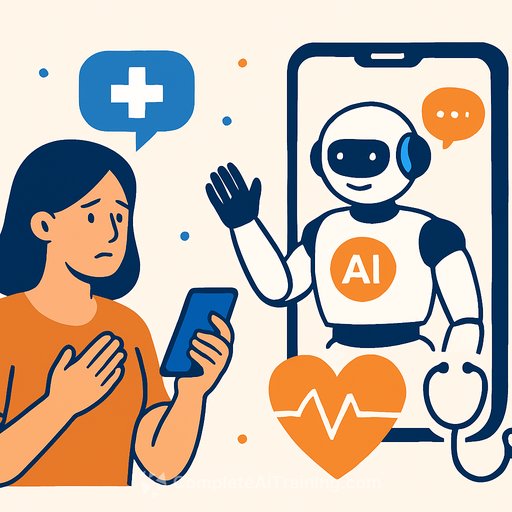
Generative AI in healthcare: promise, risk, and what leaders must do now
Generative AI is changing clinical work. It's speeding up documentation, sharpening decision support, and improving patient communication. Many clinicians feel a real cut in administrative burden ("pajama time") and faster paths to a decision. A recent survey found that about 22% of healthcare organizations have already implemented AI tools.
But as with every big tech swing, impact depends on how we deploy it. The question isn't should we use it - it's how to use it responsibly without breaking trust, safety, or equity.
The rise of shadow AI
Shadow AI is real: clinicians using generative tools outside institutional oversight. That may feel efficient in the moment, but it invites misinformation, hallucinations, and confident answers that are wrong for the patient in front of you.
Consider a question on treating an acute complicated UTI as an outpatient. Fluoroquinolones might surface as a solid option - unless the patient is pregnant, where they should be avoided due to fetal risk. Clinical nuance matters. GenAI shouldn't just give answers; it should clarify context and patient factors before suggesting anything.
Close the governance gap
There's a gap between what GenAI can deliver and how it aligns to policy, regulation, and good clinical practice. Leaving that gap unmanaged will widen disparities and erode trust. Oversight doesn't slow innovation; it enables it by giving teams clear rules for safe build, deployment, and use.
AI tools should live in secure, monitored environments with real-time detection of unsafe or unsanctioned use. Clinicians need training on value and limits. And systems must support continuous feedback as practice and technology change.
Practical guardrails leaders can implement now
- Start with high-signal use cases: ambient documentation, inbox triage, prior-auth prep, patient education with clear boundaries.
- Human-in-the-loop by design: clinicians review, edit, and own final outputs.
- Data governance: PHI handling, HIPAA compliance, logging, and retention policies that are explicit and enforced.
- Secure access: SSO, role-based controls, least privilege, and clear separation of test vs. production.
- Validation before scale: prospective tests on local data, error analysis, and clinical safety sign-off.
- Equity checks: measure disparate performance across demographics; remediate or block use if gaps persist.
- Monitoring and incident response: track drift, hallucination rates, near misses; define escalation paths and rollback.
- Reference discipline: require citations or source provenance where appropriate; flag uncertainty.
- Prompt and UX standards: collect structured context (e.g., pregnancy status) before suggesting decisions, and apply Design principles to prompts and interfaces to reduce misuse.
- Vendor diligence: model lineage, data sources, security posture, BAA, auditability, and indemnification.
- Shadow AI policy: what is allowed, what is not, and approved alternatives inside your environment.
- Education that sticks: short, role-based training on safe use, failure modes, and common pitfalls.
For policy and safety context, see the WHO guidance on ethics and governance of AI for health and the FDA's view on AI/ML-enabled medical devices.
Shift focus from hype to measurable value
Novelty isn't the goal. Tangible ROI is. Demand evidence that tools reduce administrative drag, speed decisions, and support better outcomes and experience. Be equally clear about what these tools can't do and where human judgment stays in charge.
What to measure
- Administrative time per clinician per day and after-hours EHR time.
- Time-to-decision for common pathways (e.g., chest pain, UTI, sepsis screens).
- Documentation quality: completeness, accuracy, and audit findings.
- Patient experience scores and portal responsiveness.
- Clinical outcomes tied to use case (readmissions, adherence, throughput).
- Burnout signals: turnover intent, EHR well-being metrics.
- Cost per visit/admission and revenue cycle impacts (denials, first-pass yield).
A simple rollout playbook
- Pick one workflow, one specialty, one site. Define success criteria before you start.
- Map the workflow. Insert AI where it reduces clicks or clarifies decisions - not where it adds steps.
- Stand up a safe sandbox. Red-team for hallucinations, bias, leakage, and prompt injection.
- Align legal, compliance, security, and clinical leadership early. Document guardrails.
- Train users with real cases. Pair quick-reference guides with office hours.
- Go live with opt-in superusers. Monitor, collect feedback, and iterate weekly.
- Report results openly. If targets are met, scale. If not, pause and fix.
- Schedule model and prompt updates with change control and re-validation.
Leadership sets the tone
Technology won't fix misaligned incentives, fragmented workflows, or weak processes. Leaders will. Set a clear policy, pick evidence-backed tools, and keep patient safety and trust non-negotiable.
If we do this well, GenAI won't replace clinical judgment - it will clear the path for it. Less busywork. Faster clarity. Better care.
Next step: upskill your teams
If your clinicians and ops teams need structured, role-based learning on safe, practical AI use, explore curated AI courses by job.
Your membership also unlocks: