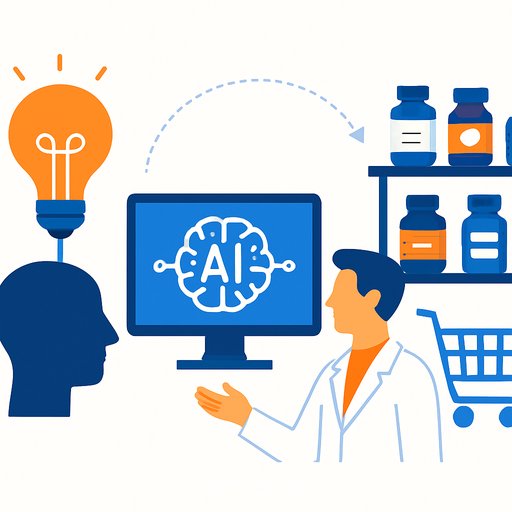
How AI Transforms Supplement R&D: Faster Research, Sharper Formulation, Safer Execution
AI is no longer optional for product teams. It speeds up discovery, flags risks early and keeps execution tight - as long as humans lead with judgment and scientific rigor.
Use AI for depth and speed. Use your team for strategy, standards and decisions. For teams building skills in data mining, modeling and automation, see the AI Learning Path for Data Scientists for a structured curriculum.
At a Glance
- AI compresses weeks of research into days and improves decision quality across the R&D pipeline.
- The edge comes from pairing AI insights with clear hypotheses, tight prompts and disciplined execution.
- Compliance, claims and patents still demand human review and accountability.
Why this matters for product development
Breakthroughs come from speed plus direction. If the greats had today's information flow, they would have shipped sooner. Your team can, too - if AI is built into the process instead of tacked on at the end.
Think of AI as an accelerator for focus. It finds patterns fast, but it won't pick your bets or carry your standards. That's your job.
How AI streamlines early Research
Research speed: Start with data mining. Let AI scan literature, reports and public datasets to surface patterns tied to stability, shelf-life, taste, dosing and bioavailability. You'll see likely failure points before they become expensive.
Product ideation: AI can cluster feedback from conferences, customer calls and surveys to spot rising ingredients and claims. Word-of-mouth still matters in nutraceuticals - AI just gives it structure and signal.
Literature review: Replace weeks of manual reading with AI-driven synthesis. Have it summarize findings, propose Design of experiments (DOE) and flag novel combinations worth testing. Keep your prompts specific to the use case and target population.
Patent analysis: Use AI with patent databases to check prior art, spot white space and reduce duplication. For global searches, WIPO PATENTSCOPE is a strong starting point.
Market validation: Turn insights into testable hypotheses. Ask AI to estimate TAM/SAM, map competing claims and pressure-test price points. Kill ideas that don't meet demand or margin thresholds - early.
Regulatory screening: Have AI flag red zones for claims and ingredients before you invest in lab time. For U.S. context, review FDA GRAS guidance as part of due diligence.
Result: early-stage work shifts from slow and manual to focused and data-led, with fewer surprises downstream.
How AI reduces friction in development and formulation
Lab simulation: Run virtual models to predict bioavailability, stability and ingredient interactions under different conditions. AI-assisted excipient selection trims guesswork and gives junior formulators a confident starting point while giving veterans a quick gut-check.
Experimentation design (DOE): Ask AI to draft DOE tables, define variables and controls, and suggest statistical models. It can also recommend instrumentation - e.g., which encapsulation approach or spray dryer specs - so you waste fewer batches.
Project planning: Feed AI the scope, budget and constraints. Have it propose timelines, resource loads, cost models and risk registers. Use chatbots for real-time notes, workload tracking and quick troubleshooting across functions.
AI as a partner, not a replacement
AI supports; it doesn't lead. Product and R&D leaders still make trade-offs, uphold scientific integrity and set the bar for claims.
Before scale-up, run the essentials: GRAS/NDI checks, claims validation, global regs review and a patent sweep. AI can prep the work. You sign off.
A practical playbook for product teams
- Define the problem tightly: Who is it for? What outcome? What constraints (taste, dose, form factor, cost)?
- Prompt with context: Provide population, mechanism, dosage range, target claims and regulatory markets. Short, specific and structured.
- Pressure-test with data: Ask AI for counter-evidence, confounders and likely failure modes. Plan tests to break your own idea.
- Close the loop fast: Move from virtual to bench with a small, clear DOE. Update assumptions after every run.
- Document decisions: Keep an auditable trail of sources, prompts and choices for QA, regulatory and IP.
Known limits (and how to handle them)
Model gaps: AI can miss context or misread abstracts. Cross-check with primary studies and SMEs.
Sustainability and compute: Favor lightweight tools for routine work; save heavy runs for high-impact questions.
Data quality: Garbage in, garbage out. Curate your sources and lock a reference library for the team.
Bottom line
AI speeds discovery, sharpens formulation choices and reduces execution risk. The teams that win pair it with clear hypotheses, clean data and strong leadership standards.
Build AI into the way you research, decide and ship - then let the science, the market and your results do the talking.
Your membership also unlocks: