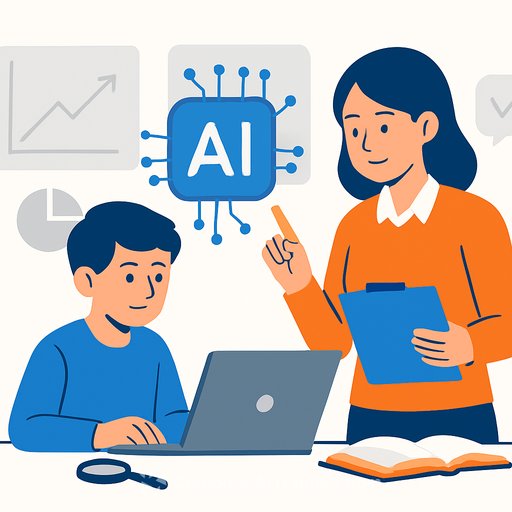
How AI is helping some educators teach science and research
In October, Society for Science brought 200 research teachers to Washington, D.C. for a weekend packed with practice-focused sessions. Backed by Regeneron and DoD STEM through the Defense STEM Education Consortium, the agenda ranged from building research programs to a hands-on look at how generative AI can support student research without crossing ethical lines.
One session led by Brandon Boswell (Cypress Bay High School, FL) and Rojhene Jamero (Desert Pines High School, NV) zeroed in on using AI chatbots for research ideation and workflow support. Their stance was simple: AI is a tool-useful across the research lifecycle when guided, monitored and cited.
Why AI belongs in the research classroom
- It speeds up brainstorming, keyword discovery and scoping so students spend more time on method, analysis and interpretation.
- It can summarize abstracts, propose comparison frameworks and draft data tables, while students do the thinking and decision-making.
- It builds student independence-if you teach them how to question outputs, verify sources and show their work.
A practical student workflow (from idea to analysis)
- Start broad, then narrow: Ask an AI tool for subtopics and key terms for a general interest area (e.g., CRISPR, microplastics, solar cell efficiency). Curate, don't copy.
- Search with intent: Turn those terms into search strings and head to Google Scholar. Pull 10-15 recent abstracts that directly match the question space.
- Summarize for signal: Have AI produce 1-2 sentence summaries of each abstract plus a quick matrix of variables, methods and sample sizes. Flag anything that looks off and verify manually.
- Find the gap: Ask AI to list unresolved questions based on the summaries. Pick one gap that's feasible with available time, tools and ethics approvals.
- Draft the research question: Write your own RQ, then use AI to stress-test clarity, measurability and scope. Final wording is the student's decision.
- Plan methods with guardrails: Ask for method options, controls and potential confounds. Confirm feasibility with your teacher; document all advice you accept or reject.
- Organize data: Use AI to format blank tables, codebooks or analysis checklists. Students collect data, run stats and interpret results themselves.
- Track everything: Keep a prompt log and a literature matrix. Transparency matters-especially for competitions and publications.
Case study: from a broad idea to a testable question
A student began with "Are supplement labels accurate?"-interesting, but too wide. With AI as a sounding board, he found that mislabeling rates vary by category and narrowed to a single target: lion's mane mushroom supplements. That shift turned a vague concern into a concrete, testable plan around label accuracy and quality control.
Academic integrity: what to teach and enforce
- No copy-paste. AI outputs are inputs to thinking, not finished work. Summaries, outlines and tables are starting points.
- Disclose AI use. Require a short "AI assistance" note in methods/acknowledgments and in competition entries.
- Cite appropriately. Follow your style guide for AI citations. See APA's guidance on citing AI systems like ChatGPT: APA: How to cite ChatGPT.
- Verify claims and citations. Check facts, chase down original sources and reject fabricated references.
- Protect data and privacy. Don't paste identifiable or sensitive information into public tools.
- Teachers model the standard. Demonstrate prompt design, critique outputs in front of students and show your own disclosure language.
Classroom policies that work
- Define allowed vs. prohibited uses: Brainstorming, summarizing abstracts and formatting tables may be allowed; generating research questions, writing analysis or conclusions is not.
- Require process evidence: Prompt logs, annotated PDFs and a literature matrix make thinking visible.
- Use a "tool declaration" line: Note the model (e.g., Copilot, ChatGPT), date and task supported.
- Rubrics that reward thinking: Heavier weight on method quality, data integrity and interpretation, not polish alone.
- Competition readiness: Ensure students include AI disclosures and citations in all materials.
Common pitfalls to teach explicitly
- Hallucinations: Confident, wrong answers-always verify.
- Fake references: Never accept a citation without finding the source.
- Overreliance: Letting AI steer the project can flatten originality.
- Equity and access: Match expectations to the tools your district provides (many use Microsoft Copilot); offer no-cost alternatives when possible.
What educators shared next
The AI conversation continued into a scientific integrity workshop where teachers compared policies, disclosure templates and citation practices. The consensus: integrate AI where it saves time, keep students accountable for original thought and make transparency non-negotiable.
If you want structured upskilling on prompt craft, evaluation and research workflows, explore these resources: AI courses by job.
Date: December 2, 2025
Your membership also unlocks: