AI-Driven Influence Operations: Threats to Middle Eastern Information Sovereignty in the Age of Synthetic Media
AI has turned influence operations into a low-cost, high-scale function. That's a problem for governments, platforms, and any ops team responsible for trust, safety, comms, or security in the Middle East.
The playbook is simple: flood channels, impersonate insiders, exploit cognitive shortcuts, then move fast enough to outrun attribution. Your job is to shrink time-to-detection, raise the cost of deception, and build public resilience ahead of the next surge.
What's actually new
- Scale at near-zero marginal cost: LLM-driven bots can generate convincing text nonstop.
- Believability on demand: deepfakes, AI headshots, and voice clones reduce the friction to trust.
- Personalization: models can infer interests and likely traits from public data to tailor hooks.
- Algorithmic leverage: systems boost provocative content, compounding effects like the illusory truth and social proof biases.
Case brief: ISIS
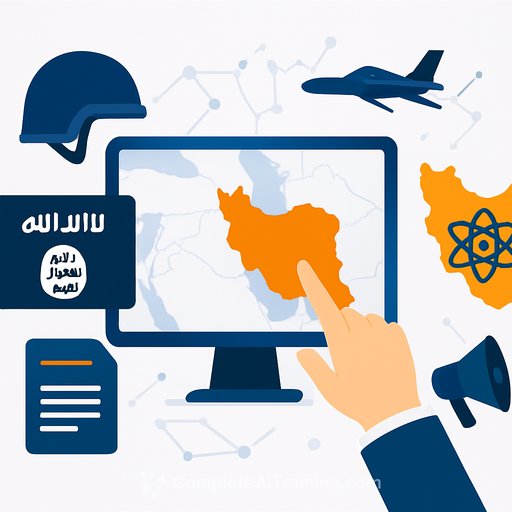
Historically, ISIS exploited platform algorithms and repetition to inflate perceived support and push propaganda. Tools like the Dawn of Glad Tidings app once coordinated tens of thousands of posts in a day.
Today the tooling is cheaper and smarter. Bots amplify content on Telegram, generative models draft persuasive narratives, and deepfake news-style videos add false legitimacy. Automatic speech recognition helps translate and distribute content quickly. Small cells can now run operations that used to require large teams.
Case brief: The Muslim Brotherhood
The Brotherhood's "E-militias" used fake accounts and coordinated hashtags to simulate momentum. Platforms have removed large bot networks tied to its affiliates across Egypt, Turkey, Morocco, and Libya, including accounts with AI-generated profile photos.
Beyond loud propaganda, more covert tactics matter: AI-assisted text generation to impersonate locals, seed divisive talking points, and evade legal risk. Messages that appear to come from in-group members typically persuade more-and they're harder to attribute and counter quickly.
Case brief: Iran as a state actor
Iran's IRGC-linked units combine coordinated propaganda, social engineering, and cyber operations. Investigations have exposed ChatGPT-powered content farms, large bot datasets targeting rivals, and campaigns impersonating local news outlets in Arab states.
The standout move is social engineering at scale. Groups like Charming Kitten impersonate researchers and journalists to lure targets to credential traps. LLMs raise quality, volume, and personalization, and voice cloning expands the attack surface.
For context, see recent disruptions by OpenAI and Microsoft on Iranian influence activity: OpenAI report and Microsoft analysis.
Near-term risks you should plan for
- LLM impersonation of politicians and public figures, boosted by more convincing deepfakes.
- Automated personality inference from digital footprints feeding microtargeting pipelines.
- Chatbot recruiters that build rapport and adapt narratives one-to-one at scale.
- End-to-end automation across content creation, amplification, and engagement farming.
Ops playbook: What to deploy now
1) Detection and monitoring
- Bot detection at the graph and content levels: velocity spikes, coordination clusters, recycled phrasing, account-age anomalies, and AI-headshot signatures.
- Deepfake and synthetic media checks in the pipeline: audio-visual forensics, lip-sync drift, emotion mismatches, and model-specific artifacts.
- Provenance by default: adopt C2PA-style content authenticity signals where feasible; verify and log any watermark or label on ingest.
- Threat intel integration: ingest IO indicators into SIEM/SOAR and watch for cross-platform pivots within hours, not days.
For deeper methods on detection, forensics, and threat intel, see Research.
2) Platform and policy controls
- Raise friction for automation: stronger verification for high-reach accounts, rate limits for new accounts, mandatory disclosure for automated posting.
- Clear takedown pathways: pre-agreed evidence thresholds, 24/7 escalation channels, and regional legal cooperation for spoofed media outlets.
- API governance: restrict unlabelled bot access and rotate keys aggressively; require labeling of AI-generated content distributed via APIs.
3) Social engineering defenses
- Zero-trust for inbound outreach: no links or files from "journalists/researchers" without out-of-band verification and domain checks.
- Hardened identity: phishing-resistant MFA, hardware keys for VIPs, strict session lifetimes, and forced re-auth on sensitive actions.
- Voice and meeting safeguards: use callback codes for phone requests and watermark internal recordings; treat urgent requests as high risk.
- Mail security tuned for LLM phish: look for high-quality but off-context asks, slight role mismatches, and newly-registered domains.
4) Public resilience and workforce readiness
- Prebunking and inoculation: short, repeatable modules that show common manipulation tactics-bots, deepfakes, impersonation-and how to spot them.
- Tabletop the info-ops kill chain: run quarterly drills on rumor spikes, fake politician audio, and coordinated hashtag pushes.
- Classroom and youth programs: adolescents are more susceptible to social influence, so build early digital and AI literacy into curricula.
If your ops teams need a fast upskill path on AI-aware workflows, see courses by job and popular certifications.
5) Crisis communications that work under stress
For messaging and reputational playbooks tailored to rapid-response scenarios, see AI for PR & Communications.
- Pre-approved holding lines and rumor-control hubs you can publish in minutes.
- Templates for visual disclaimers on likely deepfake formats and voice-message forgeries.
- A single source of truth updated on a strict cadence; syndicate to SMS, WhatsApp, and local broadcasters to reach low-bandwidth audiences.
6) Metrics that matter
- Lead time: first-signal to first-action minutes.
- Takedown time: report to removal across platforms.
- Containment: growth rate of targeted narratives after intervention.
- False positives: precision of bot and deepfake flags.
- Readiness: training completion and drill performance for comms and security teams.
7) Data and governance
- Minimize data while enabling detection: collect only what's needed to spot coordination and verify authenticity.
- Document model use: when you rely on AI to flag bots or media, track versions, thresholds, and reviewer overrides.
- Privacy and legal alignment: enforce retention limits and consent rules, especially for face or voice analysis.
8) 30-60-90 day rollout
- Days 0-30: stand up IO monitoring in your SIEM, enable phishing-resistant MFA for VIPs, publish your takedown SOP, and ship prebunking v1.
- Days 31-60: integrate deepfake checks into media workflows, launch quarterly drills, and lock down API keys and automation labeling.
- Days 61-90: deploy content provenance signals, expand cross-border takedown channels, and tune ML thresholds from real incidents.
What this means for operations
AI gives adversaries speed, scale, and plausible deniability. Your edge is disciplined detection, preplanned comms, and a public that knows the tricks before they see them.
Treat this as an always-on function. Shorten feedback loops, practice under live traffic, and make truth easy to find-then make it boring for attackers to try again.
Your membership also unlocks: