AI-Driven Generative Design: Moving Engineering from Iteration to Innovation
Great products aren't born from guessing. They come from exploring more of the design space earlier, with physics and manufacturability built in. That's what AI-driven generative Design delivers: thousands of valid alternatives up front, faster engineering cycles, and cleaner trade-offs.
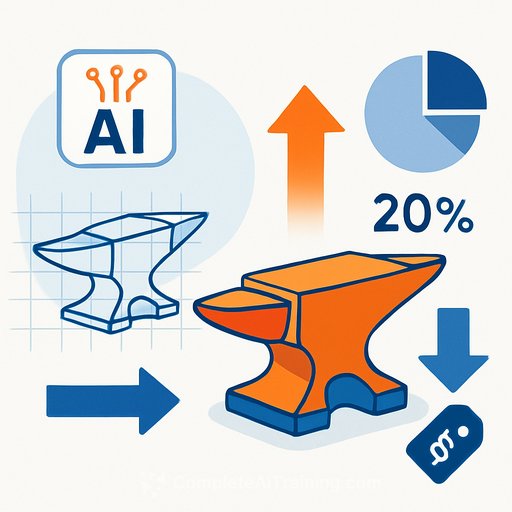
Teams are reporting 30-50% faster time-to-market, 10-50% weight reductions, and up to 20% cost savings. Less rework. Fewer late surprises. More confidence in the concepts you greenlight.
At a glance
- Massive exploration: AI evaluates thousands of options against real constraints (loads, materials, process, cost).
- Faster programs: Up to 50% acceleration by moving simulation and optimization to the front of the process.
- Lean parts: Up to 50% weight reduction while meeting stiffness and strength targets.
From "draw and test" to "define and explore"
Traditional workflows start with geometry and iterate through simulation, prototyping, and edits. That limits how many concepts you can reasonably test.
Generative flips the script. You define the problem (loads, materials, interfaces, process, targets), then let the system explore. You review ranked, valid options rather than guess which idea might work.
Beyond topology optimization
Topology optimization trims material from an existing shape. Generative design starts clean and creates geometry to meet multiple objectives at once. It respects material behavior and how you plan to make the part-additive, casting, forging, or machining.
With AI in the loop, each iteration learns from the last. Over time, the system spots patterns that lead to better outcomes under specific conditions.
How AI fits into the workflow
- Automated decisions: Scores options across competing goals like weight, stiffness, and manufacturability.
- Simulation inside the loop: FEA and multiphysics validate every candidate as it's generated.
- Constraint awareness: Enforces realities like minimum wall thickness, draft, and tool access from the start.
- Design learning: Uses prior test data or field performance to guide future exploration.
The result is a parallel workflow-simulation, optimization, and manufacturability checks happen together instead of in sequence.
Where teams are applying it
- Aerospace and defense: Lightweight structures to optimize payload, range, and safety.
- Automotive and transportation: Multi-load components (suspension arms, crash structures) that balance stiffness, weight, and cost.
- Industrial equipment: Frames and machine bases with better stiffness-to-weight ratios, reducing vibration and energy use.
- Medical devices: Orthopedic implants and surgical tools with strength, conformity, and less material.
- Consumer products: Structural efficiency with clean, organic aesthetics and better ergonomics.
Measured outcomes
- Time to market: 30-50% faster by front-loading exploration and combining optimization with simulation.
- Weight efficiency: 10-50% lighter parts meeting strength and stiffness targets. For example, Jacobs reports up to 50% mass reduction and about 20% design-time savings.
- Cost: Up to 20% savings via less material, part consolidation, and simpler production.
- Innovation throughput: Teams review hundreds or thousands of viable geometries; Zeiss used this breadth to identify stronger options.
- Sustainability: Lighter parts reduce fuel use and emissions; Cummins commonly sees 10-15% material reductions.
Solving the manufacturability gap
High-performing designs that can't be produced create friction later. Generative design builds process rules into the front end. If you specify "additive only" or "3-axis milling," geometry generation respects it.
This is especially useful for additive manufacturing. Structures that were impractical with traditional methods become feasible, and supports, overhangs, and minimum features are managed early. For background on additive constraints and standards, see NIST's work on additive manufacturing.
Make it real: a 30-60 day pilot
- Pick the right part: Target a component with clear load cases, aggressive weight or cost targets, and room for change.
- Lock the constraints: Materials, restricted zones, keep-outs, interfaces, and the intended manufacturing process.
- Define success metrics: Rank objectives (e.g., 30% weight cut, equal stiffness, 10% cost drop). Set pass/fail thresholds.
- Automate the loop: Integrate FEA, set batch runs, and generate hundreds of candidates overnight.
- Screen for production: Apply process checks (draft, tool reach, minimum thickness, overhangs) before human review.
- Converge the shortlist: Compare top designs against KPIs, then validate with higher-fidelity simulation and a prototype.
- Document the rules: Capture constraints, solver settings, and review criteria so the next project moves faster.
What to watch
- Garbage in, garbage out: Poor load cases or boundary conditions lead to weak results. Calibrate with test data if you have it.
- Overfitting to the solver: Don't chase theoretical wins that vanish under real manufacturing limits. Keep process rules tight.
- Change management: New shapes require new supplier conversations and inspection plans. Involve manufacturing early.
Why this matters to product development
Most teams are capacity-limited during concept development. Generative design expands your option set without ballooning headcount. You start with vetted candidates that meet your constraints, then spend your time on trade-offs, risk, and program goals.
It also improves institutional knowledge. Seeing how geometry shifts with each constraint teaches your team faster than isolated simulations and scattered prototypes.
The road ahead
As AI improves, generative design will feel more like a connected system: design targets, simulation, cost models, and manufacturing data in one loop. Engineers still set the problem. AI surfaces more viable paths and shortens the learning curve.
If your team is building AI skills for product development, explore role-based training options here: AI courses by job.
Your membership also unlocks: