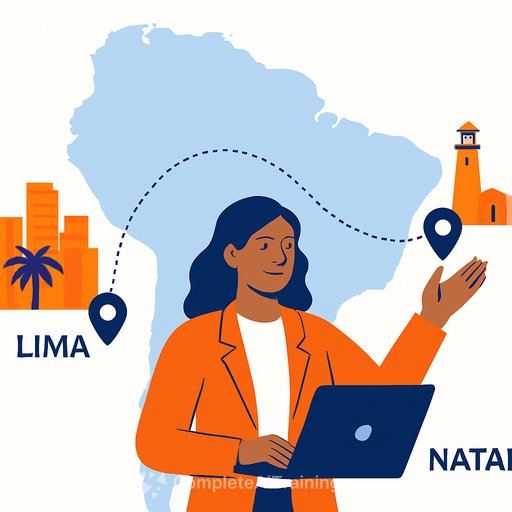
Global Connections: Professor Gomezgil Yaspik Brings Bowdoin's AI and Humanities Research to South America
Professor Gomezgil Yaspik, of the Digital and Computational Studies Program, represented Bowdoin across multiple academic venues in Peru and Brazil-advancing international work in data science, artificial intelligence, and the humanities.
AI and Education: Lima, Peru
In Lima, at the Pontifical Catholic University of Peru (PUCP), Yaspik delivered a talk on "Large Language Models for the Social Sciences." This session built on Bowdoin's recent presence in the region with former students Ari Bersch '25 and Ian Stebbins '25.
Her message was straightforward: generative models are both objects we study and tools we use. For liberal-arts pedagogy and research, that means interrogating bias, documenting prompts and data sources, and treating model output as evidence to be tested-no different from any experimental pipeline.
Brazil: Workshops, Classrooms, and Faculty Development
In Brazil, Yaspik ran a series of Portuguese-language workshops with municipal and federal partners. At the Universidade Federal do Rio Grande do Norte, she led a session on integrating data science with critical humanities perspectives in the classroom.
At Escola Agrícola de Jundiaí-the former school of Bowdoin's Ana Lopes '27-she met with more than 100 students to discuss responsible use of AI for research and learning. A separate workshop with faculty centered on policy, assessment, and equity. She also gave a keynote at Parnamirim Federal School focused on AI literacy and preparing students for a fast-changing digital environment.
Neuroscience Collaboration: Natal, Brazil
The visit concluded at the Instituto Internacional de Neurociências in Natal, where Yaspik met with researchers to explore collaborations at the intersection of AI, brain science, and human learning. The conversations pointed to shared agendas across model evaluation, cognitive insights, and education research.
What's Next: Data Science Lab and the Hastings Initiative
Across events, Yaspik previewed her upcoming Data Science Lab, slated for launch in summer 2026. The lab will serve as a hub for projects that connect data, ethics, and society with clear routes to classroom application.
This work fits the Hastings Initiative for AI and Humanity, supported by alumnus Reed Hastings '83, which centers the relationship between digital artifacts and human values-and how each influences the other.
Practical takeaways for scientists and research leaders
- Make AI literacy concrete: define allowed use, citation norms for model-assisted writing, and expectations for versioning prompts and datasets.
- Co-teach across fields: pair data science with humanities to test model claims, surface bias, and sharpen critique.
- Localize for adoption: the Brazil workshops ran fully in Portuguese and partnered with public institutions-language and context matter.
- Bridge labs and schools: student sessions plus faculty development create a feedback loop for curriculum, evaluation, and policy.
- Plan infrastructure early: for a 2026 lab, scope compute, governance, and IRB workflows alongside pedagogy and outreach.
Further reading and resources
- UNESCO guidance on generative AI in education and research
- Building a training path for your team? See curated options by role: Complete AI Training: Courses by Job
Published: December 05, 2025
Your membership also unlocks: