AI that fixes LPO chaos in Tanzania's supply chains
Operations teams across Tanzania spend 20+ hours every week typing Local Purchase Orders into ERPs. PDFs. Emails. Scanned handwriting. It adds up-slower decisions, delayed deliveries, stock-outs, complaints, and lost revenue.
Factories automate lines. Warehouses track inventory. Quality gets sensors and dashboards. Procurement, though, is still stuck in manual entry because most tools don't handle the messy, inconsistent documents common in our market.
Why procurement has lagged
Global procurement software assumes clean data and standard formats. Tanzania doesn't work that way. Distributors use different templates, product names vary, tax rules shift by customer, and many orders arrive as scanned images. The result: rework, errors, and stalled throughput.
What's changing
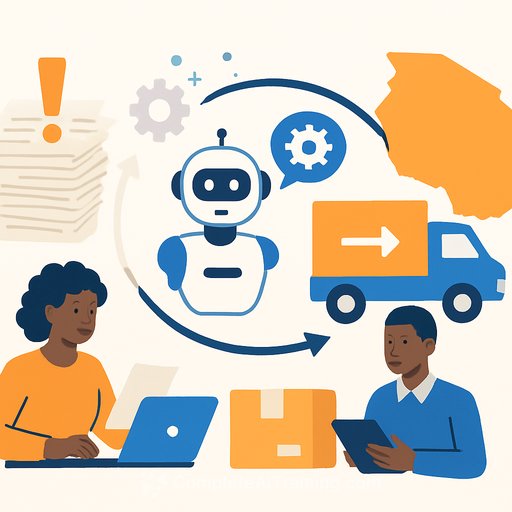
Local software teams are building AI that reads unstructured LPOs and turns them into clean, validated orders. These systems are built for the realities on the ground-FMCG, beverage, retail, agriculture, and industrial trade.
One example: Eva Docs.ai by Solutech. It reads LPOs from email or upload, maps products, extracts quantities and customer-specific pricing, applies the right taxes, and posts directly to your ERP. That removes manual keying and standardizes procurement workflows across regions and distributor networks.
Proof from East African operators
Early adopters such as Highlands Drinks Limited, Text Book Centre, Steelwool Africa, and Maxam Limited report real results. Teams are saving 10-15 hours per week, cutting order-to-delivery from days to hours, and reducing document errors by 40-50 percent. That hits the P&L-faster cash cycles, fewer disputes, and better fill rates.
The strategic case for Tanzania
Policy momentum is strong. Digital programs and pro-industry initiatives make this a practical move, not a moonshot. For context, see the World Bank's overview of Digital Tanzania.
Some teams still prefer manual control. Others see AI as an efficiency lever. Either way, speed, accuracy, and agility will decide who wins across regions-and AI-led procurement will become standard.
What operations leaders should do next
- Baseline: Track weekly LPO volume, processing time, and error rates for 4 weeks.
- Fit check: Require OCR for PDFs/scans, email parsing, SKU and customer-price-list mapping, tax logic, and ERP posting.
- Pilot scope: Start with one distributor or region and 2-3 high-volume SKUs.
- KPIs: Time saved per week, cycle time (LPO received to ERP posted), error rate, and order accuracy.
- Controls: Approval rules, audit trails, tax configurations, and user permissions.
- Change: Update SOPs, train staff, and set a weekly review to clear edge cases.
Integration checklist
- ERP connection: Credentials, sandbox, and test company ready.
- Product master: Clean SKUs, aliases, and UOMs aligned to distributor naming.
- Price lists: Customer-specific pricing and discounts loaded and current.
- Tax: VAT, exemptions, and customer tax profiles confirmed.
- Exception handling: Clear routing for unknown SKUs, unreadable scans, and mismatched prices.
ROI snapshot
If your team spends 20 hours a week on LPO entry and AI removes 12 of those, you free more than 600 hours a year. Even a modest reduction in errors and faster cycle times compounds-fewer stock-outs, fewer credit notes, better service levels.
Bottom line
AI that reads and posts LPOs is no longer theoretical. It's live, it works with local formats, and it delivers measurable gains now. Start small, prove the numbers, and scale across distributors.
If you're upskilling your team on AI workflow automation and ERP-adjacent use cases, explore practical curricula here: AI courses by job.
Your membership also unlocks: