Hassayampa Ranch: Where AI meets the desert-and tests the limits of land, water, and power
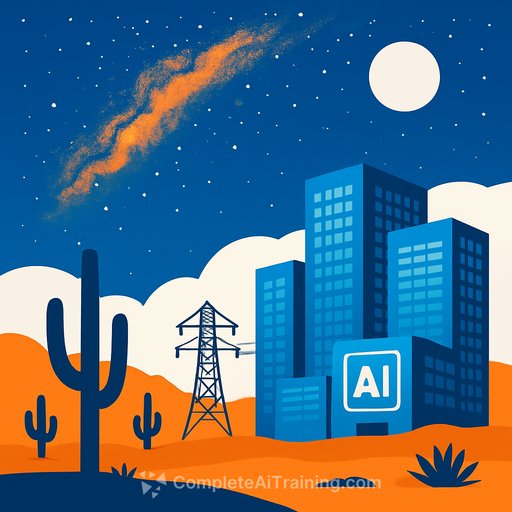
Hassayampa Ranch sits 50 miles west of Phoenix, ringed by saguaro and home to coyotes, jackrabbits, and rattlesnakes. A few hundred people live there for the quiet and the stars.
Now the desert is slated for an AI-scale transformation. Maricopa County supervisors approved an amendment to enable industrial rezoning on a 2,000-acre parcel-paving the way for a mega data center campus that neighbors openly oppose.
Developer Anita Verma-Lallian acquired the tract in May 2025 for $51 million, backed by investors including Chamath Palihapitiya. Her team is courting a cloud hyperscaler-Meta, Google, OpenAI, or others-to anchor the site. "We have probably six to eight large hyperscalers that are interested in looking at it," she said.
What's actually being built
The plan calls for a multi-building campus with aisles of GPU racks, 24/7 cooling, and roughly 1.5 gigawatts of load-enough electricity for over a million homes. Estimated build cost: up to $25 billion.
Expect phased delivery, shell-first strategies, and tenant-driven fit-out standards. Noise controls, heat rejection, and utility tie-ins will dictate the site plan as much as the building footprint.
Why this desert site pencils
- Proximity to major generation: near the Palo Verde nuclear plant and existing transmission corridors.
- Gas pipeline in reach: supports on-site generation or peaker capacity if grid interconnection lags.
- Scale: 2,000 acres is rare in Arizona's privately held inventory (only ~17% of land is private).
- Regulatory opening: housing stalled after Arizona limited new "assured water supply" certificates; industrial uses don't require that certificate at zoning. The parcel sits within the Phoenix Active Management Area, so groundwater rules still apply (Arizona AMA overview).
Local pushback you should plan for
Neighbors worry about wells, traffic, noise, light, and property values. Some moved there to see the Milky Way; nonstop cooling plants and construction equipment don't help that dream.
The development team says it will preserve washes, increase setbacks, and refine screening during site-plan review. That's where view corridors, landscaping, building height, night lighting, and acoustic controls are negotiated-often the make-or-break phase for projects this large.
Water: the red line in the West Valley
Options on the table include partnering with the area's water utility, tenant-supplied water via new wells, on-site storage, and aggressive recycling. Final usage and sources will be defined at site planning and tenant selection.
Design choices matter: air-cooled vs. evaporative cooling, hybrid chillers, warm-water liquid cooling, and heat reuse can dramatically change annual gallons and summer peaks. Teams should spell this out early and consider targeted training - for example, AI Design Courses - to reduce risk and win credibility with neighbors.
Power: the real bottleneck
1.5 GW requires multiple high-voltage interconnects, new substations, and long-lead equipment. Even with big load centers nearby, interconnection queues can stretch years-often longer than entitlement timelines.
Mitigation levers: staged capacity blocks, dual feeds, on-site gas peakers, battery storage, and early utility design packages. Track the interconnection queue health and cycle times in your region (Berkeley Lab queue tracker).
How the deal got unlocked
The land previously had residential zoning for a master-planned community, but the housing plan stalled after water restrictions. Industrial didn't require proving a long-term water supply at zoning-so the use case pivoted.
Verma-Lallian aims to land a hyperscaler, then build out in phases. She also closed a separate 2,069-acre sale in nearby Buckeye for $136 million, signaling an asset strategy focused on land, scale, and power adjacency.
The national picture
AI data centers are moving from quiet utilities to front-page fights. Projects in Louisiana, Wisconsin, and Georgia have triggered campaigns over power prices, water draw, safety, and light and noise pollution.
Federal policy has prioritized speed-an AI Action Plan, permitting acceleration, and grid expansion-while political voices from both parties argue over costs and benefits. Meanwhile, hyperscalers and AI firms are pushing record capex, with industry spending projected to reach $1 trillion annually by 2030.
Construction and delivery realities
- Lead times: transformers, switchgear, generators, chillers, and GPU supply chains drive schedule risk. Pre-buy long-lead items.
- Cooling strategy: liquid-ready designs reduce water consumption and increase density but change commissioning and O&M needs.
- Acoustics: continuous equipment loads require berms, sound walls, low-noise fans, and strict nighttime dBA limits.
- Thermal and heat maps: sun exposure, wind patterns, and monsoon events affect layout, plume dispersion, and flood routing.
- 24/7 operations: design for shift parking, service yards, and secure logistics with conflict-free truck paths.
Entitlements and incentives checklist
- Zoning and use: confirm permitted industrial uses, height, FAR, and outdoor equipment allowances.
- Setbacks and screening: commit to view corridors, lighting caps (shielding, CCT), and native buffers.
- Water rights and reporting: AMA compliance, metering, recycling commitments, contingency sources.
- Power roadmap: interconnection studies, substation siting, easements, on-site generation permits.
- Traffic and safety: construction phasing plan, haul routes, school-hour restrictions, dust control.
- Incentives: sales/use tax relief on equipment, property tax abatement, FTZ, accelerated depreciation.
- Community benefits: well protections, emergency services support, noise/light guarantees, local hiring.
- Exit optionality: design shells for future use-manufacturing, logistics, or mixed industrial-if AI demand cools.
What to promise-and what to prove
- Noise: third-party modeling, enforceable dBA limits, and continuous monitoring at property lines.
- Light: full cutoff fixtures, low color temperature, and time-based dimming.
- Water: max-usage caps by phase, recycling targets, drought triggers, and public reporting.
- Power: phase-aligned capacity with utility letters, plus backup plans if interconnects slip.
- Desert washes: preserve drainage paths, use crossing structures, and design for monsoon flow.
The investor view
Palihapitiya calls energy the fulcrum asset for AI-era infrastructure. The wrapper is the data center; the constraint is reliable megawatts.
For developers and contractors, the win comes from controlling land with transmission access, solving water, and de-risking entitlement-then aligning with a tenant's playbook. If AI demand stalls, a well-planned shell can pivot to other industrial uses.
Rule-of-thumb guardrails
- Capex: AI-grade builds can exceed $10M per delivered MW depending on density, cooling, and power redundancy.
- Schedule: 24-48 months to meaningful capacity if interconnects cooperate; longer if new substations are required.
- Staffing: thousands of construction jobs; 100-300 operations staff per campus phase depending on automation.
Read the room in Tonopah
Some residents accept growth; others feel pushed out by noise, lights, and higher bills. One neighbor put it plainly: "I wish her a lot of success. I just don't want a data center in my backyard."
If you want approvals and a social license, earn it. Bring transparent water math, strict noise and light limits, real benefits, and binding enforcement. Anything less reads as a blank check.
Where to skill up
If your team needs practical training on AI and how it impacts development, construction, and operations workflows, browse role-specific programs here: Complete AI Training - Courses by Job.
Your membership also unlocks: