AI processes medical data faster than human teams, research finds
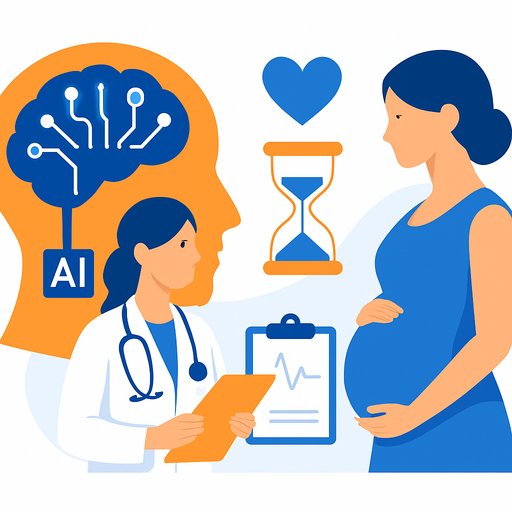
Researchers at UC San Francisco and Wayne State University used generative AI to analyze complex pregnancy datasets and build preterm birth prediction models in minutes. In several cases, AI matched or outperformed results from traditional, human-led teams. The work points to a practical shift: less time stitching pipelines together, more time testing hypotheses.
Why it matters
Preterm birth remains the leading cause of newborn death, with roughly 1,000 premature births each day in the United States. Better risk prediction can sharpen trial design, guide early interventions, and help clinicians allocate attention before complications surface.
What the researchers did
- Compiled microbiome data from about 1,200 pregnant women across nine studies.
- Prompted eight AI chatbots to generate analytical code on datasets previously analyzed in a global DREAM challenge.
- Four chatbots produced usable models; some matched or exceeded the performance of human teams.
- The AI-assisted effort took around six months, compared with nearly two years to consolidate earlier results.
- A small team-a master's student and a high school student-built working prediction models in minutes using detailed prompts.
What this means for your lab
- Treat chatbots as junior coders: request feature engineering, cross-validation, baselines, and explainable outputs-then review and refactor.
- Lock down evaluation: predefine metrics and data splits; benchmark against strong baselines and prior challenge leaderboards.
- Enforce reproducibility: version prompts, code, packages, and seeds; containerize runs and log artifacts.
- Keep humans in the loop: only half the systems delivered usable models-expect code review, unit tests, and failure modes.
- Mind governance: avoid sharing PHI in prompts; use de-identified subsets or synthetic samples for AI-assisted coding.
Key notes from the team
"These AI tools could relieve one of the biggest bottlenecks in data science: building our analysis pipelines," said University of California San Francisco Professor of Pediatrics Marina Sirota. Wayne State University's Adi L. Tarca added that generative AI lets researchers focus more on scientific questions and less on writing boilerplate code.
Limitations to watch
- Generated code may compile yet mask data leakage, label drift, or biased preprocessing-inspect every step.
- Cross-cohort generalization is uncertain; external validation and sensitivity analyses remain non-negotiable.
- Tool variance is high; different chatbots produce different pipelines and defaults, so compare and stress-test.
Resources
- Challenge-style benchmarks: DREAM Challenges
- U.S. prematurity context: CDC preterm birth
- Practical workflows and training: AI for Healthcare
Bottom line: generative AI can compress weeks of coding into minutes, but publishable science still hinges on clean data, strong baselines, and rigorous validation. Use AI for speed; keep your standards for truth the same.
Your membership also unlocks: