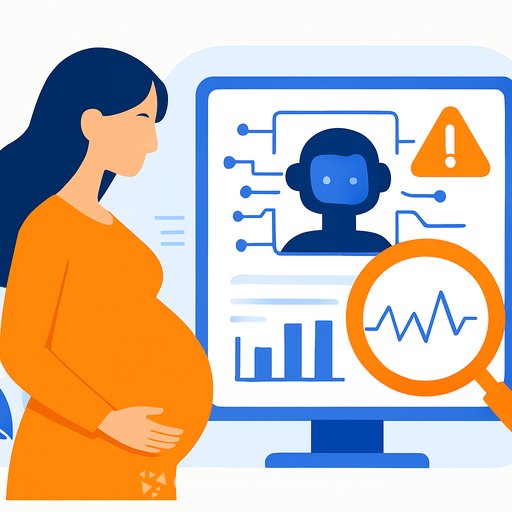
AI Bots Analyze Big Data To Help Predict Preterm Birth
News Published: February 20, 2026
Original story: University of California San Francisco
Image credit: Anna Hecker / Unsplash
In a head-to-head test, teams at UC San Francisco and Wayne State University showed that generative AI can decode complex pregnancy datasets far faster than traditional approaches-sometimes matching or beating models built by seasoned data science teams.
Scientists and AI-assisted teams worked from the same challenge: predict preterm birth using data from more than 1,000 pregnant women. With focused prompts, junior researchers produced working analysis code in minutes, a task that normally takes experts hours to days.
From months of coding to minutes of working pipelines
The edge came from AI's ability to generate analysis pipelines from short, specialized instructions. Of eight chatbots tested, four produced usable code that held up against models from prior benchmark challenges.
That speed mattered. A small team ran experiments, validated outputs, and drafted a manuscript within months-a pace that can compress exploratory cycles and move findings to peer review faster.
"These AI tools could relieve one of the biggest bottlenecks in data science: building our analysis pipelines," said Marina Sirota, PhD, interim director of UCSF's Bakar Computational Health Sciences Institute and principal investigator of the March of Dimes Prematurity Research Center at UCSF. "The speed-up couldn't come sooner for patients who need help now." The study appears in Cell Reports Medicine.
Can big data make pregnancy safer?
Preterm birth is the leading cause of newborn death and a major driver of long-term motor and cognitive impairment. Roughly 1,000 babies are born too soon in the U.S. every day.
To find biomarkers and improve risk prediction, UCSF teams compiled vaginal microbiome data from about 1,200 pregnant women across nine studies with tracked outcomes-an effort built on open data sharing and cross-lab collaboration. "This kind of work is only possible with open data sharing, pooling the experiences of many women and the expertise of many researchers," said Tomiko T. Oskotsky, MD, co-director of the March of Dimes Preterm Birth Data Repository and associate professor at UCSF BCHSI.
Previously, the group coordinated a global competition, DREAM (Dialogue on Reverse Engineering Assessment and Methods), drawing 100+ teams to build machine learning models from these datasets. Most teams met the three-month modeling window, yet aggregating results and publishing took nearly two years.
What the AI actually did
Researchers asked eight generative AI tools-via natural language prompts-to build algorithms for three tasks mirrored from DREAM: predict preterm birth from vaginal microbiome data, and estimate gestational age from blood or placental samples. The AI-produced code was then executed on the original challenge datasets.
Half of the tools generated models that matched the human-built baselines, and in some cases performed better. End to end-from concept to journal submission-the AI-driven effort took roughly six months.
There are caveats. Models can overfit, mis-handle confounders, or produce misleading results without careful checks. "Thanks to generative AI, researchers with a limited background in data science won't always need to form wide collaborations or spend hours debugging code," said Adi L. Tarca, PhD, co-senior author and professor at Wayne State University. "They can focus on answering the right biomedical questions."
Practical takeaways for research teams
- Use LLMs to scaffold analysis fast: data loaders, feature engineering, cross-validation loops, baseline models, and plotting. Keep prompts specific to the dataset and task.
- Guard against leakage and bias: enforce train/test splits by subject, apply cross-study validation, and pre-register evaluation metrics. Always re-run with fixed seeds and environment locks.
- Tighten reproducibility: version prompts, code, environments, and data snapshots. Log model configs and artifacts for peer review.
- Human-in-the-loop is non-negotiable: review feature importance, confirm biological plausibility, and stress-test across cohorts.
If you're integrating LLM-based coding into your workflow, see practical patterns in Generative Code.
Why this matters now
Reliable, faster analysis could accelerate progress on clinical tools for preterm birth risk and more accurate gestational age estimates-both core to timely, appropriate care. The work shows that with strong prompts, open datasets, and rigorous validation, small teams can move complex biomedical modeling forward without a months-long coding grind.
Reference: Sarwal R, Tarca V, Dubin CA, et al. Benchmarking large language models for predictive modeling in biomedical research with a focus on reproductive health. Cell Reports Medicine. 2026;7(2). https://doi.org/10.1016/j.xcrm.2026.102594
Related resource: DREAM Challenges (benchmarking and community-driven model development)
This article has been adapted from source materials for clarity and length. For more information, please contact the cited source.
Your membership also unlocks: