AI-supported storytelling helps adult learners grasp environmental science
University of Phoenix has published a peer-reviewed study in Glacies examining how character-driven narratives, paired with human-centered AI, help adult learners make sense of complex scientific ideas. The work focuses on ENV/100T: Principles of Environmental Science, a general education course for non-science majors.
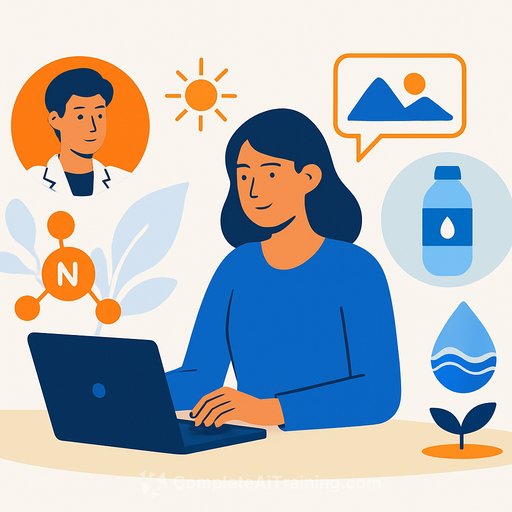
Instead of leading with formulas and jargon, the course introduces original characters that embody processes and cycles. Faculty then use AI-generated imagery-guided by a clear pedagogical brief-to keep visuals consistent and reinforce key concepts.
Key facts
- Course: ENV/100T Principles of Environmental Science (non-science majors; adult learners)
- Method: Character-driven, storybook approach; AI-generated imagery developed through a human-centered, faculty-guided design process
- Characters: Nico Nitrogen, Remi Rock, Waverly Water
- Learner sentiment: 87.1% enjoyed the narratives; 82.0% said the approach reinforced systems thinking
- Study design: Mixed-method, IRB-exempt; applies the Curriculum Redesign and AI-Facilitated Transformation model
- Publication: Peer-reviewed, open access in Glacies
What the course did differently
The instructional team built a storybook format where characters personify environmental processes-nitrogen cycling, rock formation, and water movement-set in recognizable contexts. These narratives reduce initial friction for learners returning to science after time away, giving them a simple, memorable way to compare processes and track cause-and-effect.
Faculty and instructional designers adopted a human-centered AI workflow: draft learning goals first, script stories second, and use AI last to create consistent character imagery. The AI work was bounded by a style guide and review steps to preserve scientific accuracy and visual continuity.
What the research found
Students responded well to the approach. 87.1% reported that they enjoyed the anthropomorphic narratives, and 82.0% said the method strengthened systems thinking-comparing, connecting, and reasoning across Earth systems rather than memorizing isolated facts.
Reflections showed students used the characters to explain processes in their own words, spot relationships, and communicate cause-and-effect more clearly. Consistent visuals appeared to lower cognitive load and helped learners track how changes propagate through systems.
"Adult learners benefit when we make space for curiosity and play as part of serious learning," said Dr. Kelly. "By inviting students to meet characters like Nico Nitrogen and Waverly Water, we help them see the patterns and relationships that exist in environmental systems. AI-supported imagery brought those stories to life with consistency and clarity, and students used the characters to explain ideas, test their understanding, and stay engaged as the work became more complex."
Why this matters for science and research professionals
For large general-education courses and workforce-reentry students, the first barrier is often engagement. Character-based narratives, when grounded in accurate science and paired with consistent visuals, can nudge learners past that barrier while preserving conceptual depth.
The model offers a repeatable way to integrate generative AI responsibly: constrain AI to serve pedagogy, codify style and accuracy checks, and evaluate with mixed methods. It's a practical pattern any institution can adapt, especially where instructors need rapid, consistent visual assets without diluting rigor.
Implementation notes you can apply
- Start with outcomes: Write explicit concept goals and misconceptions to address before any story work.
- Anthropomorphism with guardrails: Let characters personify processes, not oversimplify them; include checkpoints where the "character view" is mapped back to the scientific model.
- AI image pipeline: Create a shared prompt library, style guide, and exemplar set; log model/version; run faculty QA for scale bars, labels, and proportionality.
- Consistency over flash: Keep a stable visual identity for characters across modules so learners can compare scenarios quickly.
- Active use, not passive reading: Ask students to narrate a cycle from a character's perspective, then translate it into a diagram or equations.
- Measure what matters: Combine sentiment data with artifacts (explanations, diagrams) scored against systems-thinking rubrics.
- Ethics and approvals: Document your AI workflow, data handling, and accessibility; seek IRB guidance early even for exempt designs.
Context: the setting and concept choice
The narratives draw on real-world backdrops, including the Jökulsárlón proglacial lagoon in Iceland, which provides rich, observable dynamics for water, rock, and biogeochemical cycles. See background on Jökulsárlón for geographic context.
Characters like Nico Nitrogen, Remi Rock, and Waverly Water act as anchors across weeks of content, letting instructors thread assessments and discussions through a shared cast rather than introducing brand-new metaphors each time.
Study design at a glance
- Mixed-method approach: Quantitative surveys paired with qualitative reflections and artifact review.
- Model used: Curriculum Redesign and AI-Facilitated Transformation (CR-AFT) to guide the shift from traditional exposition to narrative-first materials.
- Population: Adult learners and non-science majors enrolled in ENV/100T.
Where to read the study
The peer-reviewed, open-access article "Harnessing AI, Virtual Landscapes, and Anthropomorphic Imaginaries to Enhance Environmental Science Education at Jökulsárlón Proglacial Lagoon, Iceland" appears in Glacies. Search the title in the journal to access the full text.
Related resources
For more practical examples of human-centered AI in teaching and assessment, explore AI for Education.
About University of Phoenix
University of Phoenix innovates to help working adults build careers and skills. Flexible schedules, relevant courses, interactive learning, a skills-mapped curriculum across bachelor's and master's programs, and a Career Services for Life ® commitment support learners who are balancing work and family. For more information, visit phoenix.edu/blog.html.
Your membership also unlocks: